














メッセージ

This is the product's own frame. Your conversations appear here once you have an account.

Get started now
通知

This is the product's own frame. Alerts about your business appear here once you have an account.

日本語
The room where it happens, digitally

The Boardroom.

A meeting space attached to your boards — decisions made with the work on the table, minutes kept automatically.

Why it matters

What this does for your business.

Meet on the workThe board is the agenda; nothing gets re-explained.
Minutes, keptWhat was decided lands back on the board.
Async-friendlyCan't attend? The room remembers for you.
Part of one platform — works hand-in-hand withFocusBoards·チームの決定

Convene the room

Advisors who do not all agree, on one decision of yours.

Put a question to the Boardroom and Maven takes the chair. Each advisor puts a case in its own voice, the chair says which one holds, and the room ends in motions you approve or reject.

You set the question, and the room.Write the decision the way you would say it out loud, and pick which of Maven's specialists sit on it. Maven always chairs.

They argue it out.The marketer, the researcher and the problem solver each put a case, out of the business you have already described to Maven, and they contradict each other. That disagreement is the part a single tidy answer cannot give you.

A summary, then motions.The chair says which argument holds and why, and recommends something narrower than any one advisor asked for. Then the room turns into a short list of things to do, each waiting on your approve or your reject.

The meeting is kept.A meeting reopens with its cases, its summary and what you decided still on it, so a call you made months ago is still explicable.

Maven adds this one: every other tool here does what you decide — this is the one that argues with you first.

The Boardroom

A question you cannot settle on your own, put to a room of advisors who do not all agree.
You put the questionOne decision, written the way you would say it out loud, and the advisors you want sitting on it. Maven takes the chair.
They argue it outEach advisor puts its case in its own voice — the marketer, the researcher, the problem solver — arguing from the business you have already described to Maven rather than from a template. They contradict each other, and that is the point of a board.
A summary, then motionsMaven says which argument it thinks holds and why, and the room ends in a short list of things to do. Each one is yours to approve or reject, and the whole meeting stays where you can read it back.
Read more about The Boardroom

You cannot argue a decision out with yourself. This is a room that will.

You write the decision the way you would say it out loud — should this change, is this worth doing, which of these two — and pick which of Maven’s specialists sit on it. Maven always chairs.

Then they put their cases. The marketer, the researcher and the problem solver each answer in their own voice, out of the business you have already described to Maven, and they disagree with each other in plain words. That disagreement is the thing a single answer cannot give you: one of them will be arguing the position you were quietly avoiding.

Maven sums up as a chair does. It says which argument it thinks holds, names the one that changed its mind, and recommends something narrower than any single advisor asked for — then tells you when it would be worth looking at again.

And the room ends in motions rather than in a wall of prose. Each is one thing to do, written plainly, marked either as advice or as work that belongs to a named part of the product, and waiting on your approve or your reject. Nothing moves because a room of advisors thought it should.

The meeting is kept. It reopens with the cases, the summary and what you decided still on it, so a call you made in August is still explicable in November.

What it actually does

  • A room of named advisors, convened on one decision of yours
  • Cases argued in plain words, against each other, not in a single tidy answer
  • A chair’s summary, then motions you approve or reject one at a time

What that changes for you

  • The argument against the thing you want to do gets made out loud, by somebody
  • A decision ends in a short list of things to do rather than in more reading
  • Months later the reasoning is still there, and so is what you chose

You come away with a decision you can defend, and the argument that produced it.

A look inside The Boardroom

The Boardroom — platform screenshots

Real screens from the product. Open any one full size, or switch the set to light or dark.

閉じる
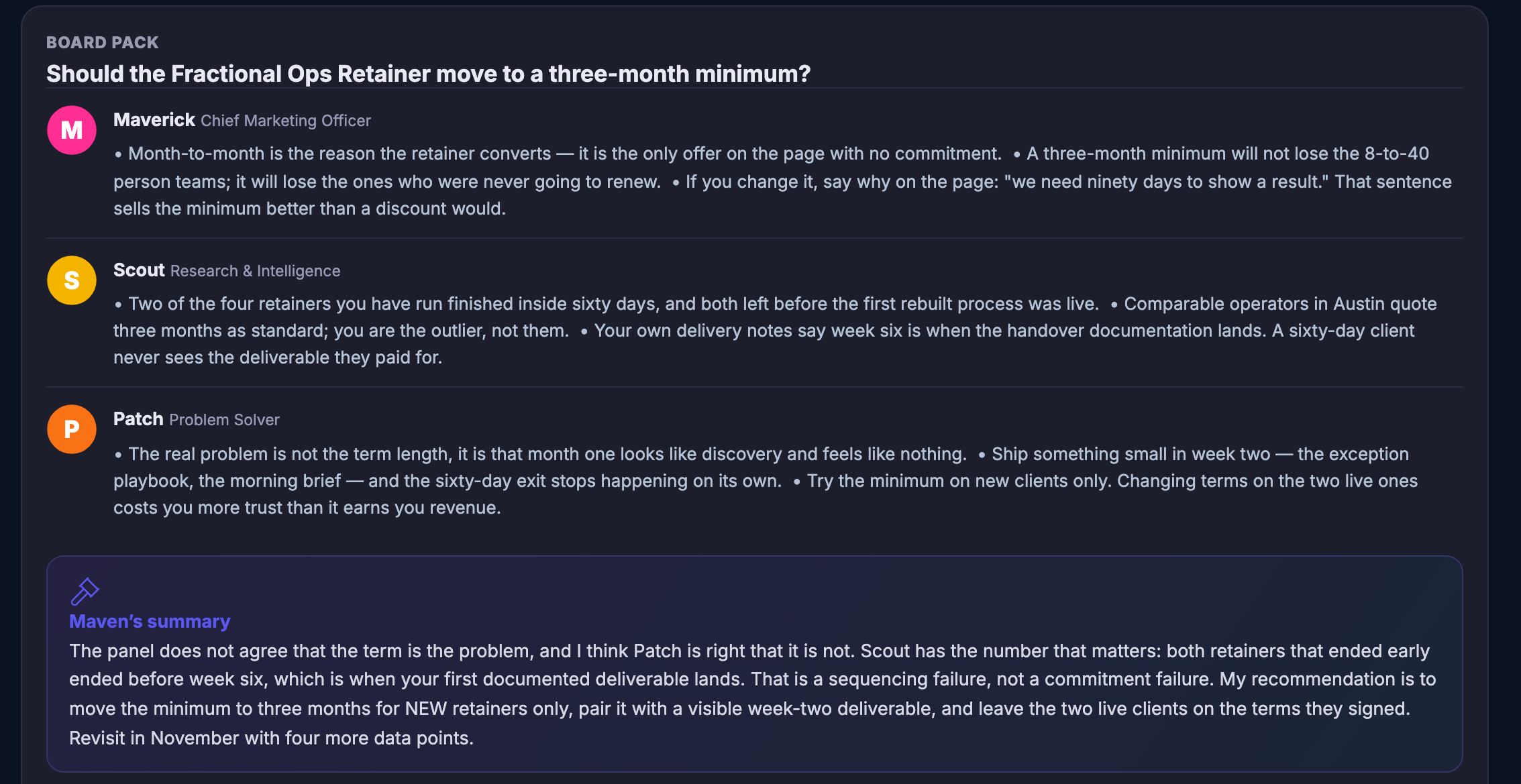
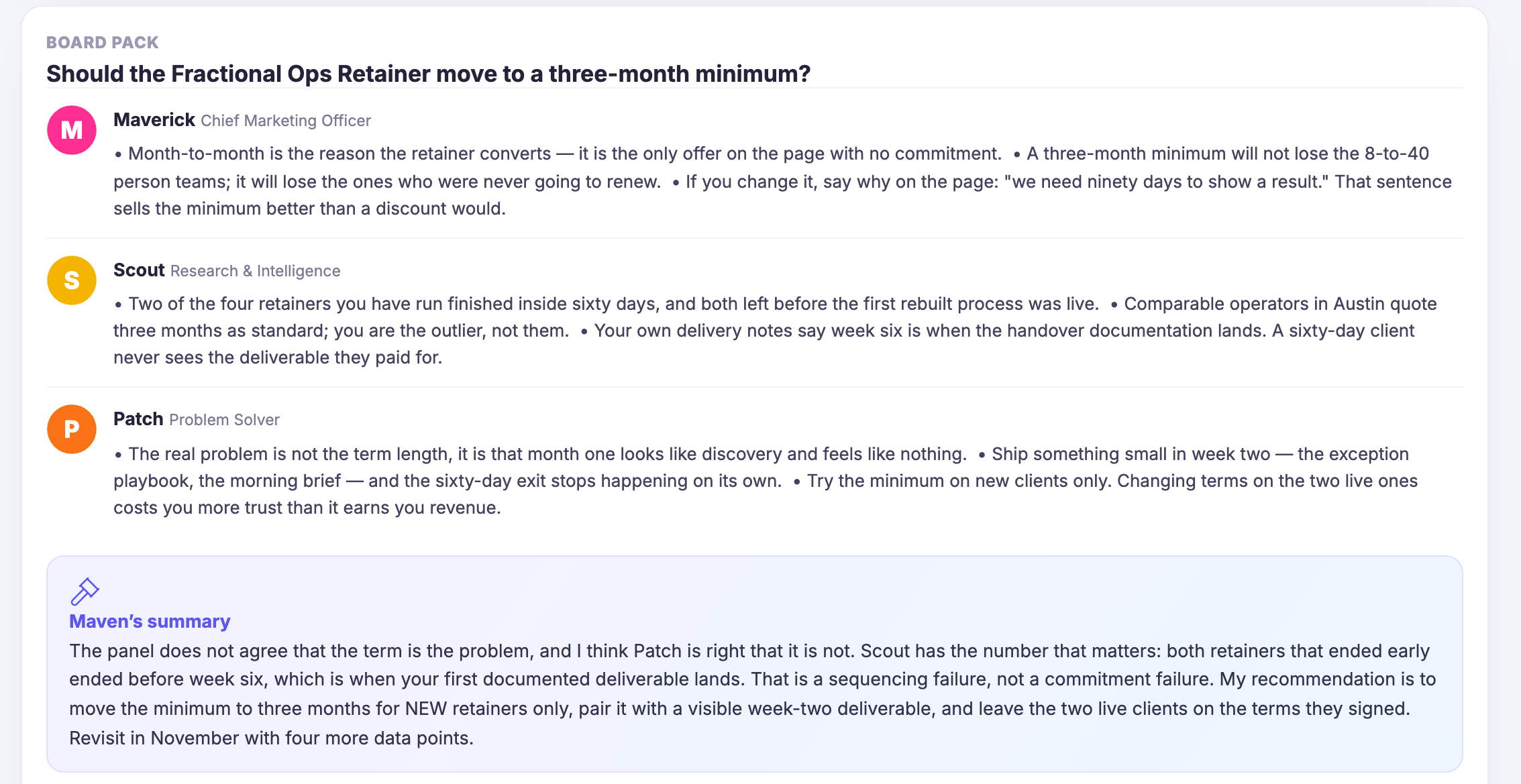
A board pack open on one decision: labelled board pack, headed with the question itself — whether the fractional ops retainer should move to a three-month minimum. Under it the advisors take the question in turn, each behind a coloured monogram, named with the job they hold. Maverick, the chief marketing officer, argues for leaving it alone: month-to-month is the reason the retainer converts, a minimum would only lose the clients who were never going to renew, and if it changes the page has to say why. Scout, research and intelligence, argues the other way with the account’s own history — retainers that ended early, ended before the first documented deliverable landed, and comparable operators in the same city quote longer as standard. Patch, the problem solver, says both of them are answering the wrong question: the term is not the problem, the first month feeling like nothing is, and the fix is to ship something small early and try the minimum on new clients only. Beneath them, under a gavel, Maven’s summary in its own tinted panel: the panel does not agree, here is which argument holds and why, here is what I recommend, and here is when to look at it again. The panel runs on past the foot of the frame, where the motions the meeting ended in are waiting.A board pack open on one decision: labelled board pack, headed with the question itself — whether the fractional ops retainer should move to a three-month minimum. Under it the advisors take the question in turn, each behind a coloured monogram, named with the job they hold. Maverick, the chief marketing officer, argues for leaving it alone: month-to-month is the reason the retainer converts, a minimum would only lose the clients who were never going to renew, and if it changes the page has to say why. Scout, research and intelligence, argues the other way with the account’s own history — retainers that ended early, ended before the first documented deliverable landed, and comparable operators in the same city quote longer as standard. Patch, the problem solver, says both of them are answering the wrong question: the term is not the problem, the first month feeling like nothing is, and the fix is to ship something small early and try the minimum on new clients only. Beneath them, under a gavel, Maven’s summary in its own tinted panel: the panel does not agree, here is which argument holds and why, here is what I recommend, and here is when to look at it again. The panel runs on past the foot of the frame, where the motions the meeting ended in are waiting.
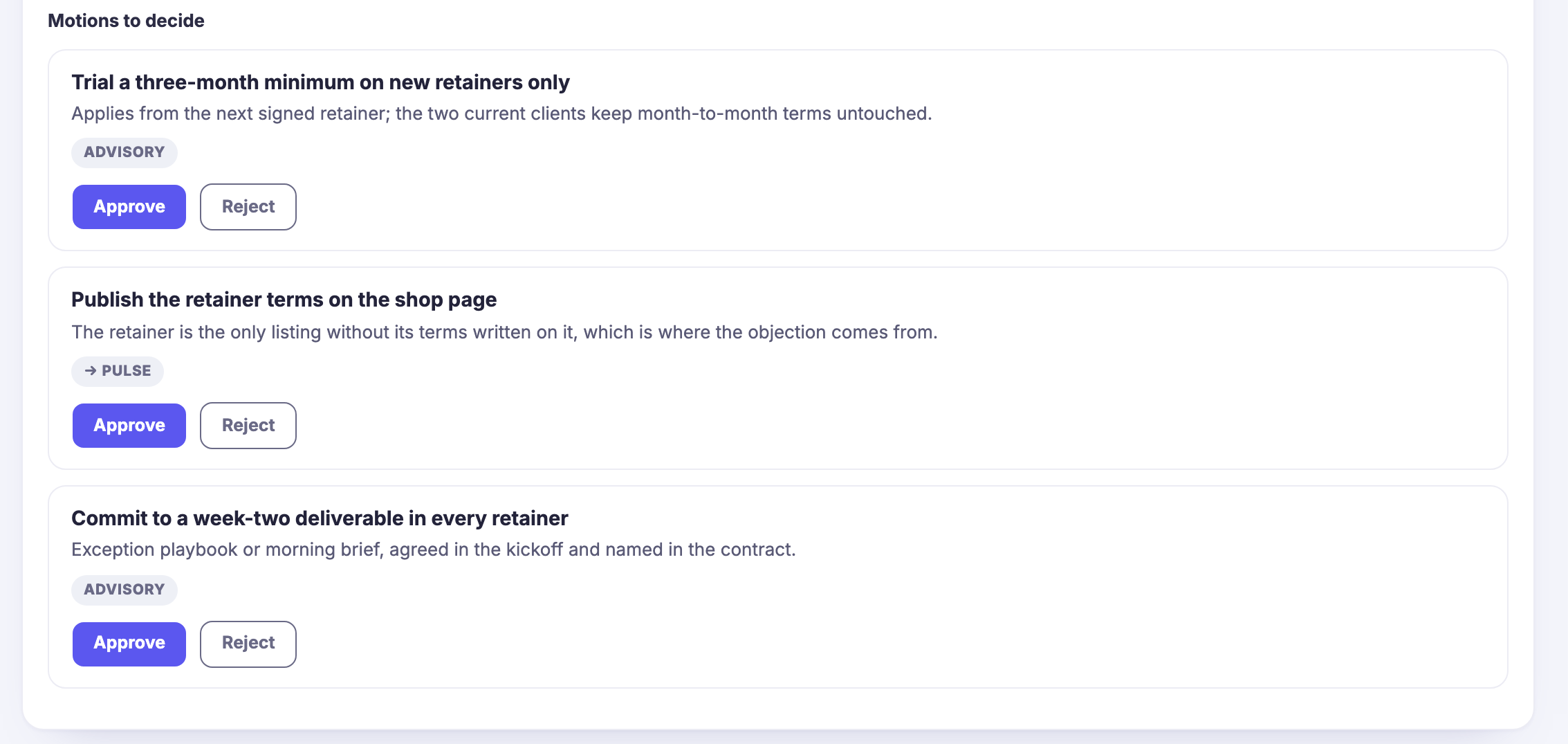
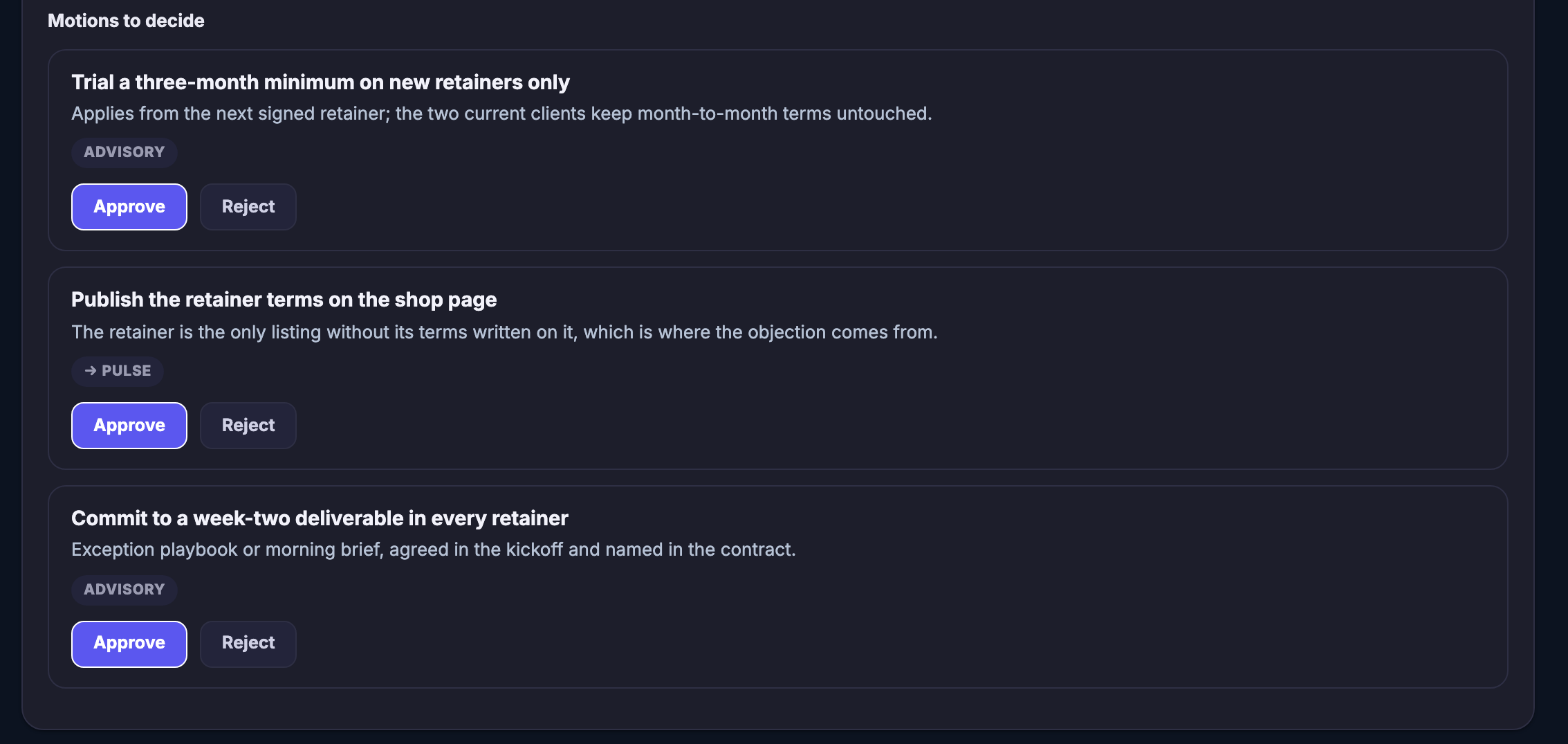
The same meeting’s motions, under a heading reading motions to decide. Each sits in its own bordered row: a plain-language motion at the top — trial the minimum on new retainers only; publish the retainer terms on the shop page; commit to a deliverable in the second week of every retainer — then one line saying exactly what it would mean, including which clients it would leave untouched. Under that a small pill marking what the motion is: advisory on two of them, and on the other an arrow pointing at the part of the product that would carry it out. Then the decision itself, still open: an approve control filled in indigo beside a plain reject control. The heading sits at the top edge, with the panel it belongs to running on above it, where the cases were put.The same meeting’s motions, under a heading reading motions to decide. Each sits in its own bordered row: a plain-language motion at the top — trial the minimum on new retainers only; publish the retainer terms on the shop page; commit to a deliverable in the second week of every retainer — then one line saying exactly what it would mean, including which clients it would leave untouched. Under that a small pill marking what the motion is: advisory on two of them, and on the other an arrow pointing at the part of the product that would carry it out. Then the decision itself, still open: an approve control filled in indigo beside a plain reject control. The heading sits at the top edge, with the panel it belongs to running on above it, where the cases were put.
The log the room keeps, in a card headed past meetings. Under the heading the meetings this account has held, one to a row, each written as the question it was called to settle — whether the retainer should move to a longer minimum, filling the last of the seats for a workshop, and whether to sell a playbook or give it away to build the list — with the date it was held set against the right-hand edge of its row. Each row is a door back into that meeting, opening again on the cases, the summary and what was decided.The log the room keeps, in a card headed past meetings. Under the heading the meetings this account has held, one to a row, each written as the question it was called to settle — whether the retainer should move to a longer minimum, filling the last of the seats for a workshop, and whether to sell a playbook or give it away to build the list — with the date it was held set against the right-hand edge of its row. Each row is a door back into that meeting, opening again on the cases, the summary and what was decided.

The Boardroom

閉じる
A board pack open on one decision: labelled board pack, headed with the question itself — whether the fractional ops retainer should move to a three-month minimum. Under it the advisors take the question in turn, each behind a coloured monogram, named with the job they hold. Maverick, the chief marketing officer, argues for leaving it alone: month-to-month is the reason the retainer converts, a minimum would only lose the clients who were never going to renew, and if it changes the page has to say why. Scout, research and intelligence, argues the other way with the account’s own history — retainers that ended early, ended before the first documented deliverable landed, and comparable operators in the same city quote longer as standard. Patch, the problem solver, says both of them are answering the wrong question: the term is not the problem, the first month feeling like nothing is, and the fix is to ship something small early and try the minimum on new clients only. Beneath them, under a gavel, Maven’s summary in its own tinted panel: the panel does not agree, here is which argument holds and why, here is what I recommend, and here is when to look at it again. The panel runs on past the foot of the frame, where the motions the meeting ended in are waiting.A board pack open on one decision: labelled board pack, headed with the question itself — whether the fractional ops retainer should move to a three-month minimum. Under it the advisors take the question in turn, each behind a coloured monogram, named with the job they hold. Maverick, the chief marketing officer, argues for leaving it alone: month-to-month is the reason the retainer converts, a minimum would only lose the clients who were never going to renew, and if it changes the page has to say why. Scout, research and intelligence, argues the other way with the account’s own history — retainers that ended early, ended before the first documented deliverable landed, and comparable operators in the same city quote longer as standard. Patch, the problem solver, says both of them are answering the wrong question: the term is not the problem, the first month feeling like nothing is, and the fix is to ship something small early and try the minimum on new clients only. Beneath them, under a gavel, Maven’s summary in its own tinted panel: the panel does not agree, here is which argument holds and why, here is what I recommend, and here is when to look at it again. The panel runs on past the foot of the frame, where the motions the meeting ended in are waiting.

The Boardroom

閉じる
The same meeting’s motions, under a heading reading motions to decide. Each sits in its own bordered row: a plain-language motion at the top — trial the minimum on new retainers only; publish the retainer terms on the shop page; commit to a deliverable in the second week of every retainer — then one line saying exactly what it would mean, including which clients it would leave untouched. Under that a small pill marking what the motion is: advisory on two of them, and on the other an arrow pointing at the part of the product that would carry it out. Then the decision itself, still open: an approve control filled in indigo beside a plain reject control. The heading sits at the top edge, with the panel it belongs to running on above it, where the cases were put.The same meeting’s motions, under a heading reading motions to decide. Each sits in its own bordered row: a plain-language motion at the top — trial the minimum on new retainers only; publish the retainer terms on the shop page; commit to a deliverable in the second week of every retainer — then one line saying exactly what it would mean, including which clients it would leave untouched. Under that a small pill marking what the motion is: advisory on two of them, and on the other an arrow pointing at the part of the product that would carry it out. Then the decision itself, still open: an approve control filled in indigo beside a plain reject control. The heading sits at the top edge, with the panel it belongs to running on above it, where the cases were put.

The Boardroom

閉じる
The log the room keeps, in a card headed past meetings. Under the heading the meetings this account has held, one to a row, each written as the question it was called to settle — whether the retainer should move to a longer minimum, filling the last of the seats for a workshop, and whether to sell a playbook or give it away to build the list — with the date it was held set against the right-hand edge of its row. Each row is a door back into that meeting, opening again on the cases, the summary and what was decided.The log the room keeps, in a card headed past meetings. Under the heading the meetings this account has held, one to a row, each written as the question it was called to settle — whether the retainer should move to a longer minimum, filling the last of the seats for a workshop, and whether to sell a playbook or give it away to build the list — with the date it was held set against the right-hand edge of its row. Each row is a door back into that meeting, opening again on the cases, the summary and what was decided.

A look inside The Boardroom

Stills from the product, one after the next.

A board pack open on one decision: labelled board pack, headed with the question itself — whether the fractional ops retainer should move to a three-month minimum. Under it the advisors take the question in turn, each behind a coloured monogram, named with the job they hold. Maverick, the chief marketing officer, argues for leaving it alone: month-to-month is the reason the retainer converts, a minimum would only lose the clients who were never going to renew, and if it changes the page has to say why. Scout, research and intelligence, argues the other way with the account’s own history — retainers that ended early, ended before the first documented deliverable landed, and comparable operators in the same city quote longer as standard. Patch, the problem solver, says both of them are answering the wrong question: the term is not the problem, the first month feeling like nothing is, and the fix is to ship something small early and try the minimum on new clients only. Beneath them, under a gavel, Maven’s summary in its own tinted panel: the panel does not agree, here is which argument holds and why, here is what I recommend, and here is when to look at it again. The panel runs on past the foot of the frame, where the motions the meeting ended in are waiting.A board pack open on one decision: labelled board pack, headed with the question itself — whether the fractional ops retainer should move to a three-month minimum. Under it the advisors take the question in turn, each behind a coloured monogram, named with the job they hold. Maverick, the chief marketing officer, argues for leaving it alone: month-to-month is the reason the retainer converts, a minimum would only lose the clients who were never going to renew, and if it changes the page has to say why. Scout, research and intelligence, argues the other way with the account’s own history — retainers that ended early, ended before the first documented deliverable landed, and comparable operators in the same city quote longer as standard. Patch, the problem solver, says both of them are answering the wrong question: the term is not the problem, the first month feeling like nothing is, and the fix is to ship something small early and try the minimum on new clients only. Beneath them, under a gavel, Maven’s summary in its own tinted panel: the panel does not agree, here is which argument holds and why, here is what I recommend, and here is when to look at it again. The panel runs on past the foot of the frame, where the motions the meeting ended in are waiting.
The same meeting’s motions, under a heading reading motions to decide. Each sits in its own bordered row: a plain-language motion at the top — trial the minimum on new retainers only; publish the retainer terms on the shop page; commit to a deliverable in the second week of every retainer — then one line saying exactly what it would mean, including which clients it would leave untouched. Under that a small pill marking what the motion is: advisory on two of them, and on the other an arrow pointing at the part of the product that would carry it out. Then the decision itself, still open: an approve control filled in indigo beside a plain reject control. The heading sits at the top edge, with the panel it belongs to running on above it, where the cases were put.The same meeting’s motions, under a heading reading motions to decide. Each sits in its own bordered row: a plain-language motion at the top — trial the minimum on new retainers only; publish the retainer terms on the shop page; commit to a deliverable in the second week of every retainer — then one line saying exactly what it would mean, including which clients it would leave untouched. Under that a small pill marking what the motion is: advisory on two of them, and on the other an arrow pointing at the part of the product that would carry it out. Then the decision itself, still open: an approve control filled in indigo beside a plain reject control. The heading sits at the top edge, with the panel it belongs to running on above it, where the cases were put.
The log the room keeps, in a card headed past meetings. Under the heading the meetings this account has held, one to a row, each written as the question it was called to settle — whether the retainer should move to a longer minimum, filling the last of the seats for a workshop, and whether to sell a playbook or give it away to build the list — with the date it was held set against the right-hand edge of its row. Each row is a door back into that meeting, opening again on the cases, the summary and what was decided.The log the room keeps, in a card headed past meetings. Under the heading the meetings this account has held, one to a row, each written as the question it was called to settle — whether the retainer should move to a longer minimum, filling the last of the seats for a workshop, and whether to sell a playbook or give it away to build the list — with the date it was held set against the right-hand edge of its row. Each row is a door back into that meeting, opening again on the cases, the summary and what was decided.

See it in your own business.

Everything on this page comes with the platform — start free and try it on your real work.

Get started now

Next Up: FocusBoards

Every next step has a visible place, and nothing quietly stalls.

Maven に質問