






Messages

This is the product's own frame. Your conversations appear here once you have an account.

Get started now
Notifications

This is the product's own frame. Alerts about your business appear here once you have an account.

English
The seat was still open, and the project said so itself

Join the thing somebody is already building.

Every member promotes one main project, it travels with them across the network, and it names the help it is still short of — so there is work you could join before you have anything of your own.

Why it matters

What people are building — and the help they are still short of.

One project each, and it goes where they goA member promotes a single main project, so it turns up wherever they do rather than sitting on a board somebody has to remember to open.
The gap is written on the projectEach one names the roles it is still short of, in the owner’s own words, so you read a gap instead of guessing where you would fit.
Asking to join is one short formYour name, what you can help with and a line about why — it goes to the owner to accept or decline, and the answer comes back in Conversations.
Part of one platform — works hand-in-hand withThe Network·FocusBoards·Memberships

The project

One project each, carried wherever the member goes.

Most of a network shows you people. This shows you the work — the one thing each member is actually building.

A project belongs to a person.Every project is attached to the member promoting it, so there is always somebody to look up and somebody to ask, rather than a posting that expires and leaves nobody behind it.

It travels with them.The project turns up wherever its owner turns up on the network, instead of sitting on a board that somebody has to remember to go and open.

One each, so it means something.A member promotes a single main project rather than a shelf of them, which is why what you are reading is the thing they are giving their year to.

The index is browsable on its own terms.The whole list can be narrowed to the projects looking for collaborators, the ones raising money, or the ones added this week.

The record

A page that shows what actually moved.

A project keeps a public record of itself, so you can tell whether you are joining something starting or something nearly there.

Dated updates, in the owner's words.What moved and when is posted on the project itself — a permit signed off, a seat claimed — so progress is a record rather than a claim.

The story sits under the work.Beneath the updates the owner writes what the project is for and why it matters to them, which is the part a list of tasks can never carry.

The people already on it are named.Collaborators appear on the project with their faces and their profiles, so you can see who you would be working alongside before you ask.

Money and hands in the same place.Where a project is also raising, how far it has got sits on the same page as the roles it is short of, instead of living somewhere else entirely.

The way in

The help still wanted, and the form that asks for it.

Each project names the roles it has not filled, and putting your hand up is a short form on the project rather than an introduction you have to engineer.

The roles name themselves.Stall build volunteers, a type designer, a case-study writer, an audio engineer — the gap is written in the owner's own words, so you can tell in a sentence whether it is your gap.

Three lines, not a covering letter.Your name, what you can help with, and a line about why. That is the whole of the ask, and it sits on the project you are asking about.

The owner decides, and you hear back.The request goes to the member running the project to accept or decline, and the answer arrives in Conversations rather than disappearing into nothing.

It works the same way when the project is yours.The roles you leave open are how people find their way to your work, and the same short form brings them to you.

Because you said I sell nothing yet.

Projects

What the other members are actually building, listed with the help each one is still short of — so there is work you could join before you have anything of your own.
One project each, and it travels with themEvery member promotes a single main project, and it goes wherever they go on the network. A project is therefore attached to a person you can look up and follow, not to a posting that expires and leaves nobody to ask.
The help wanted is named on the projectEach one carries the roles it is still short of, in the words the owner used — the person who could design the type, the one who could engineer the audio, the volunteers who could build the stalls. You read a gap instead of guessing where you would fit.
Asking to join is one short formThe way in sits on the project itself: your name, what you can help with, and a line about why. It goes to the owner to accept or decline, and the answer comes back in Conversations rather than into nothing.
Read more about Projects

Work that is already moving, and the seat on it that nobody has taken yet.

Most of what a network shows you is people. This shows you the work. Every member here promotes one main project — the thing they are actually building — and it travels with them, so it turns up wherever they do rather than sitting on a board somebody has to remember to visit.

Each project says what it is still short of. Not a general call for help: the roles, in the owner’s own words. You are reading somebody’s actual gap, and you can tell in a sentence whether it is your gap. Where a project is also raising money, how far along it is sits on the same card, so you know whether you are joining something starting or something nearly there.

Asking is a form on the project itself rather than an introduction you have to engineer. Your name, what you can help with, a line about why. It goes to the owner, who accepts or declines, and the answer comes back in Conversations. The featured project’s own updates record a founder who joined exactly that way.

And a project keeps a public record of itself: dated updates of what actually moved, the story in the owner’s words, the collaborators already on it and the roles still open. That is the difference between a profile saying what somebody does and a page showing what they are doing this month — and it is the same difference when the project on the page is yours.

What it actually does

  • One main project per member, carried across the network
  • The roles a project is short of, named on the project
  • A request to join that goes to the owner to accept or decline

What that changes for you

  • You can join work that is already moving instead of starting from nothing
  • You find out what somebody needs before you write to them
  • The people you end up working with arrive with a record you can read

You come away with work you could be on this month, and the names of the people running it.

A look inside Projects

Projects — platform screenshots

Real screens from the product. Open any one full size, or switch the set to light or dark.

Close
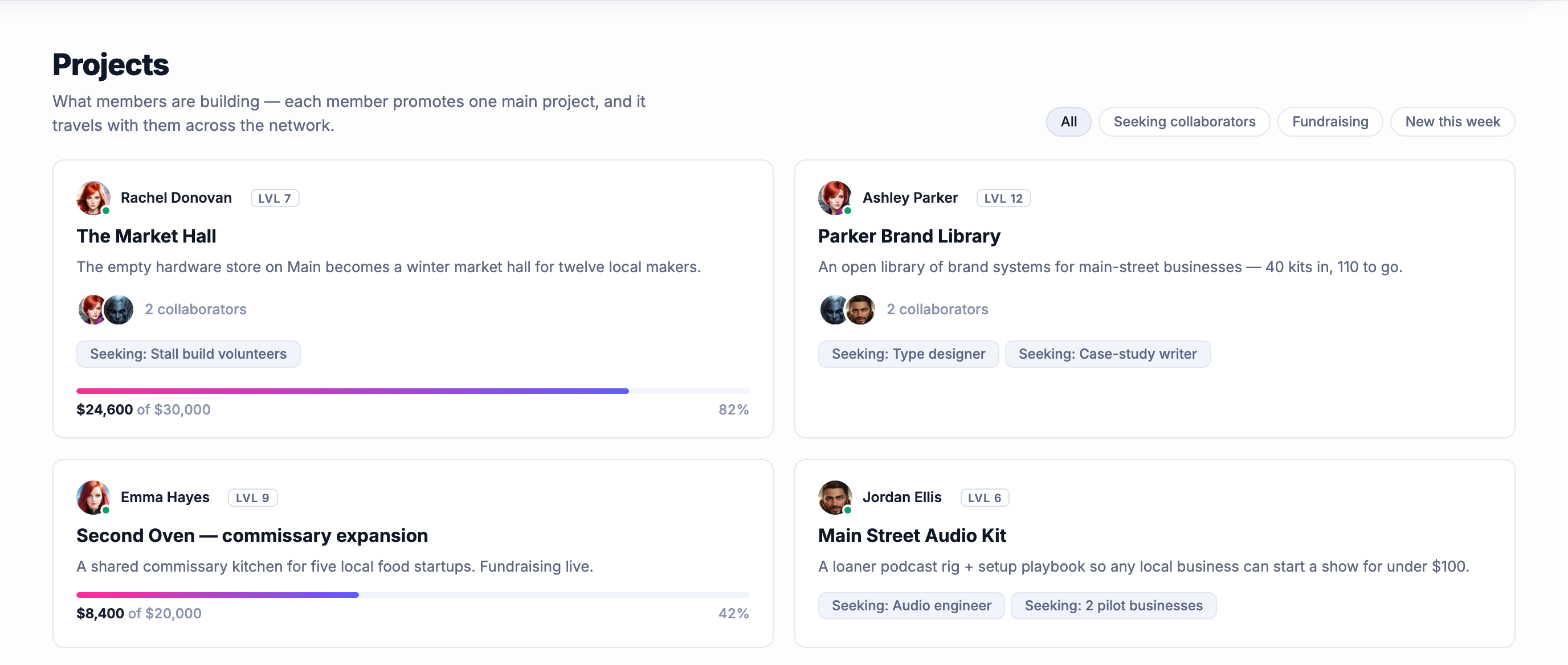
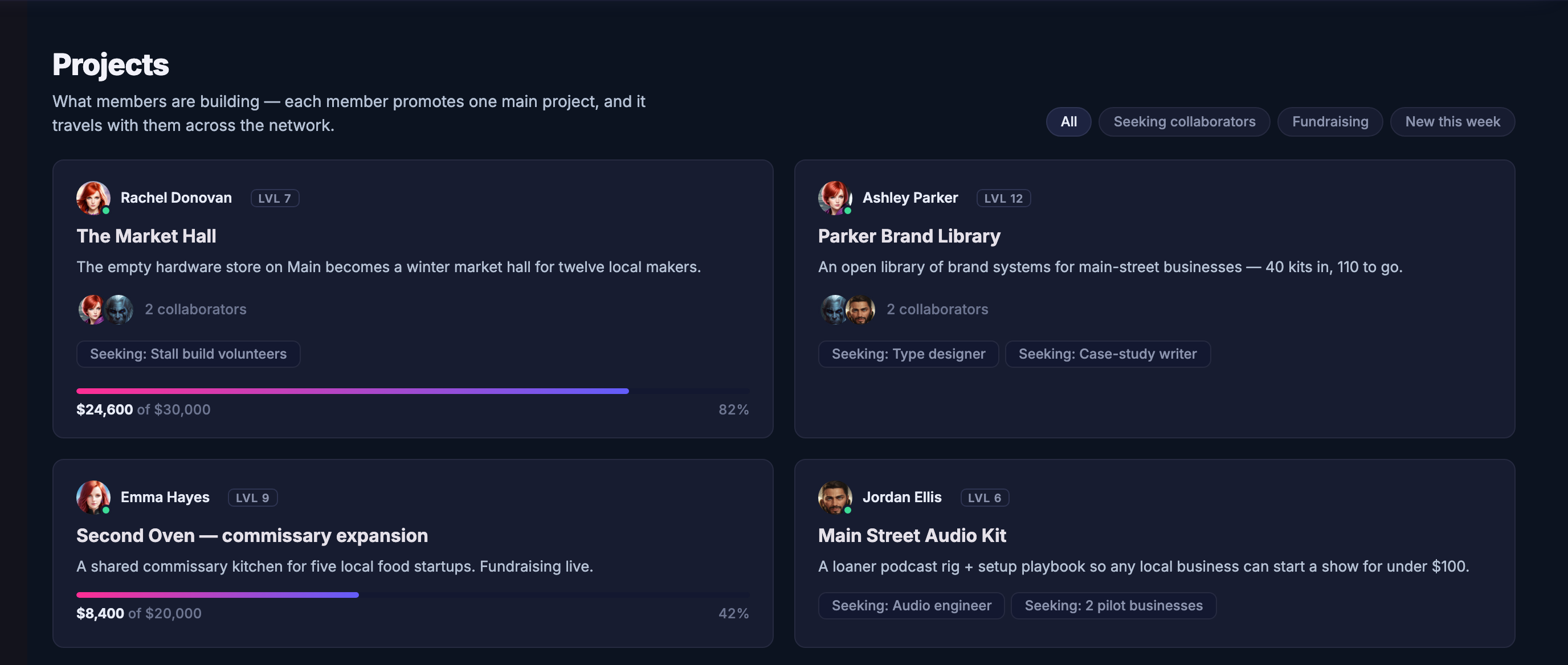
The Projects index on the network: the heading Projects over a line saying this is what members are building, that each member promotes one main project, and that it travels with them across the network; beside it, filters for everything, for the projects seeking collaborators, for the ones raising money, and for the ones added this week. Beneath, a grid of project cards. Each names the member who owns it, with their photograph and a level badge, then the project’s title and a sentence of what it is — an empty hardware store becoming a winter market hall for local makers, an open library of brand systems for main-street businesses, a shared commissary kitchen for food start-ups, a loaner podcast rig with a setup playbook. Under that, a row of collaborator faces with the number of them written out, and chips naming what the project is seeking: stall build volunteers, a type designer, a case-study writer, an audio engineer, pilot businesses. Where a project is raising money, a progress bar runs across the foot of its card with the amount raised against its target and the share of it reached.The Projects index on the network: the heading Projects over a line saying this is what members are building, that each member promotes one main project, and that it travels with them across the network; beside it, filters for everything, for the projects seeking collaborators, for the ones raising money, and for the ones added this week. Beneath, a grid of project cards. Each names the member who owns it, with their photograph and a level badge, then the project’s title and a sentence of what it is — an empty hardware store becoming a winter market hall for local makers, an open library of brand systems for main-street businesses, a shared commissary kitchen for food start-ups, a loaner podcast rig with a setup playbook. Under that, a row of collaborator faces with the number of them written out, and chips naming what the project is seeking: stall build volunteers, a type designer, a case-study writer, an audio engineer, pilot businesses. Where a project is raising money, a progress bar runs across the foot of its card with the amount raised against its target and the share of it reached.
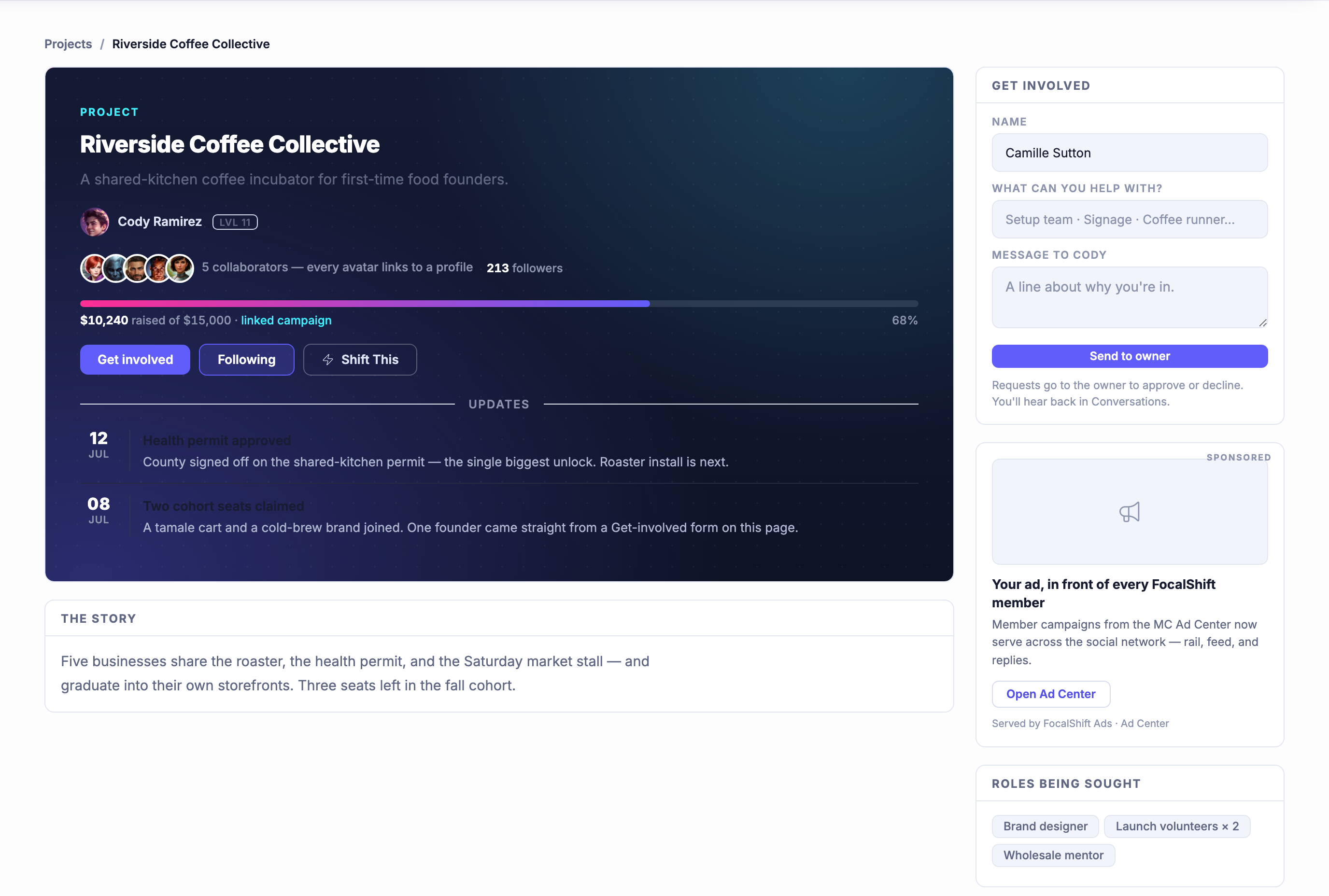
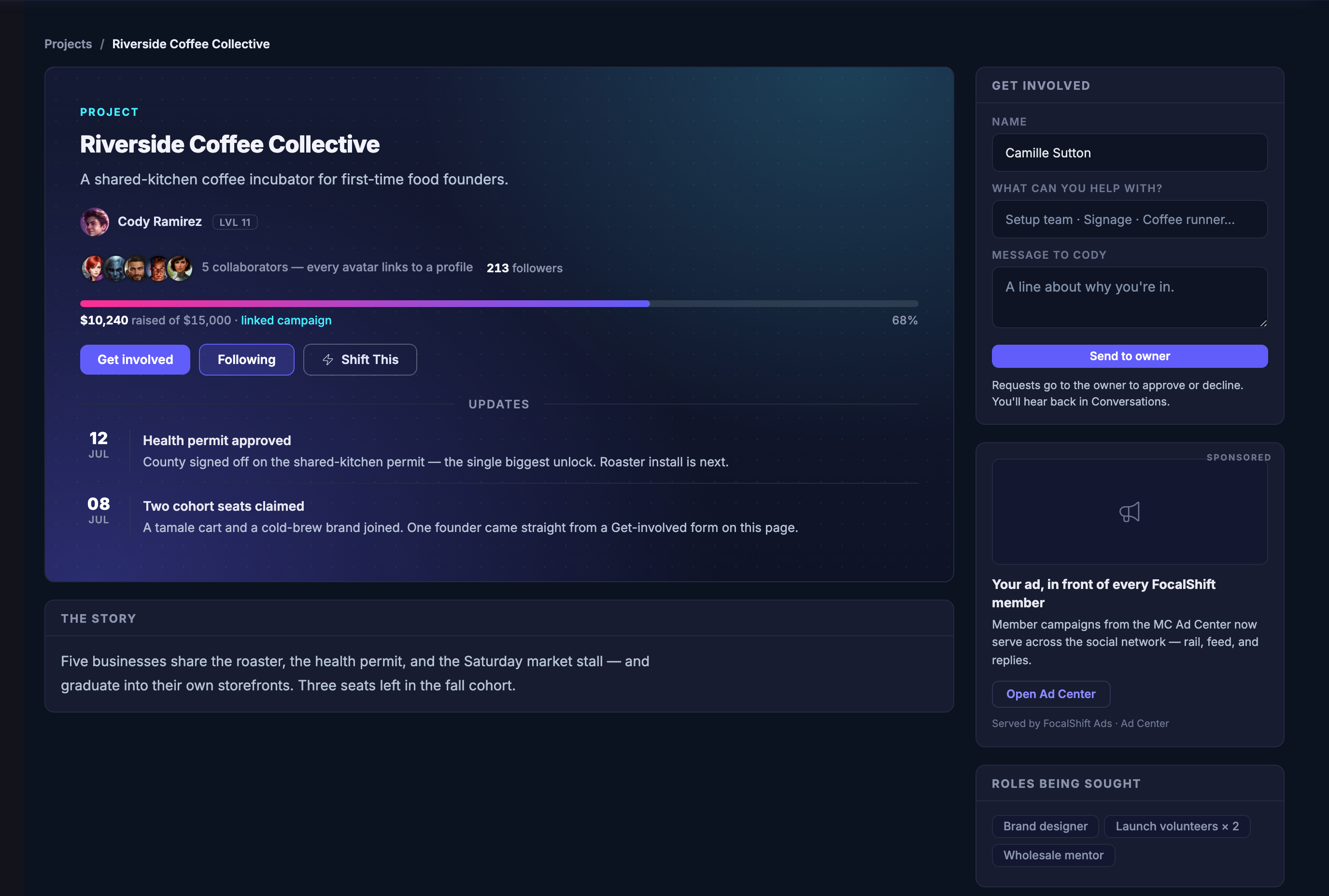
One project opened on its own page: a trail back to the index, then the project itself on a dark panel — the word project above its name, a sentence of what it is, the member who owns it with their photograph and a level badge, a row of collaborator faces with the note that every one of them links to a profile, the number of people following it, and a bar showing what has been raised against the target beside a link to the campaign behind it. Under the bar, controls to get involved, to follow, and to shift it. Below those, the project’s own updates, each dated: a health permit signed off, called the single biggest unlock; and two seats in the cohort claimed — one of them, the entry says, by a founder who came straight from the get-involved form on this page. Beneath the panel, the story of the project in the owner’s own words. Down the right-hand side, the get-involved form with the visitor’s own name already filled in, a field for what they can help with and a message to the owner, above a note that requests go to the owner to approve or decline and the reply arrives in Conversations; then the network’s own advertising slot, offering a member’s campaign a place in front of every member, with its artwork not yet supplied; then the roles this project is still seeking, named as chips.One project opened on its own page: a trail back to the index, then the project itself on a dark panel — the word project above its name, a sentence of what it is, the member who owns it with their photograph and a level badge, a row of collaborator faces with the note that every one of them links to a profile, the number of people following it, and a bar showing what has been raised against the target beside a link to the campaign behind it. Under the bar, controls to get involved, to follow, and to shift it. Below those, the project’s own updates, each dated: a health permit signed off, called the single biggest unlock; and two seats in the cohort claimed — one of them, the entry says, by a founder who came straight from the get-involved form on this page. Beneath the panel, the story of the project in the owner’s own words. Down the right-hand side, the get-involved form with the visitor’s own name already filled in, a field for what they can help with and a message to the owner, above a note that requests go to the owner to approve or decline and the reply arrives in Conversations; then the network’s own advertising slot, offering a member’s campaign a place in front of every member, with its artwork not yet supplied; then the roles this project is still seeking, named as chips.

Projects

Close
The Projects index on the network: the heading Projects over a line saying this is what members are building, that each member promotes one main project, and that it travels with them across the network; beside it, filters for everything, for the projects seeking collaborators, for the ones raising money, and for the ones added this week. Beneath, a grid of project cards. Each names the member who owns it, with their photograph and a level badge, then the project’s title and a sentence of what it is — an empty hardware store becoming a winter market hall for local makers, an open library of brand systems for main-street businesses, a shared commissary kitchen for food start-ups, a loaner podcast rig with a setup playbook. Under that, a row of collaborator faces with the number of them written out, and chips naming what the project is seeking: stall build volunteers, a type designer, a case-study writer, an audio engineer, pilot businesses. Where a project is raising money, a progress bar runs across the foot of its card with the amount raised against its target and the share of it reached.The Projects index on the network: the heading Projects over a line saying this is what members are building, that each member promotes one main project, and that it travels with them across the network; beside it, filters for everything, for the projects seeking collaborators, for the ones raising money, and for the ones added this week. Beneath, a grid of project cards. Each names the member who owns it, with their photograph and a level badge, then the project’s title and a sentence of what it is — an empty hardware store becoming a winter market hall for local makers, an open library of brand systems for main-street businesses, a shared commissary kitchen for food start-ups, a loaner podcast rig with a setup playbook. Under that, a row of collaborator faces with the number of them written out, and chips naming what the project is seeking: stall build volunteers, a type designer, a case-study writer, an audio engineer, pilot businesses. Where a project is raising money, a progress bar runs across the foot of its card with the amount raised against its target and the share of it reached.

Projects

Close
One project opened on its own page: a trail back to the index, then the project itself on a dark panel — the word project above its name, a sentence of what it is, the member who owns it with their photograph and a level badge, a row of collaborator faces with the note that every one of them links to a profile, the number of people following it, and a bar showing what has been raised against the target beside a link to the campaign behind it. Under the bar, controls to get involved, to follow, and to shift it. Below those, the project’s own updates, each dated: a health permit signed off, called the single biggest unlock; and two seats in the cohort claimed — one of them, the entry says, by a founder who came straight from the get-involved form on this page. Beneath the panel, the story of the project in the owner’s own words. Down the right-hand side, the get-involved form with the visitor’s own name already filled in, a field for what they can help with and a message to the owner, above a note that requests go to the owner to approve or decline and the reply arrives in Conversations; then the network’s own advertising slot, offering a member’s campaign a place in front of every member, with its artwork not yet supplied; then the roles this project is still seeking, named as chips.One project opened on its own page: a trail back to the index, then the project itself on a dark panel — the word project above its name, a sentence of what it is, the member who owns it with their photograph and a level badge, a row of collaborator faces with the note that every one of them links to a profile, the number of people following it, and a bar showing what has been raised against the target beside a link to the campaign behind it. Under the bar, controls to get involved, to follow, and to shift it. Below those, the project’s own updates, each dated: a health permit signed off, called the single biggest unlock; and two seats in the cohort claimed — one of them, the entry says, by a founder who came straight from the get-involved form on this page. Beneath the panel, the story of the project in the owner’s own words. Down the right-hand side, the get-involved form with the visitor’s own name already filled in, a field for what they can help with and a message to the owner, above a note that requests go to the owner to approve or decline and the reply arrives in Conversations; then the network’s own advertising slot, offering a member’s campaign a place in front of every member, with its artwork not yet supplied; then the roles this project is still seeking, named as chips.

A look inside Projects

Stills from the product, one after the next.

The Projects index on the network: the heading Projects over a line saying this is what members are building, that each member promotes one main project, and that it travels with them across the network; beside it, filters for everything, for the projects seeking collaborators, for the ones raising money, and for the ones added this week. Beneath, a grid of project cards. Each names the member who owns it, with their photograph and a level badge, then the project’s title and a sentence of what it is — an empty hardware store becoming a winter market hall for local makers, an open library of brand systems for main-street businesses, a shared commissary kitchen for food start-ups, a loaner podcast rig with a setup playbook. Under that, a row of collaborator faces with the number of them written out, and chips naming what the project is seeking: stall build volunteers, a type designer, a case-study writer, an audio engineer, pilot businesses. Where a project is raising money, a progress bar runs across the foot of its card with the amount raised against its target and the share of it reached.The Projects index on the network: the heading Projects over a line saying this is what members are building, that each member promotes one main project, and that it travels with them across the network; beside it, filters for everything, for the projects seeking collaborators, for the ones raising money, and for the ones added this week. Beneath, a grid of project cards. Each names the member who owns it, with their photograph and a level badge, then the project’s title and a sentence of what it is — an empty hardware store becoming a winter market hall for local makers, an open library of brand systems for main-street businesses, a shared commissary kitchen for food start-ups, a loaner podcast rig with a setup playbook. Under that, a row of collaborator faces with the number of them written out, and chips naming what the project is seeking: stall build volunteers, a type designer, a case-study writer, an audio engineer, pilot businesses. Where a project is raising money, a progress bar runs across the foot of its card with the amount raised against its target and the share of it reached.
One project opened on its own page: a trail back to the index, then the project itself on a dark panel — the word project above its name, a sentence of what it is, the member who owns it with their photograph and a level badge, a row of collaborator faces with the note that every one of them links to a profile, the number of people following it, and a bar showing what has been raised against the target beside a link to the campaign behind it. Under the bar, controls to get involved, to follow, and to shift it. Below those, the project’s own updates, each dated: a health permit signed off, called the single biggest unlock; and two seats in the cohort claimed — one of them, the entry says, by a founder who came straight from the get-involved form on this page. Beneath the panel, the story of the project in the owner’s own words. Down the right-hand side, the get-involved form with the visitor’s own name already filled in, a field for what they can help with and a message to the owner, above a note that requests go to the owner to approve or decline and the reply arrives in Conversations; then the network’s own advertising slot, offering a member’s campaign a place in front of every member, with its artwork not yet supplied; then the roles this project is still seeking, named as chips.One project opened on its own page: a trail back to the index, then the project itself on a dark panel — the word project above its name, a sentence of what it is, the member who owns it with their photograph and a level badge, a row of collaborator faces with the note that every one of them links to a profile, the number of people following it, and a bar showing what has been raised against the target beside a link to the campaign behind it. Under the bar, controls to get involved, to follow, and to shift it. Below those, the project’s own updates, each dated: a health permit signed off, called the single biggest unlock; and two seats in the cohort claimed — one of them, the entry says, by a founder who came straight from the get-involved form on this page. Beneath the panel, the story of the project in the owner’s own words. Down the right-hand side, the get-involved form with the visitor’s own name already filled in, a field for what they can help with and a message to the owner, above a note that requests go to the owner to approve or decline and the reply arrives in Conversations; then the network’s own advertising slot, offering a member’s campaign a place in front of every member, with its artwork not yet supplied; then the roles this project is still seeking, named as chips.
Two people holding a large magnifying glass over a board of cards

See it in your own business.

Everything on this page comes with the platform — start free and try it on your real work.

Get started now

Next Up: Client Work

Everything a client is owed, gathered under the client.

Ask Maven