













Berichten

This is the product's own frame. Your conversations appear here once you have an account.

Get started now
Meldingen

This is the product's own frame. Alerts about your business appear here once you have an account.

Nederlands
The claim still held up six months later

Work out what the story actually is.

A storyboard is a board for the thing you are trying to establish — what genuinely backs it, what nobody has answered yet, and the people helping you prove it.

Why it matters

A board for the story itself — not the work that follows it.

A board per line of enquiryOne storyboard holds one thing you are trying to settle — its brief, its owner and the rules everyone working on it agreed to.
The thinking sits on the boardWorking notes, findings and the arguments about what they mean are posted to the storyboard rather than scattered through somebody's messages.
What is unproven says soThe board opens on what has been established, what is still open, and how much of the handover has been written.
Part of one platform — works hand-in-hand withFocusBoards·Teambesluiten·Bestanden

The thread

The thinking goes on the board, not into a chat scroll.

Every storyboard opens on its own story thread — what you found, posted where the next person will look for it.

A place to say what you found.The thread takes working notes and findings as they land, each one carrying who wrote it and when.

Argue it out in the open.Replies sit under the note they answer, so the reasoning behind a conclusion is still there when somebody questions it later.

Visible to the board, and to nobody else.Only the people who hold a seat on that storyboard can read it.

One board, every reading

Goals, questions, facts, evidence, time and connections — all one board.

They are not separate documents about the same subject. They are readings of the same storyboard, so moving between them costs nothing and re-enters nothing.

Goals, and the charter under them.What this storyboard has to settle, and the rules everyone working on it agreed to before they started.

Questions kept apart from facts.What nobody has answered yet sits in its own tab, away from what has already moved past unverified.

An evidence library.The material a claim rests on, filed against the claim itself rather than in a folder somebody has to remember.

A timeline.The same material read in the order it happened, without being entered a second time.

A mind map.Who connects to whom, drawn from the board rather than rebuilt in something else.

What you can stand behind

The story you want, and the story you can actually back.

A storyboard opens on the gap between those two, so it stays on the face of the board instead of in one person's head.

Established, still open, handed over.Three panels across the top of every board: what has been established, what nobody has answered yet, and how much of the handover has been written.

Een onderzoek moet langer meegaan dan één persoon.The handover is part of the board, so somebody else can pick the work up without being talked through it first.

The people working on it.A seat on the storyboard is the whole of what makes it visible to somebody — invite the people who should see it, and no one else.

A community side, when you want one.A storyboard can take submissions from beyond the people who own it, and keep them where the rest of the board can weigh them.

Maven adds this one: every other board here carries work that is already decided — this is the one where you work out what the story actually is.

StoryBoards

A board for the story itself — what you are trying to establish, what actually backs it, and who is helping you prove it.
A board per line of enquiryOne storyboard holds one thing you are trying to settle. It opens on what has been established, what is still open, and how much of the handover has been written — because an investigation should outlive the one person carrying it.
The thinking sits on the boardWorking notes, findings as they land, and the arguments about what they mean are posted to the board itself rather than to somebody’s messages, and only the people on that storyboard can see them.
One board, every way of reading itThe goals, the questions still open, the facts, the evidence library, where it all sits in time, and the map of who connects to whom are tabs of the same board. Nothing is re-entered to change the view.
Read more about StoryBoards

What you are trying to establish, what actually backs it, and what nobody has answered yet.

A storyboard is not a plan for work somebody has already decided on. It is the place you work out what the story is. One board holds one line of enquiry: the thing it exists to settle, the proof that would genuinely count, and the rules everyone working on it agreed to.

The board carries its own thinking. Working notes, findings as they arrive, and the arguments about what they mean are posted to the board rather than scattered through messages, and they are visible to the people on that storyboard and to nobody else.

Beside the thread sit the goals, the questions still open, the facts, the evidence library, where all of it sits in time, and the map of who connects to whom. They are not separate documents about the same subject — they are readings of one board, so moving between them costs nothing and re-entering nothing.

And the board says what it cannot yet prove. It opens on what has moved past unverified, what nobody has answered, and how much of the handover has been written, so the gap between the story you want and the story you can stand behind is on the face of it rather than in one person’s head.

What it actually does

  • A board per line of enquiry, not per project
  • The notes, the evidence and the time on one board
  • What is still unproven says so, on the front

What that changes for you

  • The story you want and the story you can back stop being the same thing
  • Somebody else can pick it up without being talked through it
  • The proof stays attached to the claim it belongs to

You come away with a story you can stand behind, and the working that shows why.

A look inside StoryBoards

StoryBoards — platform screenshots

Real screens from the product. Open any one full size, or switch the set to light or dark.

Sluiten
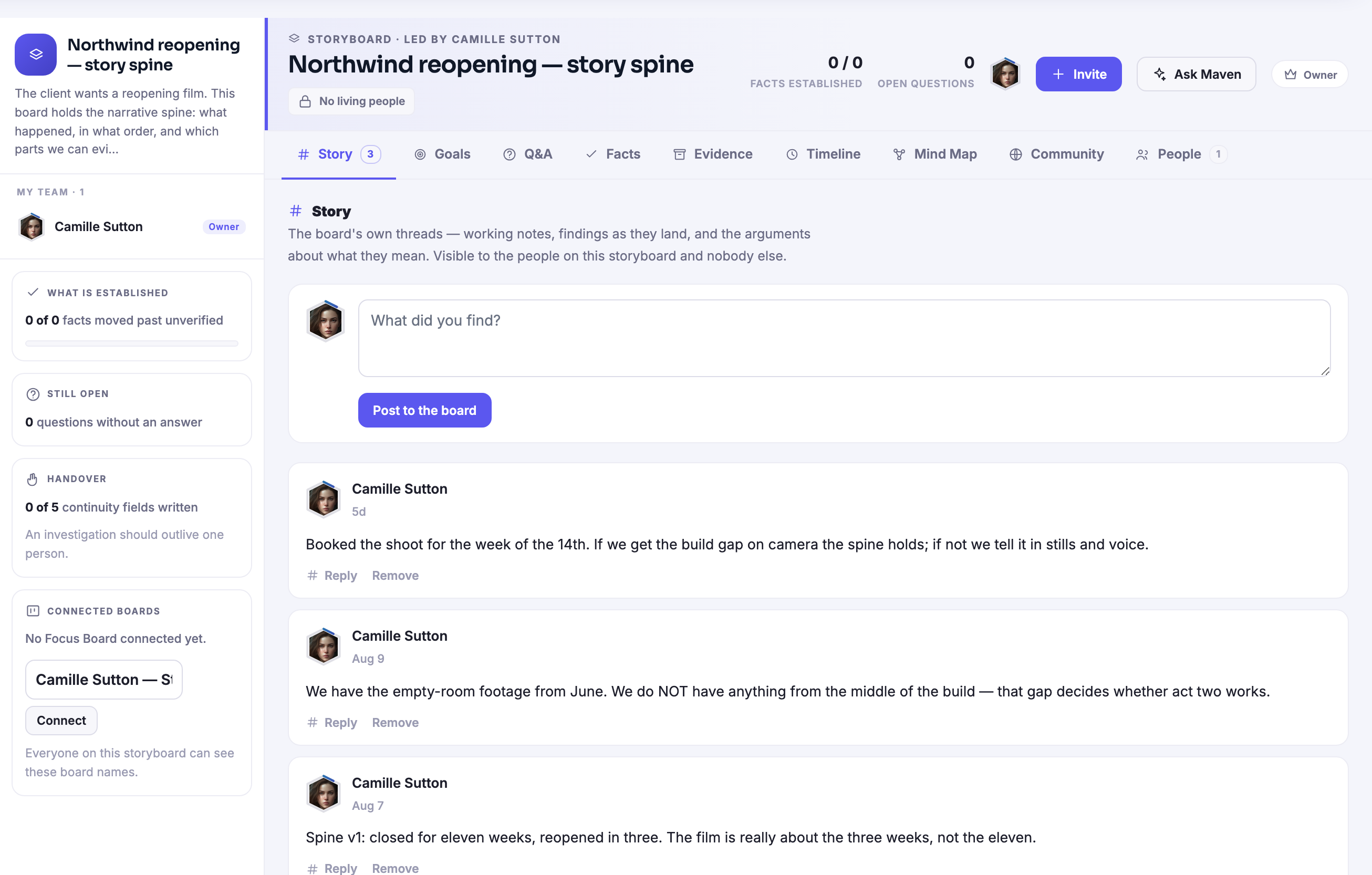
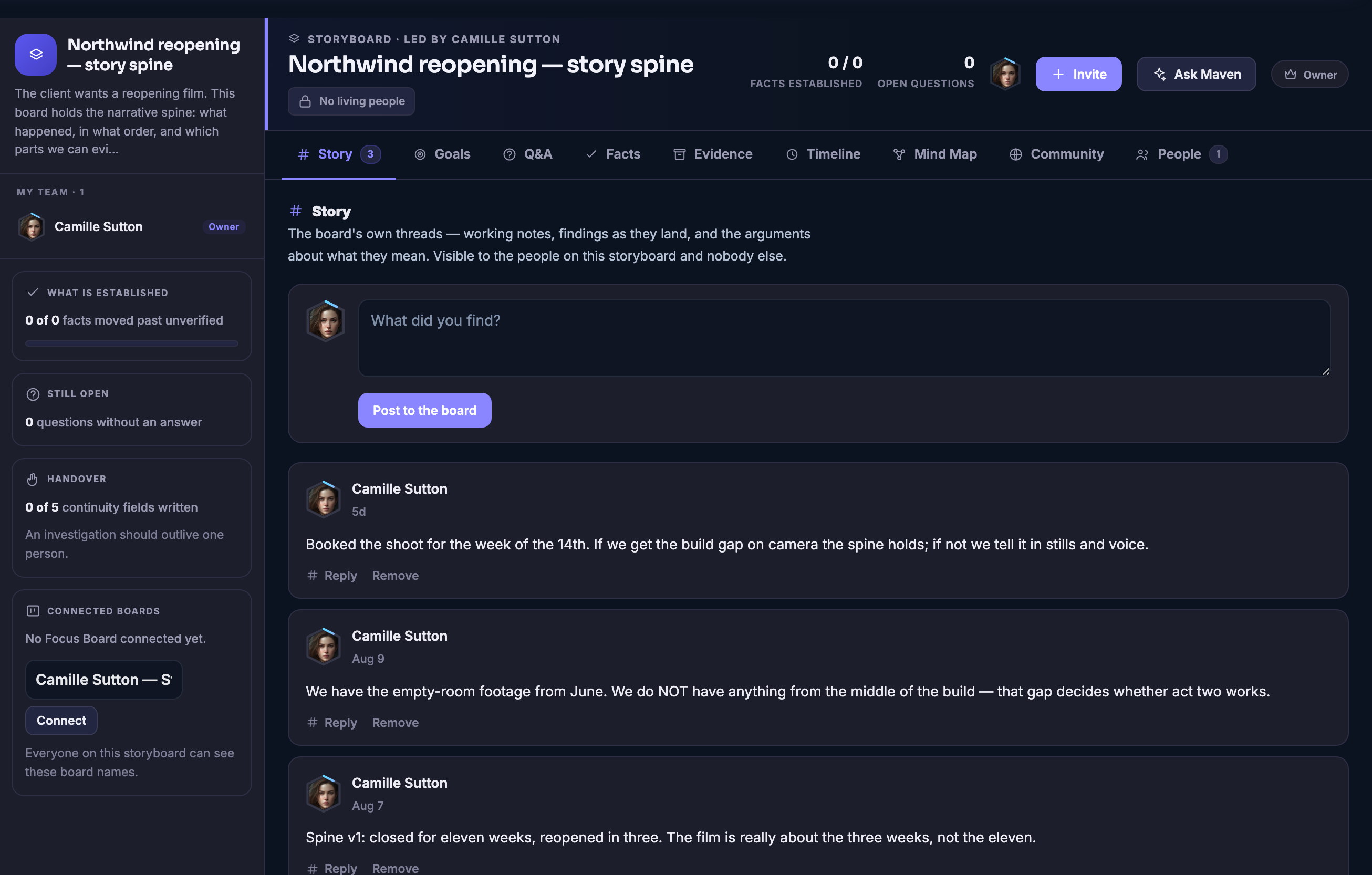
A storyboard open on its own board: the board’s name and the brief beneath it down the left, the person leading it named and badged as owner, and three panels reading what has been established, what is still open, and how much of the handover has been written — each of them still at none, under the line that an investigation should outlive one person. Below those, a panel for connected boards saying no Focus Board is connected yet, with the name of one waiting beside a control to connect it. Across the top the board’s own tabs — Story, Goals, Q&A, Facts, Evidence, Timeline, Mind Map, Community and People — beside a marking that no living person is named on this board, and controls to invite somebody or ask Maven. Under the tabs the story thread itself: a box asking what you found, and beneath it the working notes already posted, each carrying who wrote it, when, and the controls to reply to it or take it down.A storyboard open on its own board: the board’s name and the brief beneath it down the left, the person leading it named and badged as owner, and three panels reading what has been established, what is still open, and how much of the handover has been written — each of them still at none, under the line that an investigation should outlive one person. Below those, a panel for connected boards saying no Focus Board is connected yet, with the name of one waiting beside a control to connect it. Across the top the board’s own tabs — Story, Goals, Q&A, Facts, Evidence, Timeline, Mind Map, Community and People — beside a marking that no living person is named on this board, and controls to invite somebody or ask Maven. Under the tabs the story thread itself: a box asking what you found, and beneath it the working notes already posted, each carrying who wrote it, when, and the controls to reply to it or take it down.
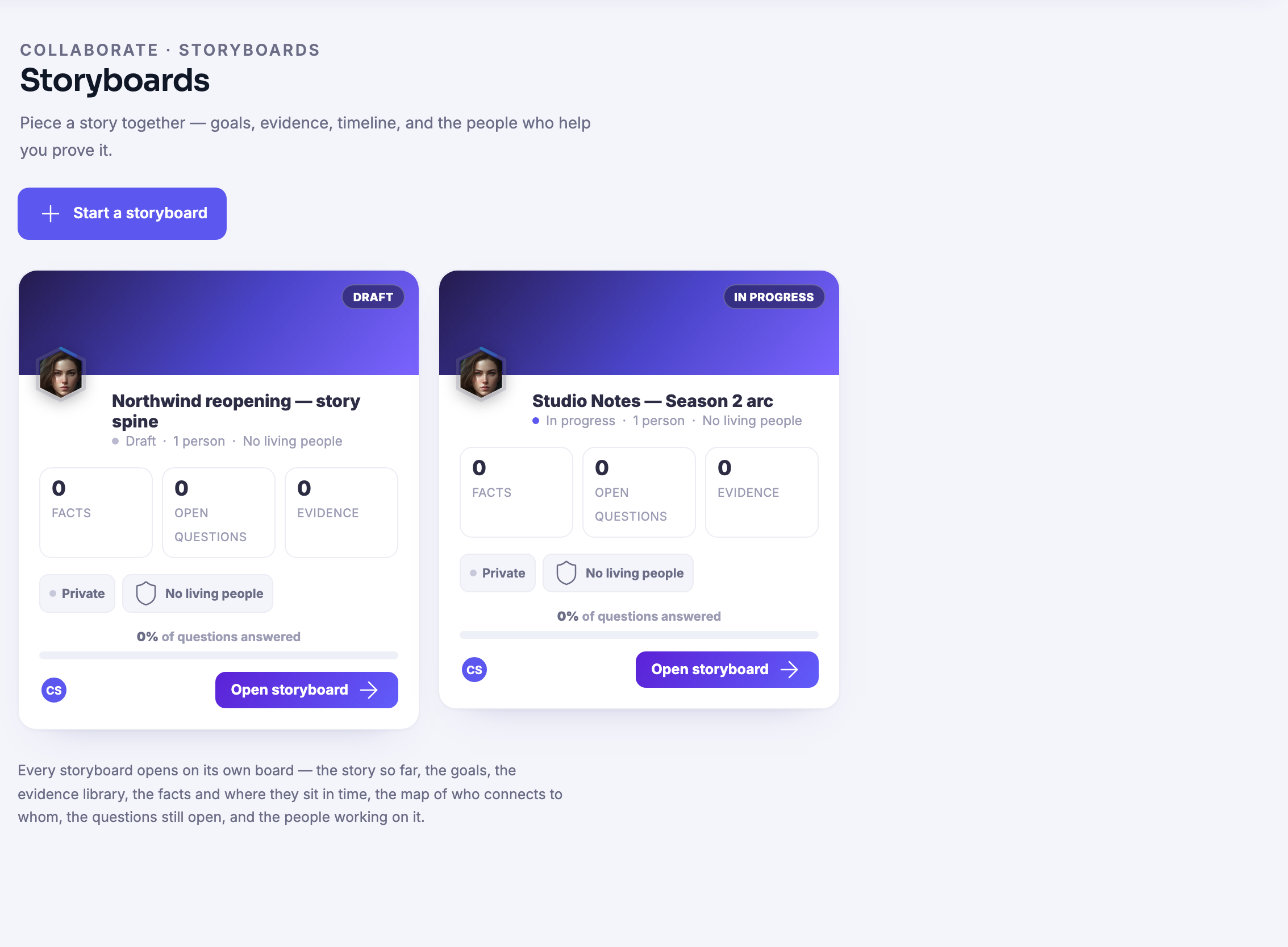
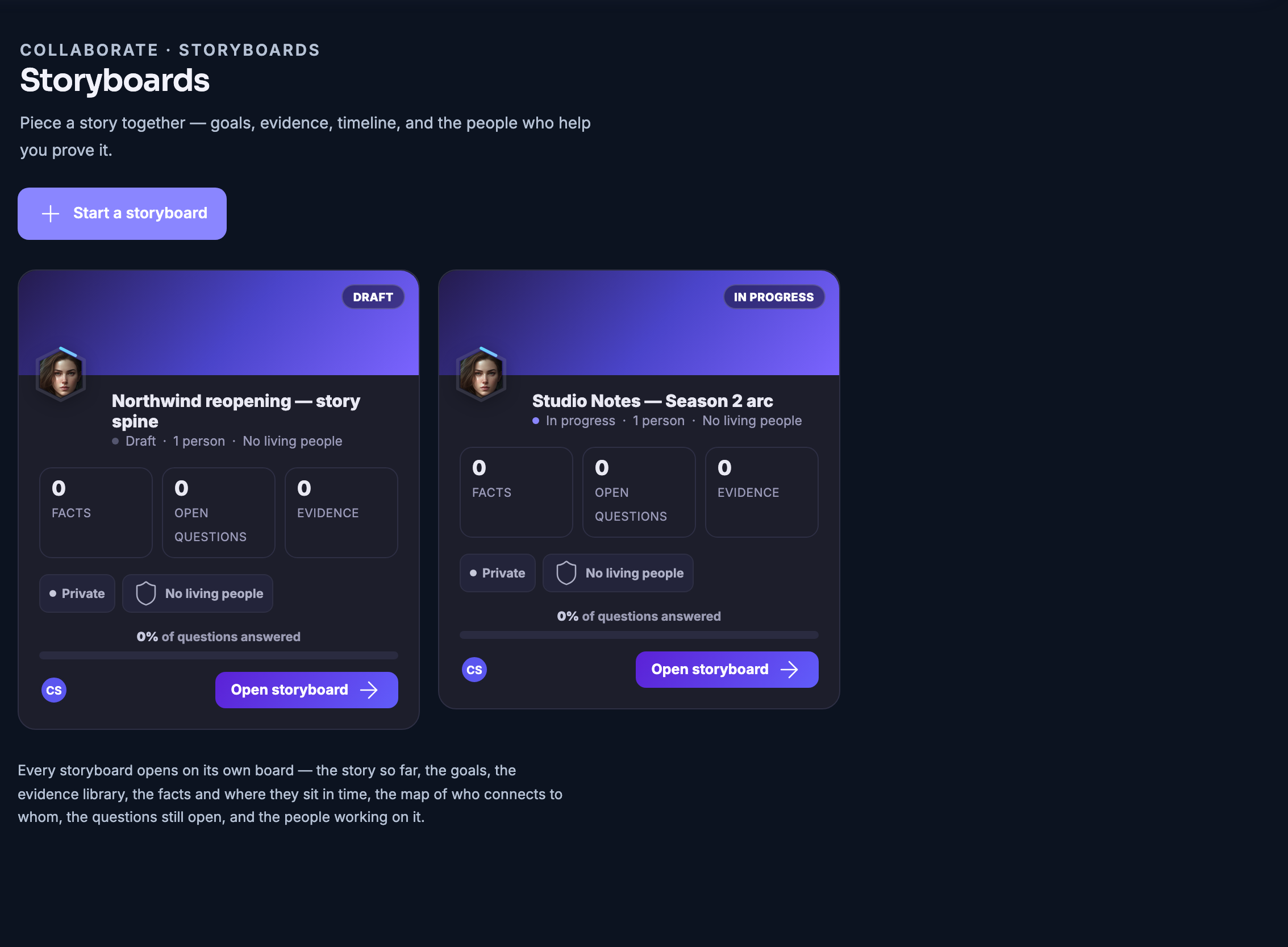
The StoryBoards home with the boards already started on it: each one named, marked as a draft or as in progress, showing who is on it and that no living person is named on it, above counters for facts, open questions and evidence that all still read none, a private marking, a share of questions answered that is also none, and a way into the board. A control to start another sits above them, and beneath them the module’s own line that every storyboard opens on its own board — the story so far, the goals, the evidence library, the facts and where they sit in time, the map of who connects to whom, the questions still open, and the people working on it.The StoryBoards home with the boards already started on it: each one named, marked as a draft or as in progress, showing who is on it and that no living person is named on it, above counters for facts, open questions and evidence that all still read none, a private marking, a share of questions answered that is also none, and a way into the board. A control to start another sits above them, and beneath them the module’s own line that every storyboard opens on its own board — the story so far, the goals, the evidence library, the facts and where they sit in time, the map of who connects to whom, the questions still open, and the people working on it.

StoryBoards

Sluiten
A storyboard open on its own board: the board’s name and the brief beneath it down the left, the person leading it named and badged as owner, and three panels reading what has been established, what is still open, and how much of the handover has been written — each of them still at none, under the line that an investigation should outlive one person. Below those, a panel for connected boards saying no Focus Board is connected yet, with the name of one waiting beside a control to connect it. Across the top the board’s own tabs — Story, Goals, Q&A, Facts, Evidence, Timeline, Mind Map, Community and People — beside a marking that no living person is named on this board, and controls to invite somebody or ask Maven. Under the tabs the story thread itself: a box asking what you found, and beneath it the working notes already posted, each carrying who wrote it, when, and the controls to reply to it or take it down.A storyboard open on its own board: the board’s name and the brief beneath it down the left, the person leading it named and badged as owner, and three panels reading what has been established, what is still open, and how much of the handover has been written — each of them still at none, under the line that an investigation should outlive one person. Below those, a panel for connected boards saying no Focus Board is connected yet, with the name of one waiting beside a control to connect it. Across the top the board’s own tabs — Story, Goals, Q&A, Facts, Evidence, Timeline, Mind Map, Community and People — beside a marking that no living person is named on this board, and controls to invite somebody or ask Maven. Under the tabs the story thread itself: a box asking what you found, and beneath it the working notes already posted, each carrying who wrote it, when, and the controls to reply to it or take it down.

StoryBoards

Sluiten
The StoryBoards home with the boards already started on it: each one named, marked as a draft or as in progress, showing who is on it and that no living person is named on it, above counters for facts, open questions and evidence that all still read none, a private marking, a share of questions answered that is also none, and a way into the board. A control to start another sits above them, and beneath them the module’s own line that every storyboard opens on its own board — the story so far, the goals, the evidence library, the facts and where they sit in time, the map of who connects to whom, the questions still open, and the people working on it.The StoryBoards home with the boards already started on it: each one named, marked as a draft or as in progress, showing who is on it and that no living person is named on it, above counters for facts, open questions and evidence that all still read none, a private marking, a share of questions answered that is also none, and a way into the board. A control to start another sits above them, and beneath them the module’s own line that every storyboard opens on its own board — the story so far, the goals, the evidence library, the facts and where they sit in time, the map of who connects to whom, the questions still open, and the people working on it.

A look inside StoryBoards

Stills from the product, one after the next.

A storyboard open on its own board: the board’s name and the brief beneath it down the left, the person leading it named and badged as owner, and three panels reading what has been established, what is still open, and how much of the handover has been written — each of them still at none, under the line that an investigation should outlive one person. Below those, a panel for connected boards saying no Focus Board is connected yet, with the name of one waiting beside a control to connect it. Across the top the board’s own tabs — Story, Goals, Q&A, Facts, Evidence, Timeline, Mind Map, Community and People — beside a marking that no living person is named on this board, and controls to invite somebody or ask Maven. Under the tabs the story thread itself: a box asking what you found, and beneath it the working notes already posted, each carrying who wrote it, when, and the controls to reply to it or take it down.A storyboard open on its own board: the board’s name and the brief beneath it down the left, the person leading it named and badged as owner, and three panels reading what has been established, what is still open, and how much of the handover has been written — each of them still at none, under the line that an investigation should outlive one person. Below those, a panel for connected boards saying no Focus Board is connected yet, with the name of one waiting beside a control to connect it. Across the top the board’s own tabs — Story, Goals, Q&A, Facts, Evidence, Timeline, Mind Map, Community and People — beside a marking that no living person is named on this board, and controls to invite somebody or ask Maven. Under the tabs the story thread itself: a box asking what you found, and beneath it the working notes already posted, each carrying who wrote it, when, and the controls to reply to it or take it down.
The StoryBoards home with the boards already started on it: each one named, marked as a draft or as in progress, showing who is on it and that no living person is named on it, above counters for facts, open questions and evidence that all still read none, a private marking, a share of questions answered that is also none, and a way into the board. A control to start another sits above them, and beneath them the module’s own line that every storyboard opens on its own board — the story so far, the goals, the evidence library, the facts and where they sit in time, the map of who connects to whom, the questions still open, and the people working on it.The StoryBoards home with the boards already started on it: each one named, marked as a draft or as in progress, showing who is on it and that no living person is named on it, above counters for facts, open questions and evidence that all still read none, a private marking, a share of questions answered that is also none, and a way into the board. A control to start another sits above them, and beneath them the module’s own line that every storyboard opens on its own board — the story so far, the goals, the evidence library, the facts and where they sit in time, the map of who connects to whom, the questions still open, and the people working on it.
A person drafting from an armchair with a laptop, a screen and a lightbulb behind them and balloons overhead

See it in your own business.

Everything on this page comes with the platform — start free and try it on your real work.

Get started now

Next Up: Social scheduling

Plan and publish across every channel.

Vraag Maven