














メッセージ

This is the product's own frame. Your conversations appear here once you have an account.

Get started now
通知

This is the product's own frame. Alerts about your business appear here once you have an account.

日本語
The regulars felt seen this week

Local customers, kept close.

Pulse gives brick-and-mortar businesses the memory big chains pay millions for — who your regulars are, when they drift, what brings them back.

Why it matters

Who keeps coming back — and who has gone quiet.

Regulars, recognizedVisit patterns and preferences, remembered without a loyalty-card corporation.
Win-backs that workQuiet for six weeks? A nudge goes out before they become a stranger.
Local by designBuilt for businesses with a door, not adapted from enterprise software.
Part of one platform — works hand-in-hand with地図上·ロイヤルティ

Maven adds this one: the book knows everyone you have met — this is the shorter list of the ones who came back.

顧客

The people who have already bought — kept close enough to come back.
The buyers, on a list of their ownWhichever door they came through — a form on your site, a booking, a referral at the counter, a conversation Maven took — the person who paid lands on one list per business, with the route they arrived by and the day they arrived beside their name.
Groups that follow behaviour, not memoryThe tags you put on somebody ride on their row where you can see them, and grouping is a view of the same screen rather than a spreadsheet you rebuild on a Friday. Who is new this month is a counter on the list, not a question.
The regulars, and the ones who have gone quietWhat a regular comes back for belongs on their record instead of in somebody’s head. And when one of them stops coming, the nudge goes out while they are still a customer rather than a stranger.
Read more about Customers

The shorter list: the people who already said yes, and what would bring them back.

A contact book answers who you know. A board answers who might buy. This answers the third question, which is the one a business with a door actually lives on: who already did, and are they still coming? It is the same platform and the same people — sorted by the only line that changes how you treat somebody, which is the one they crossed when they paid you.

Everybody on the list arrives carrying the route they came in on and the day they came, and whatever you tagged them with stays where you can see it. Picking a group is a view of the same screen rather than an export: the list narrows and the people you meant are what is left.

The point of keeping the list is what it lets you do with a quiet week. What a regular usually comes in for sits on their record rather than in the head of whoever happened to serve them, so anybody can greet them properly. And when somebody who used to come every fortnight has not been in for a while, the follow-up goes out before they have drifted off entirely.

It was built for a business with a door rather than adapted from software written for somebody else’s sales floor, which is why the list sits beside the booking page, the offer and the stamp card instead of behind a department. The people on it are the same people your letters read from and the same people the counter serves.

What it actually does

  • One list of the people who have already bought
  • The door each of them came in through, kept beside their name
  • Groups that follow behaviour rather than a file you rebuild

What that changes for you

  • You can tell a regular from a stranger without thinking about it
  • A customer who has gone quiet is noticed while it still matters
  • Anybody serving them can greet them the way you would

You come away with the shorter list — the people who already said yes.

A look inside Customers

Customers — platform screenshots

Real screens from the product. Open any one full size, or switch the set to light or dark.

閉じる
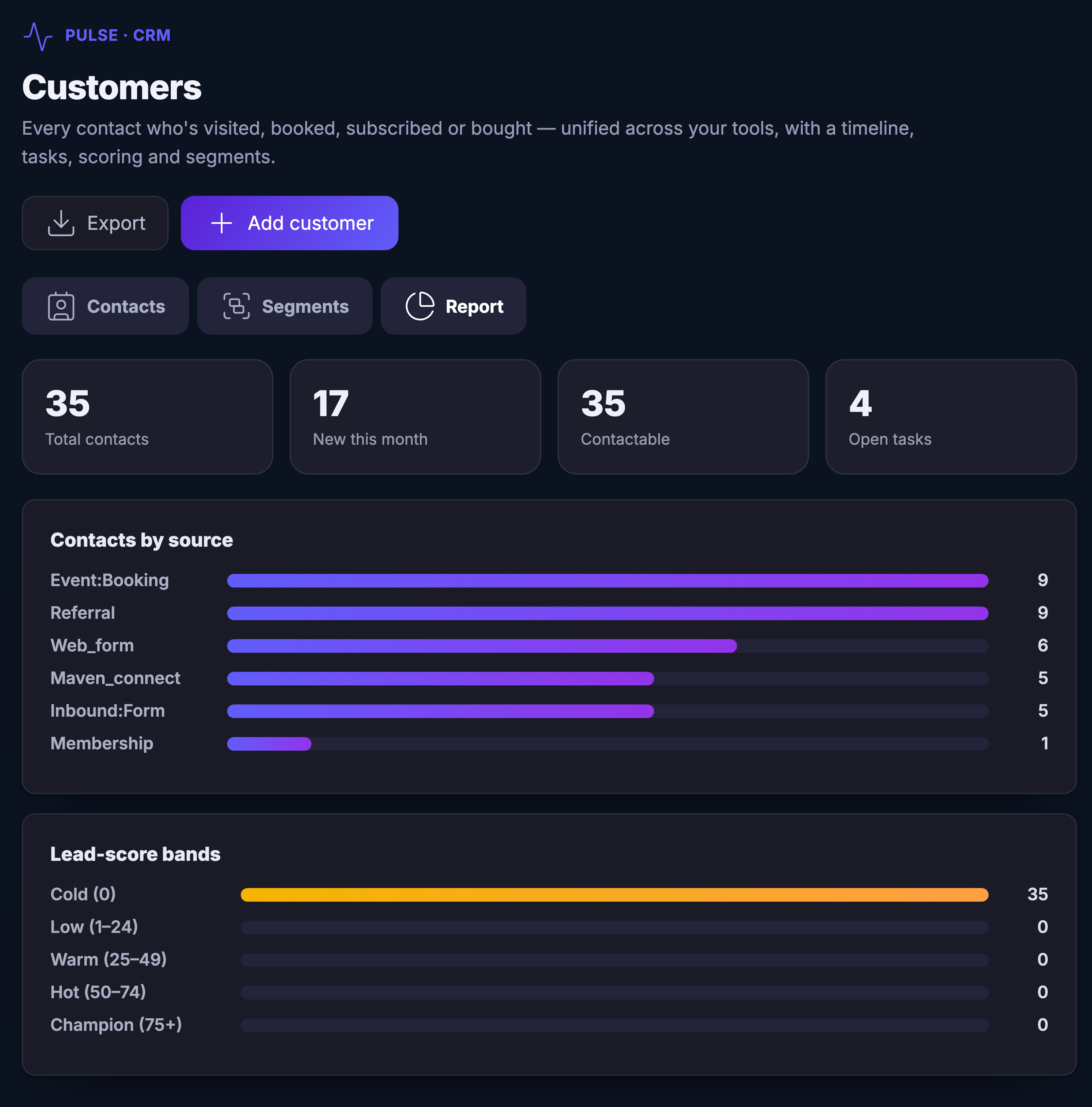
The customer records in the local-business workspace, resting on the report. An eyebrow naming the customer-relations tool sits over the heading Customers and the product’s own line — every contact who has visited, booked, subscribed or bought, unified across your tools, with a timeline, tasks, scoring and segments. Under it a control to export the list and a filled control to add a customer, then the switch between the contacts themselves, the segments they group into, and the report, resting on the report. A row of counters follows: the people the list holds, the ones who arrived this month, the ones who can be contacted, and the tasks still open on them. Then a panel headed Contacts by source, giving a bar to each door people came in through — a booking taken at an event, a referral, a web form, Maven Connect, an inbound form, and a membership — with the event bookings and the referrals running longest and the membership shortest. Below it a panel headed Lead-score bands, where the coldest band carries every person on the list and the low, warm, hot and champion bands under it all stand at nothing, because nobody in this workspace has been scored.The customer records in the local-business workspace, resting on the report. An eyebrow naming the customer-relations tool sits over the heading Customers and the product’s own line — every contact who has visited, booked, subscribed or bought, unified across your tools, with a timeline, tasks, scoring and segments. Under it a control to export the list and a filled control to add a customer, then the switch between the contacts themselves, the segments they group into, and the report, resting on the report. A row of counters follows: the people the list holds, the ones who arrived this month, the ones who can be contacted, and the tasks still open on them. Then a panel headed Contacts by source, giving a bar to each door people came in through — a booking taken at an event, a referral, a web form, Maven Connect, an inbound form, and a membership — with the event bookings and the referrals running longest and the membership shortest. Below it a panel headed Lead-score bands, where the coldest band carries every person on the list and the low, warm, hot and champion bands under it all stand at nothing, because nobody in this workspace has been scored.
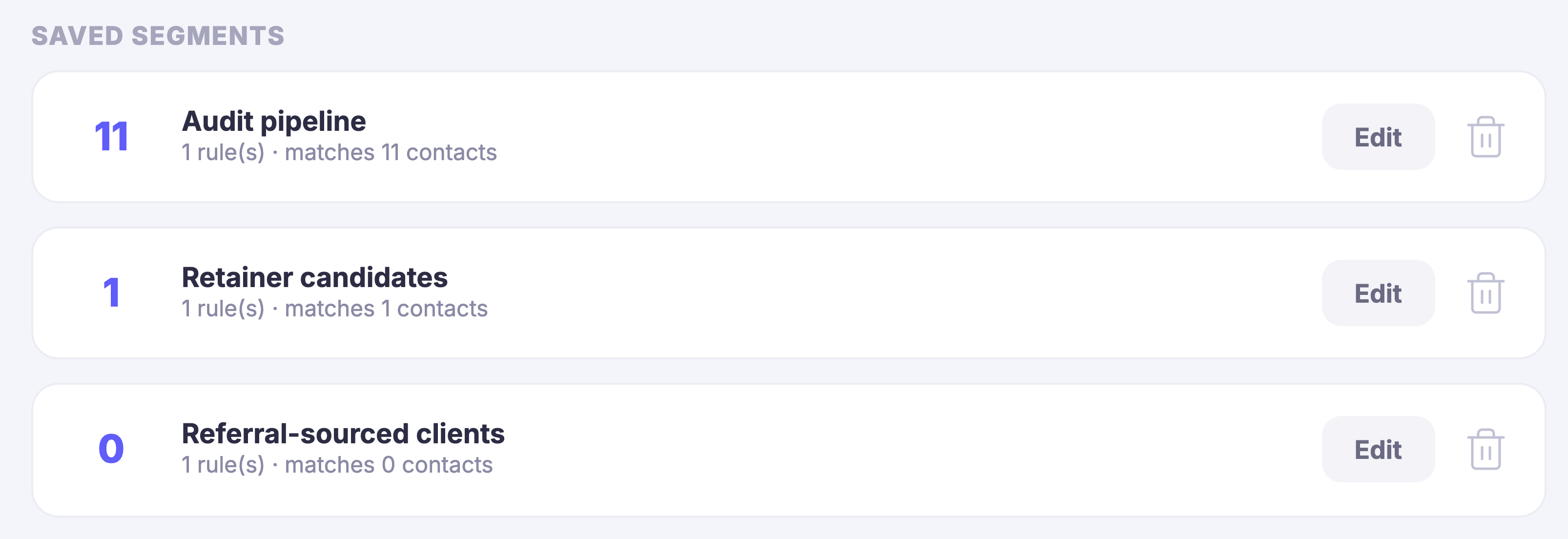
The saved groups on the customer records, under a label reading saved segments: an audit pipeline, retainer candidates, and referral-sourced clients. Each one carries at its left how many people it currently matches, and under its name how many rules it holds — printed with a bracketed plural ending instead of the right word for the number, which is a fault in the product’s own wording. Controls to edit the group or to throw it away sit at the right of each row. The last of them, referral-sourced clients, matches nobody at all.The saved groups on the customer records, under a label reading saved segments: an audit pipeline, retainer candidates, and referral-sourced clients. Each one carries at its left how many people it currently matches, and under its name how many rules it holds — printed with a bracketed plural ending instead of the right word for the number, which is a fault in the product’s own wording. Controls to edit the group or to throw it away sit at the right of each row. The last of them, referral-sourced clients, matches nobody at all.

顧客

閉じる
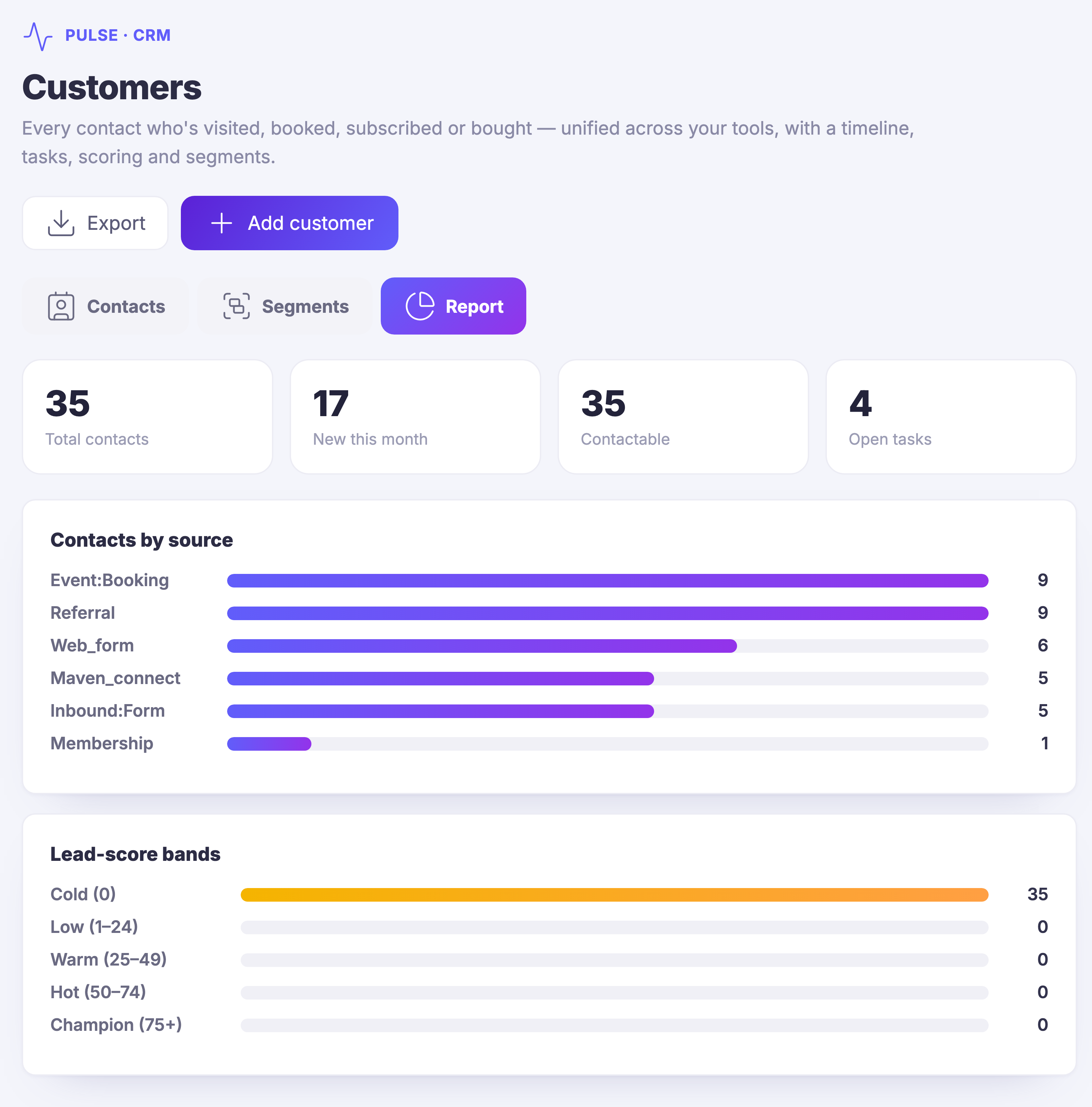
The customer records in the local-business workspace, resting on the report. An eyebrow naming the customer-relations tool sits over the heading Customers and the product’s own line — every contact who has visited, booked, subscribed or bought, unified across your tools, with a timeline, tasks, scoring and segments. Under it a control to export the list and a filled control to add a customer, then the switch between the contacts themselves, the segments they group into, and the report, resting on the report. A row of counters follows: the people the list holds, the ones who arrived this month, the ones who can be contacted, and the tasks still open on them. Then a panel headed Contacts by source, giving a bar to each door people came in through — a booking taken at an event, a referral, a web form, Maven Connect, an inbound form, and a membership — with the event bookings and the referrals running longest and the membership shortest. Below it a panel headed Lead-score bands, where the coldest band carries every person on the list and the low, warm, hot and champion bands under it all stand at nothing, because nobody in this workspace has been scored.The customer records in the local-business workspace, resting on the report. An eyebrow naming the customer-relations tool sits over the heading Customers and the product’s own line — every contact who has visited, booked, subscribed or bought, unified across your tools, with a timeline, tasks, scoring and segments. Under it a control to export the list and a filled control to add a customer, then the switch between the contacts themselves, the segments they group into, and the report, resting on the report. A row of counters follows: the people the list holds, the ones who arrived this month, the ones who can be contacted, and the tasks still open on them. Then a panel headed Contacts by source, giving a bar to each door people came in through — a booking taken at an event, a referral, a web form, Maven Connect, an inbound form, and a membership — with the event bookings and the referrals running longest and the membership shortest. Below it a panel headed Lead-score bands, where the coldest band carries every person on the list and the low, warm, hot and champion bands under it all stand at nothing, because nobody in this workspace has been scored.

顧客

閉じる
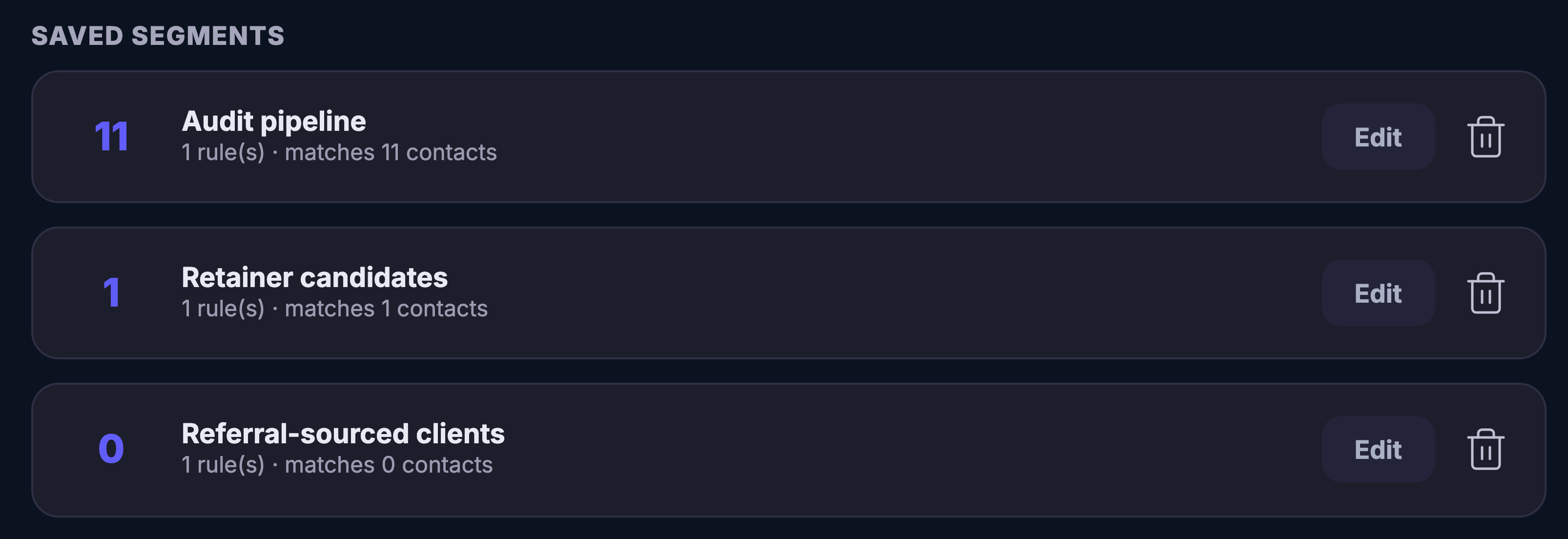
The saved groups on the customer records, under a label reading saved segments: an audit pipeline, retainer candidates, and referral-sourced clients. Each one carries at its left how many people it currently matches, and under its name how many rules it holds — printed with a bracketed plural ending instead of the right word for the number, which is a fault in the product’s own wording. Controls to edit the group or to throw it away sit at the right of each row. The last of them, referral-sourced clients, matches nobody at all.The saved groups on the customer records, under a label reading saved segments: an audit pipeline, retainer candidates, and referral-sourced clients. Each one carries at its left how many people it currently matches, and under its name how many rules it holds — printed with a bracketed plural ending instead of the right word for the number, which is a fault in the product’s own wording. Controls to edit the group or to throw it away sit at the right of each row. The last of them, referral-sourced clients, matches nobody at all.

A look inside Customers

Stills from the product, one after the next.

The customer records in the local-business workspace, resting on the report. An eyebrow naming the customer-relations tool sits over the heading Customers and the product’s own line — every contact who has visited, booked, subscribed or bought, unified across your tools, with a timeline, tasks, scoring and segments. Under it a control to export the list and a filled control to add a customer, then the switch between the contacts themselves, the segments they group into, and the report, resting on the report. A row of counters follows: the people the list holds, the ones who arrived this month, the ones who can be contacted, and the tasks still open on them. Then a panel headed Contacts by source, giving a bar to each door people came in through — a booking taken at an event, a referral, a web form, Maven Connect, an inbound form, and a membership — with the event bookings and the referrals running longest and the membership shortest. Below it a panel headed Lead-score bands, where the coldest band carries every person on the list and the low, warm, hot and champion bands under it all stand at nothing, because nobody in this workspace has been scored.The customer records in the local-business workspace, resting on the report. An eyebrow naming the customer-relations tool sits over the heading Customers and the product’s own line — every contact who has visited, booked, subscribed or bought, unified across your tools, with a timeline, tasks, scoring and segments. Under it a control to export the list and a filled control to add a customer, then the switch between the contacts themselves, the segments they group into, and the report, resting on the report. A row of counters follows: the people the list holds, the ones who arrived this month, the ones who can be contacted, and the tasks still open on them. Then a panel headed Contacts by source, giving a bar to each door people came in through — a booking taken at an event, a referral, a web form, Maven Connect, an inbound form, and a membership — with the event bookings and the referrals running longest and the membership shortest. Below it a panel headed Lead-score bands, where the coldest band carries every person on the list and the low, warm, hot and champion bands under it all stand at nothing, because nobody in this workspace has been scored.
The saved groups on the customer records, under a label reading saved segments: an audit pipeline, retainer candidates, and referral-sourced clients. Each one carries at its left how many people it currently matches, and under its name how many rules it holds — printed with a bracketed plural ending instead of the right word for the number, which is a fault in the product’s own wording. Controls to edit the group or to throw it away sit at the right of each row. The last of them, referral-sourced clients, matches nobody at all.The saved groups on the customer records, under a label reading saved segments: an audit pipeline, retainer candidates, and referral-sourced clients. Each one carries at its left how many people it currently matches, and under its name how many rules it holds — printed with a bracketed plural ending instead of the right word for the number, which is a fault in the product’s own wording. Controls to edit the group or to throw it away sit at the right of each row. The last of them, referral-sourced clients, matches nobody at all.

See it in your own business.

Everything on this page comes with the platform — start free and try it on your real work.

Get started now

Next Up: Loyalty

Give the second visit a reason to happen.

Maven に質問