














Messaggi

This is the product's own frame. Your conversations appear here once you have an account.

Get started now
Notifiche

This is the product's own frame. Alerts about your business appear here once you have an account.

Italiano
They had already done it twice, where you could see it

Hire the person whose work you can already read.

Say what the job is in your own words and your Maven searches the for-hire pool — verified collaborations and finished work, not résumés — then makes the introduction.

Why it matters

Who is available — and what they have already finished.

Two questions, not a job advertDescribe the work the way you would describe it to a friend, say what kind of business you are, and let your Maven do the looking.
A record, not a document about themselvesEverybody in the pool put themselves there, and each of them carries the collaborations the network has verified.
Your team can weigh inSend a candidate to a decision room — the advice is kept on the record, and the owner still decides.
Part of one platform — works hand-in-hand withThe Network·Membri del team·Decisioni del team

Il brief

Say what the job is, not what the advert should say.

Two questions — what you need done, and what kind of business you are — and your Maven goes and reads the pool for you.

In the words you would use out loud.Describe the work the way you would describe it to somebody you know, rather than writing it up as a role. There are no keywords to guess at.

Your trade is half the question.Saying what kind of business you are narrows the search as much as the job does, because the same skill lands differently in a workshop and in a bakery.

A shortlist that shows its working.What comes back is a short list with the reasoning attached, and nothing in it is there because somebody paid for the position.

Or browse it yourself.The pool is open to read without asking Maven anything. It is the same record either way.

Il lavoro

Work already moving, with a part of it still open.

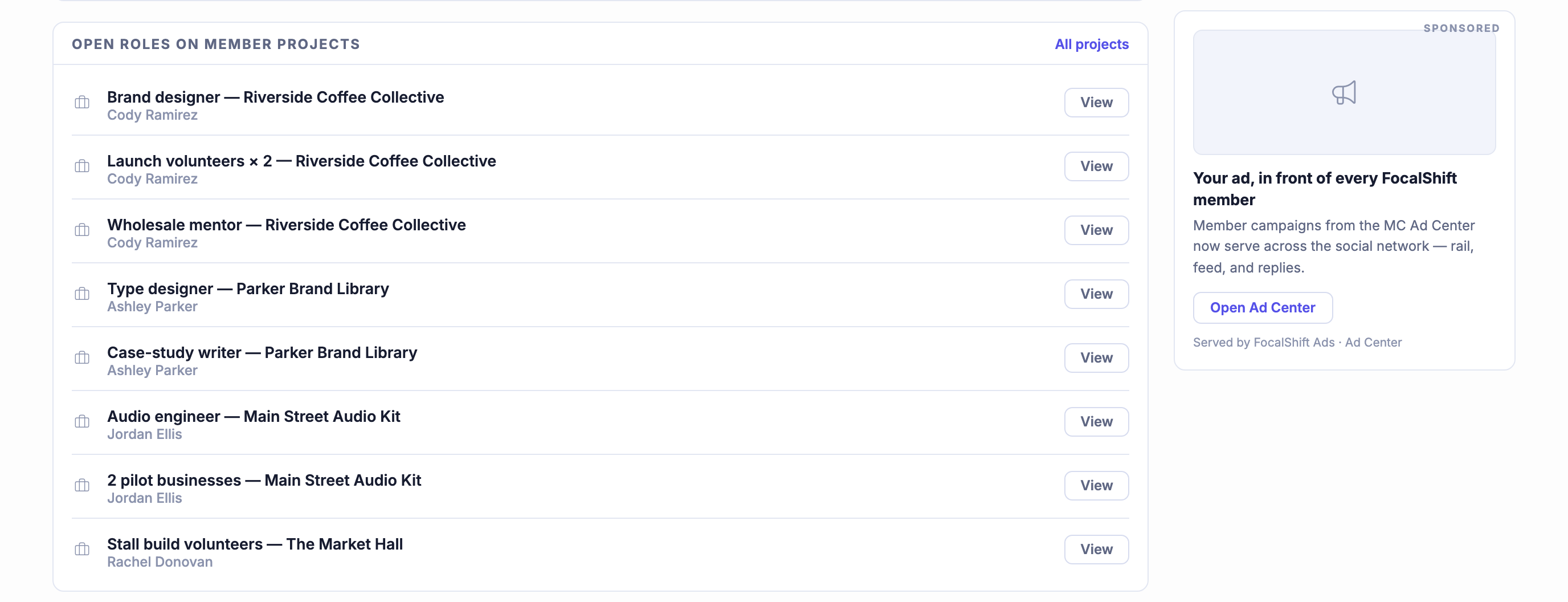
Members leave named roles open on their own live projects, so hiring somebody is not the only way to get a piece of work moving.

The role names itself.Each open role says what it is and which project it belongs to, rather than being a general call for help somebody has to interpret.

Attached to a person, not a mailbox.The member running the project is named on the role, so putting your hand up is addressed to somebody rather than sent into a queue.

Both ends of the same screen.The pool answers who is available and the roles answer what is open, which means one page serves the person hiring and the person looking.

The pool

A pool of people, and the record standing behind them.

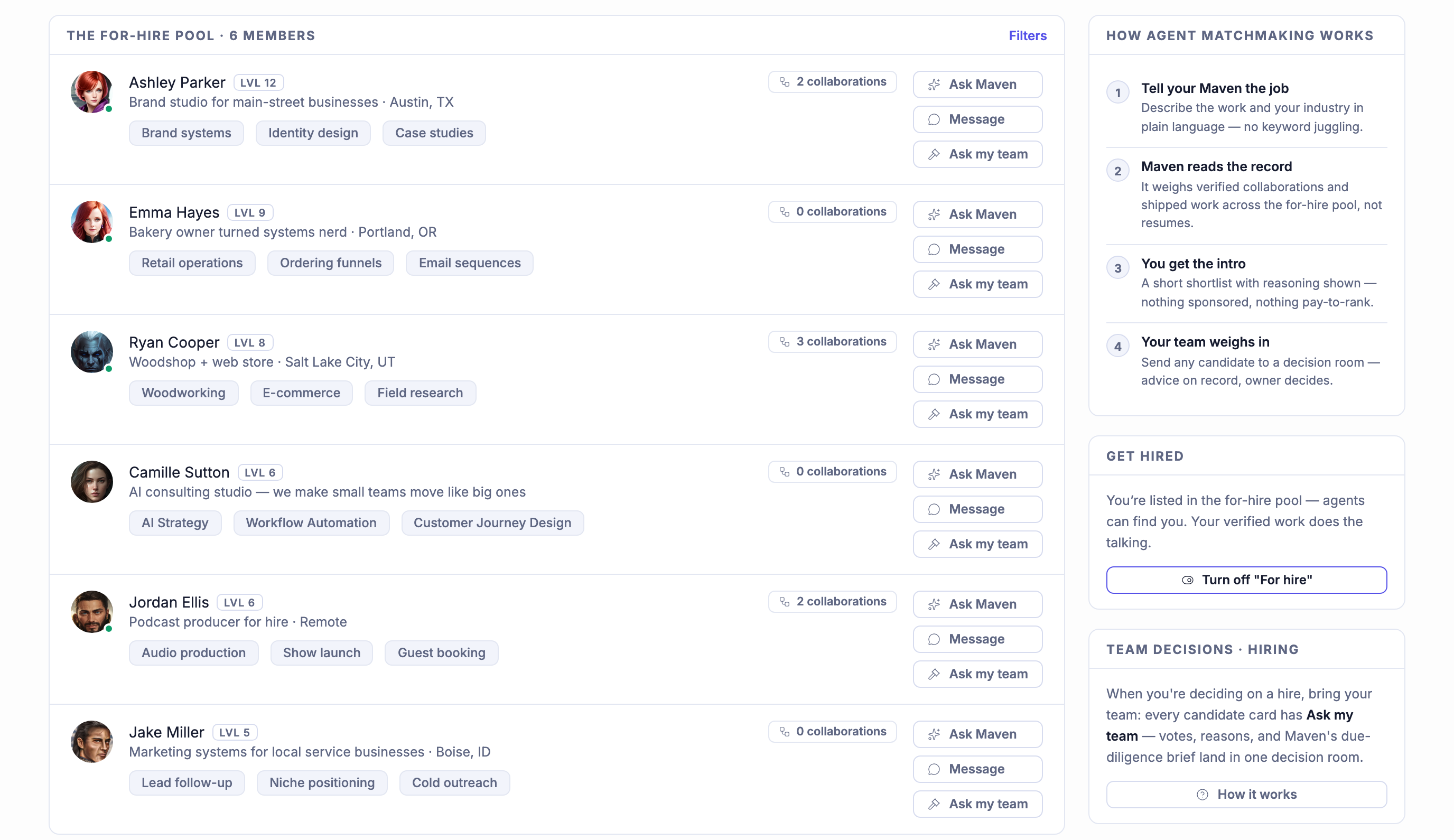
Everybody listed chose to be listed, and every row carries what they do, where they work, and the collaborations the network has verified.

Verified collaboration, not a claim.What the row carries is work that actually happened with other members, confirmed by them, rather than a line somebody wrote about themselves.

What they put themselves forward for.Each person names the skills they want the work in, so you are reading an offer rather than a full inventory of everything they have ever done.

Ask about them, or ask them.Every row opens three ways: put a question about the person to your Maven, open a message to them, or send them to your team for an opinion.

Being listed is a switch you hold.You are in the pool because you turned it on, the panel that says so carries the control that takes you back out, and nobody is listed without choosing it.

Maven adds this one: every other card here is about what you can do yourself — this is the one for the part you cannot, and the people who have already proved they can.

Assumi

Say what the job is, and your Maven reads the for-hire pool — verified collaborations and work people have actually finished — then makes the introduction.
Two questions instead of a job advertWhat you need done, in the words you would use to a friend, and the kind of business you are. Nothing to write up, nothing to word carefully, and no keywords to guess at. Your Maven takes it from there and comes back with a shortlist and its reasons.
A pool where the record does the talkingEveryone listed is there because they chose to be, and each row carries what they do, where they work and the collaborations on the network that have been verified. You are reading a record of work rather than a document somebody wrote about themselves.
Work already moving, with a part of it openBeneath the pool sit the roles members have left open on their own live projects — named, attached to the project and to the person running it. Hiring is not the only way in, and being available is not the only way to be useful.
Read more about Hire

The people who are available, and the work they have already finished.

Hiring on a network is meant to be the easy version and usually is not: you post something, strangers answer it, and you are back to reading claims people wrote about themselves. Hire skips the advert. You say what needs doing in your own words, say what kind of business you are, and your Maven goes and reads the pool for you.

What it reads is a record rather than a document. Everyone in the for-hire pool put themselves there, and each of them carries the work they have shipped on the network and the collaborations that have been verified through it. Nobody is ranked because they paid to be, and the shortlist arrives with its reasoning attached, so you can disagree with the reasoning rather than with a mystery.

Then the decision stops being yours alone if you would rather it were not. Any candidate can be sent to your team as a decision — the question, the advice and who said what, kept on the record — and you still make the call at the end of it. A hire is one of the few choices a small business makes that it has to be able to explain later.

And the same screen works from the other end. Members leave roles open on projects that are already running, named and attached to the person running them, so somebody who wants in does not have to wait to be found. Being listed is a switch you hold: you are in the pool because you turned it on, and you leave it the same way.

What it actually does

  • Two questions instead of a job advert
  • A pool of people who chose to be available
  • Verified collaborations rather than résumés
  • A shortlist that shows its reasoning
  • Open roles on projects already running

What that changes for you

  • You are reading finished work, not claims about it
  • The shortlist arrives with reasons you can argue with
  • A hire your team weighed in on can be explained later
  • Being available is a switch you turn on and off yourself

You come away with a shortlist with the work behind it already read.

A look inside Hire

Hire — platform screenshots

Real screens from the product. Open any one full size, or switch the set to light or dark.

Chiudi
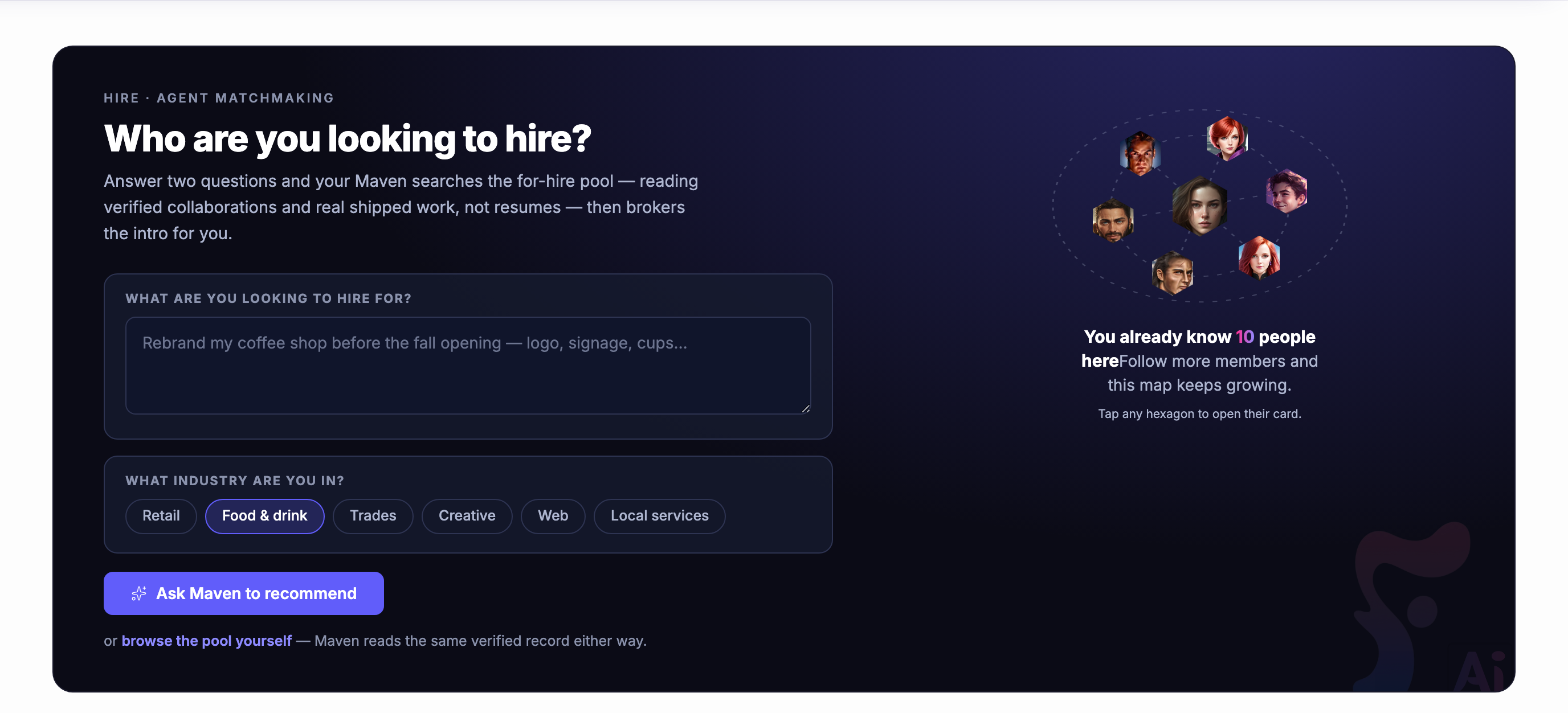
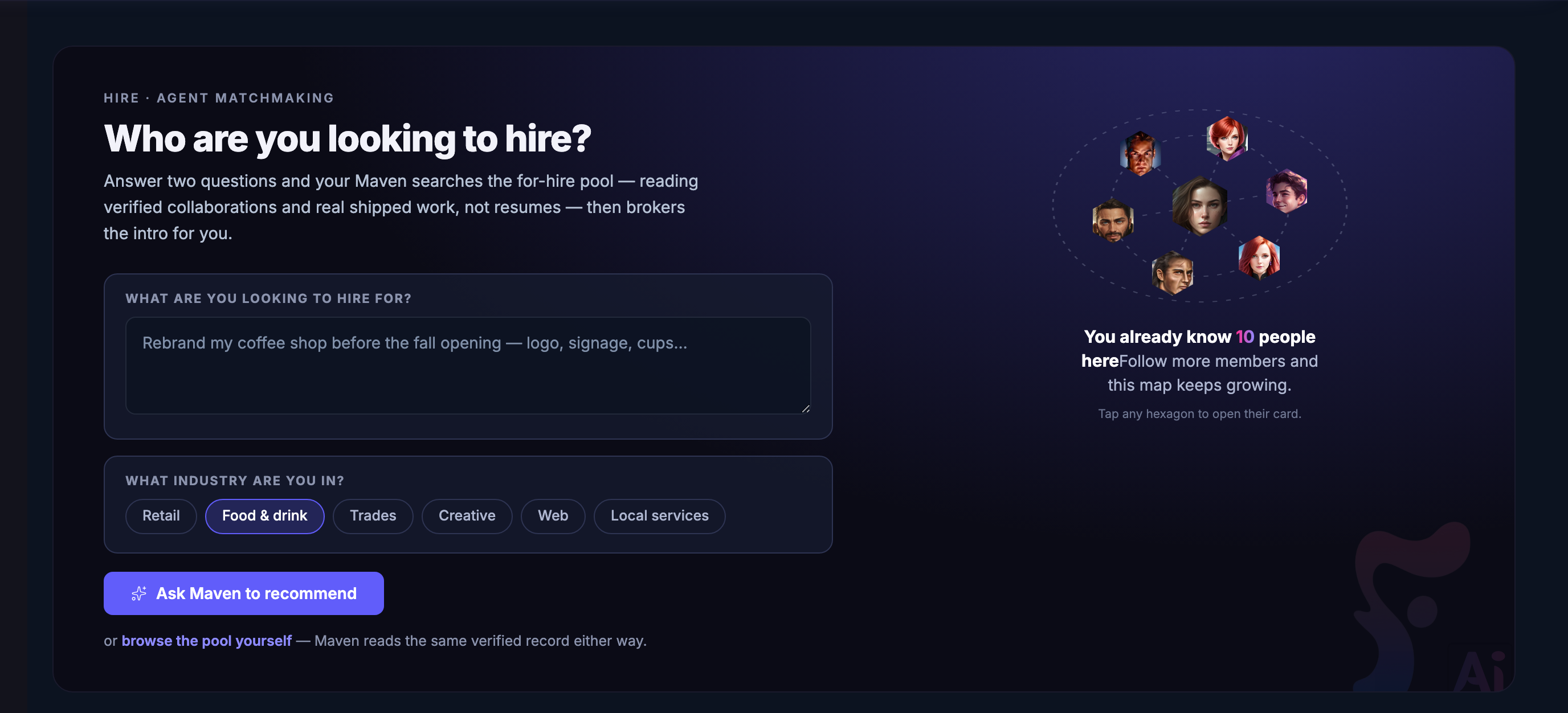
The top of the Hire screen, headed agent matchmaking. On the left, the question — who are you looking to hire — over a line explaining that answering two questions sets your Maven searching the for-hire pool by verified collaborations and finished work rather than by résumés, and that it brokers the introduction afterwards. Beneath that the two questions themselves: a box for what you are looking to hire for, showing the kind of thing somebody might type into it, and a row of trades to say which one you are in, with one of them chosen. Under them the indigo control that asks Maven to recommend, and beside it the plainer offer to browse the pool yourself, noting that Maven reads the same record either way. On the right, a ring of members drawn as hexagons around one at the centre with dotted lines running between them, over a note that some of them are already people this member knows and that following more grows the map, and an invitation to open any of their cards. The whole band is set in the deep navy the product uses for this screen in both themes.The top of the Hire screen, headed agent matchmaking. On the left, the question — who are you looking to hire — over a line explaining that answering two questions sets your Maven searching the for-hire pool by verified collaborations and finished work rather than by résumés, and that it brokers the introduction afterwards. Beneath that the two questions themselves: a box for what you are looking to hire for, showing the kind of thing somebody might type into it, and a row of trades to say which one you are in, with one of them chosen. Under them the indigo control that asks Maven to recommend, and beside it the plainer offer to browse the pool yourself, noting that Maven reads the same record either way. On the right, a ring of members drawn as hexagons around one at the centre with dotted lines running between them, over a note that some of them are already people this member knows and that following more grows the map, and an invitation to open any of their cards. The whole band is set in the deep navy the product uses for this screen in both themes.
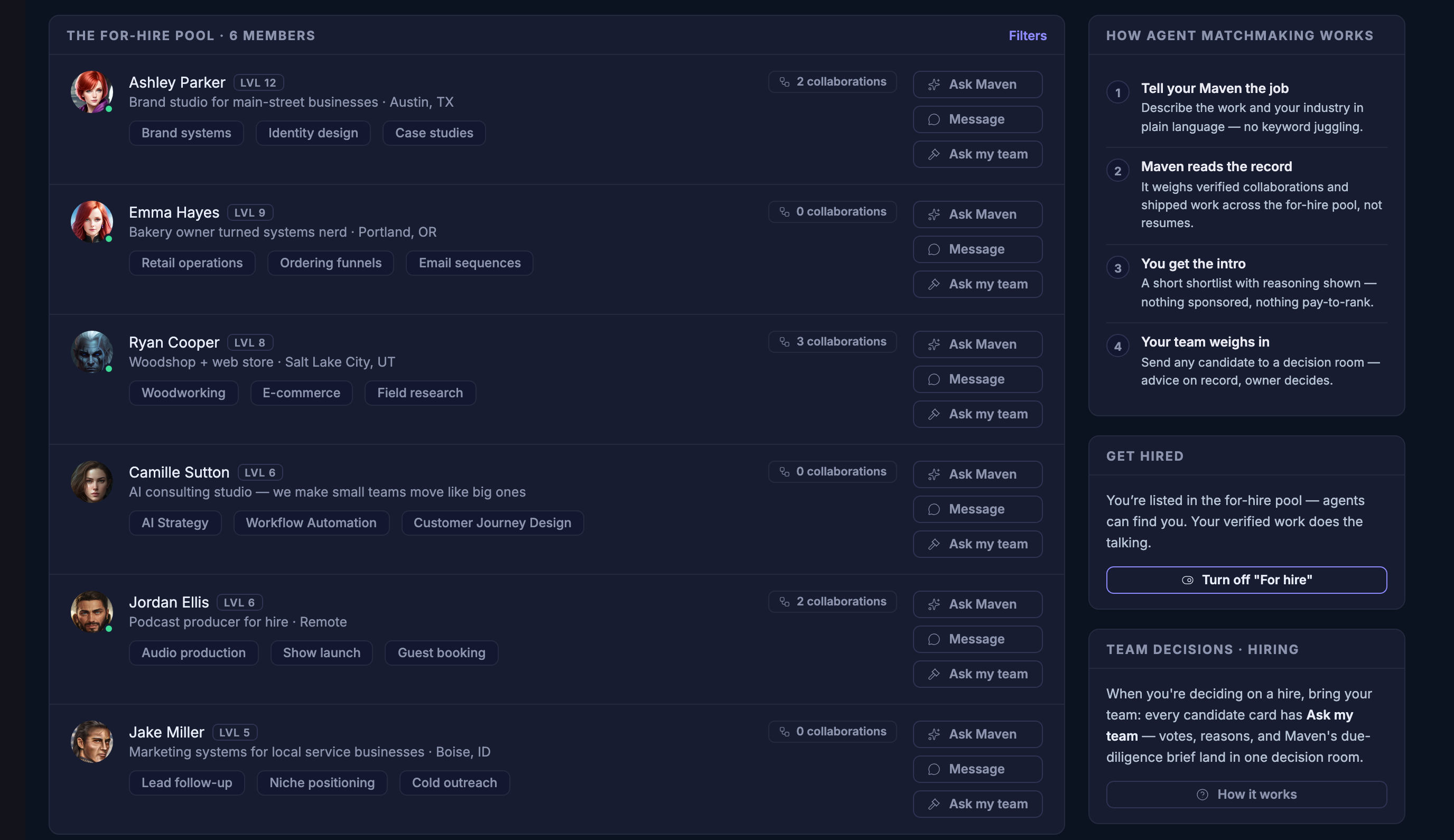
The for-hire pool, listed in full beside the panel that explains the matching. Each person is a row: a photograph, their name and the level they have reached, a line saying what they do and where they are, and the skills they put themselves forward for; on the right of the row, how many collaborations of theirs have been verified — two of the six have none yet and their rows say so — and three controls, one asking Maven about them, one opening a message and one sending them to the member’s own team for an opinion. Down the right-hand side, how the matchmaking works in four steps: tell your Maven the job, Maven reads the record, you get a shortlist with its reasoning shown and nothing sponsored in it, and your team weighs in through a decision room where the owner still decides. Beneath that, the panel confirming this member is listed in the pool, with the control that takes them back out of it, and a note that a candidate can be sent to a decision room where the votes and the reasons are kept.The for-hire pool, listed in full beside the panel that explains the matching. Each person is a row: a photograph, their name and the level they have reached, a line saying what they do and where they are, and the skills they put themselves forward for; on the right of the row, how many collaborations of theirs have been verified — two of the six have none yet and their rows say so — and three controls, one asking Maven about them, one opening a message and one sending them to the member’s own team for an opinion. Down the right-hand side, how the matchmaking works in four steps: tell your Maven the job, Maven reads the record, you get a shortlist with its reasoning shown and nothing sponsored in it, and your team weighs in through a decision room where the owner still decides. Beneath that, the panel confirming this member is listed in the pool, with the control that takes them back out of it, and a note that a candidate can be sent to a decision room where the votes and the reasons are kept.
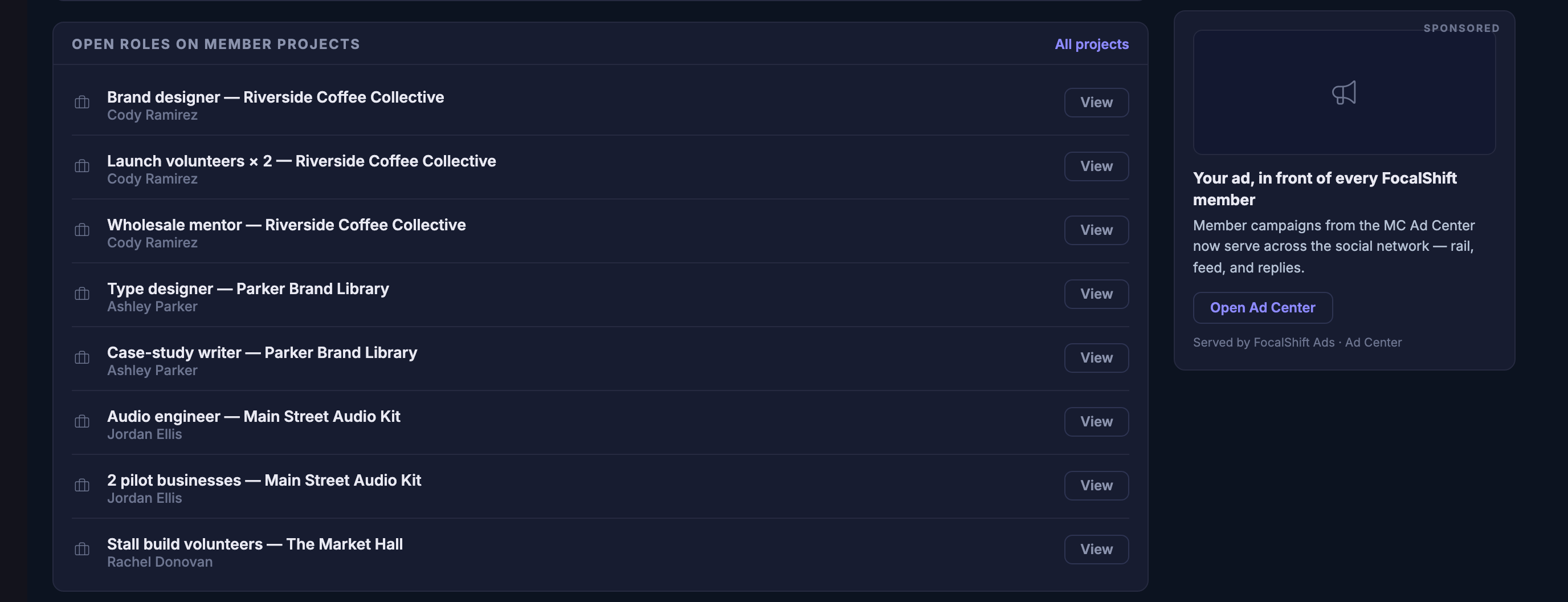
Open roles on member projects: the parts of other people’s live work that are waiting for somebody. Each row names the role and the project it belongs to — a brand designer and a wholesale mentor on one member’s coffee collective, a type designer and a case-study writer on another’s brand library, an audio engineer on a third’s audio kit, volunteers to build a stall at a market hall — with the member running the project underneath and a control that opens it. Across the top, the way through to every project on the network. In the right-hand column, the platform’s own slot offering a member’s campaign a place in front of the whole network, with the way through to the Ad Center it is run from.Open roles on member projects: the parts of other people’s live work that are waiting for somebody. Each row names the role and the project it belongs to — a brand designer and a wholesale mentor on one member’s coffee collective, a type designer and a case-study writer on another’s brand library, an audio engineer on a third’s audio kit, volunteers to build a stall at a market hall — with the member running the project underneath and a control that opens it. Across the top, the way through to every project on the network. In the right-hand column, the platform’s own slot offering a member’s campaign a place in front of the whole network, with the way through to the Ad Center it is run from.

Assumi

Chiudi
The top of the Hire screen, headed agent matchmaking. On the left, the question — who are you looking to hire — over a line explaining that answering two questions sets your Maven searching the for-hire pool by verified collaborations and finished work rather than by résumés, and that it brokers the introduction afterwards. Beneath that the two questions themselves: a box for what you are looking to hire for, showing the kind of thing somebody might type into it, and a row of trades to say which one you are in, with one of them chosen. Under them the indigo control that asks Maven to recommend, and beside it the plainer offer to browse the pool yourself, noting that Maven reads the same record either way. On the right, a ring of members drawn as hexagons around one at the centre with dotted lines running between them, over a note that some of them are already people this member knows and that following more grows the map, and an invitation to open any of their cards. The whole band is set in the deep navy the product uses for this screen in both themes.The top of the Hire screen, headed agent matchmaking. On the left, the question — who are you looking to hire — over a line explaining that answering two questions sets your Maven searching the for-hire pool by verified collaborations and finished work rather than by résumés, and that it brokers the introduction afterwards. Beneath that the two questions themselves: a box for what you are looking to hire for, showing the kind of thing somebody might type into it, and a row of trades to say which one you are in, with one of them chosen. Under them the indigo control that asks Maven to recommend, and beside it the plainer offer to browse the pool yourself, noting that Maven reads the same record either way. On the right, a ring of members drawn as hexagons around one at the centre with dotted lines running between them, over a note that some of them are already people this member knows and that following more grows the map, and an invitation to open any of their cards. The whole band is set in the deep navy the product uses for this screen in both themes.

Assumi

Chiudi
The for-hire pool, listed in full beside the panel that explains the matching. Each person is a row: a photograph, their name and the level they have reached, a line saying what they do and where they are, and the skills they put themselves forward for; on the right of the row, how many collaborations of theirs have been verified — two of the six have none yet and their rows say so — and three controls, one asking Maven about them, one opening a message and one sending them to the member’s own team for an opinion. Down the right-hand side, how the matchmaking works in four steps: tell your Maven the job, Maven reads the record, you get a shortlist with its reasoning shown and nothing sponsored in it, and your team weighs in through a decision room where the owner still decides. Beneath that, the panel confirming this member is listed in the pool, with the control that takes them back out of it, and a note that a candidate can be sent to a decision room where the votes and the reasons are kept.The for-hire pool, listed in full beside the panel that explains the matching. Each person is a row: a photograph, their name and the level they have reached, a line saying what they do and where they are, and the skills they put themselves forward for; on the right of the row, how many collaborations of theirs have been verified — two of the six have none yet and their rows say so — and three controls, one asking Maven about them, one opening a message and one sending them to the member’s own team for an opinion. Down the right-hand side, how the matchmaking works in four steps: tell your Maven the job, Maven reads the record, you get a shortlist with its reasoning shown and nothing sponsored in it, and your team weighs in through a decision room where the owner still decides. Beneath that, the panel confirming this member is listed in the pool, with the control that takes them back out of it, and a note that a candidate can be sent to a decision room where the votes and the reasons are kept.

Assumi

Chiudi
Open roles on member projects: the parts of other people’s live work that are waiting for somebody. Each row names the role and the project it belongs to — a brand designer and a wholesale mentor on one member’s coffee collective, a type designer and a case-study writer on another’s brand library, an audio engineer on a third’s audio kit, volunteers to build a stall at a market hall — with the member running the project underneath and a control that opens it. Across the top, the way through to every project on the network. In the right-hand column, the platform’s own slot offering a member’s campaign a place in front of the whole network, with the way through to the Ad Center it is run from.Open roles on member projects: the parts of other people’s live work that are waiting for somebody. Each row names the role and the project it belongs to — a brand designer and a wholesale mentor on one member’s coffee collective, a type designer and a case-study writer on another’s brand library, an audio engineer on a third’s audio kit, volunteers to build a stall at a market hall — with the member running the project underneath and a control that opens it. Across the top, the way through to every project on the network. In the right-hand column, the platform’s own slot offering a member’s campaign a place in front of the whole network, with the way through to the Ad Center it is run from.

A look inside Hire

Stills from the product, one after the next.

The top of the Hire screen, headed agent matchmaking. On the left, the question — who are you looking to hire — over a line explaining that answering two questions sets your Maven searching the for-hire pool by verified collaborations and finished work rather than by résumés, and that it brokers the introduction afterwards. Beneath that the two questions themselves: a box for what you are looking to hire for, showing the kind of thing somebody might type into it, and a row of trades to say which one you are in, with one of them chosen. Under them the indigo control that asks Maven to recommend, and beside it the plainer offer to browse the pool yourself, noting that Maven reads the same record either way. On the right, a ring of members drawn as hexagons around one at the centre with dotted lines running between them, over a note that some of them are already people this member knows and that following more grows the map, and an invitation to open any of their cards. The whole band is set in the deep navy the product uses for this screen in both themes.The top of the Hire screen, headed agent matchmaking. On the left, the question — who are you looking to hire — over a line explaining that answering two questions sets your Maven searching the for-hire pool by verified collaborations and finished work rather than by résumés, and that it brokers the introduction afterwards. Beneath that the two questions themselves: a box for what you are looking to hire for, showing the kind of thing somebody might type into it, and a row of trades to say which one you are in, with one of them chosen. Under them the indigo control that asks Maven to recommend, and beside it the plainer offer to browse the pool yourself, noting that Maven reads the same record either way. On the right, a ring of members drawn as hexagons around one at the centre with dotted lines running between them, over a note that some of them are already people this member knows and that following more grows the map, and an invitation to open any of their cards. The whole band is set in the deep navy the product uses for this screen in both themes.
The for-hire pool, listed in full beside the panel that explains the matching. Each person is a row: a photograph, their name and the level they have reached, a line saying what they do and where they are, and the skills they put themselves forward for; on the right of the row, how many collaborations of theirs have been verified — two of the six have none yet and their rows say so — and three controls, one asking Maven about them, one opening a message and one sending them to the member’s own team for an opinion. Down the right-hand side, how the matchmaking works in four steps: tell your Maven the job, Maven reads the record, you get a shortlist with its reasoning shown and nothing sponsored in it, and your team weighs in through a decision room where the owner still decides. Beneath that, the panel confirming this member is listed in the pool, with the control that takes them back out of it, and a note that a candidate can be sent to a decision room where the votes and the reasons are kept.The for-hire pool, listed in full beside the panel that explains the matching. Each person is a row: a photograph, their name and the level they have reached, a line saying what they do and where they are, and the skills they put themselves forward for; on the right of the row, how many collaborations of theirs have been verified — two of the six have none yet and their rows say so — and three controls, one asking Maven about them, one opening a message and one sending them to the member’s own team for an opinion. Down the right-hand side, how the matchmaking works in four steps: tell your Maven the job, Maven reads the record, you get a shortlist with its reasoning shown and nothing sponsored in it, and your team weighs in through a decision room where the owner still decides. Beneath that, the panel confirming this member is listed in the pool, with the control that takes them back out of it, and a note that a candidate can be sent to a decision room where the votes and the reasons are kept.
Open roles on member projects: the parts of other people’s live work that are waiting for somebody. Each row names the role and the project it belongs to — a brand designer and a wholesale mentor on one member’s coffee collective, a type designer and a case-study writer on another’s brand library, an audio engineer on a third’s audio kit, volunteers to build a stall at a market hall — with the member running the project underneath and a control that opens it. Across the top, the way through to every project on the network. In the right-hand column, the platform’s own slot offering a member’s campaign a place in front of the whole network, with the way through to the Ad Center it is run from.Open roles on member projects: the parts of other people’s live work that are waiting for somebody. Each row names the role and the project it belongs to — a brand designer and a wholesale mentor on one member’s coffee collective, a type designer and a case-study writer on another’s brand library, an audio engineer on a third’s audio kit, volunteers to build a stall at a market hall — with the member running the project underneath and a control that opens it. Across the top, the way through to every project on the network. In the right-hand column, the platform’s own slot offering a member’s campaign a place in front of the whole network, with the way through to the Ad Center it is run from.
Two people reaching around a giant phone to pass message cards to each other, a magnet above them

See it in your own business.

Everything on this page comes with the platform — start free and try it on your real work.

Get started now

Next Up: Customizations & Requests

Ask for the thing the platform does not do yet.

Chiedi a Maven