














Nachrichten

This is the product's own frame. Your conversations appear here once you have an account.

Get started now
Benachrichtigungen

This is the product's own frame. Alerts about your business appear here once you have an account.

Deutsch

Your calendar, booking itself.

They pick the time. You keep the day.

Bookings & Calendar

Turn open time into momentum.

Kai finds your service, chooses a time, and arrives ready. FocalShift protects your availability, confirms the booking, and carries the appointment into the calendar, contact, and workflow that come next.

Create your booking page One booking. The whole business stays connected.
Brand Direction Session · 2:00 PMKai chose the service, completed the intake, and received the confirmation.
Calendar updated

The idea, drawn

Open time is the only thing you cannot get back.

A booking is not a calendar entry. It is a customer deciding, a slot closing, a reminder going out, a record being written and a follow–up waiting on the other side. Bookings is all of that as one motion.

Open time on a week, claimed and confirmed

Drawn: a week with real open time on it, one slot claimed, and the confirmation that closes the loop.

Your availability is protected

Hours, buffers and the things you do not want back–to–back are rules, not hopes.

The customer arrives ready

What you need to know is asked at the moment of booking, while they are still paying attention.

It does not end at the appointment

The booking becomes a contact, a record and a next step, so the relationship keeps going after the meeting ends.

The offer comes first

They book the right work—not just an empty hour.

Define the service, provider, duration, price, capacity, and questions once. The public booking experience carries those rules from first click to confirmation.

Public booking experienceBrand Direction Session
45 min
$175 · 1 place
LeistungAnbieterDate & timeYour detailsBestätigen
What would make this session useful?Launch positioning and visual direction
Reference filebrand-notes.pdf
Preferred providerHans
AgreementSigned before confirmation
Availability with boundaries

Open the right hours. Protect everything else.

Business hours set the baseline. Provider shifts, buffers, minimum notice, daily limits, holidays, and blocked dates keep the calendar useful to the people doing the work.

15-minute buffers, 24-hour notice, and Friday afternoon protected.

Mo
Di
Mi
Do
Fr

Maven adds this one: every other screen in the module tells you what is booked — this is the one that shows you the shape of the month it is booked into.

Buchungskalender

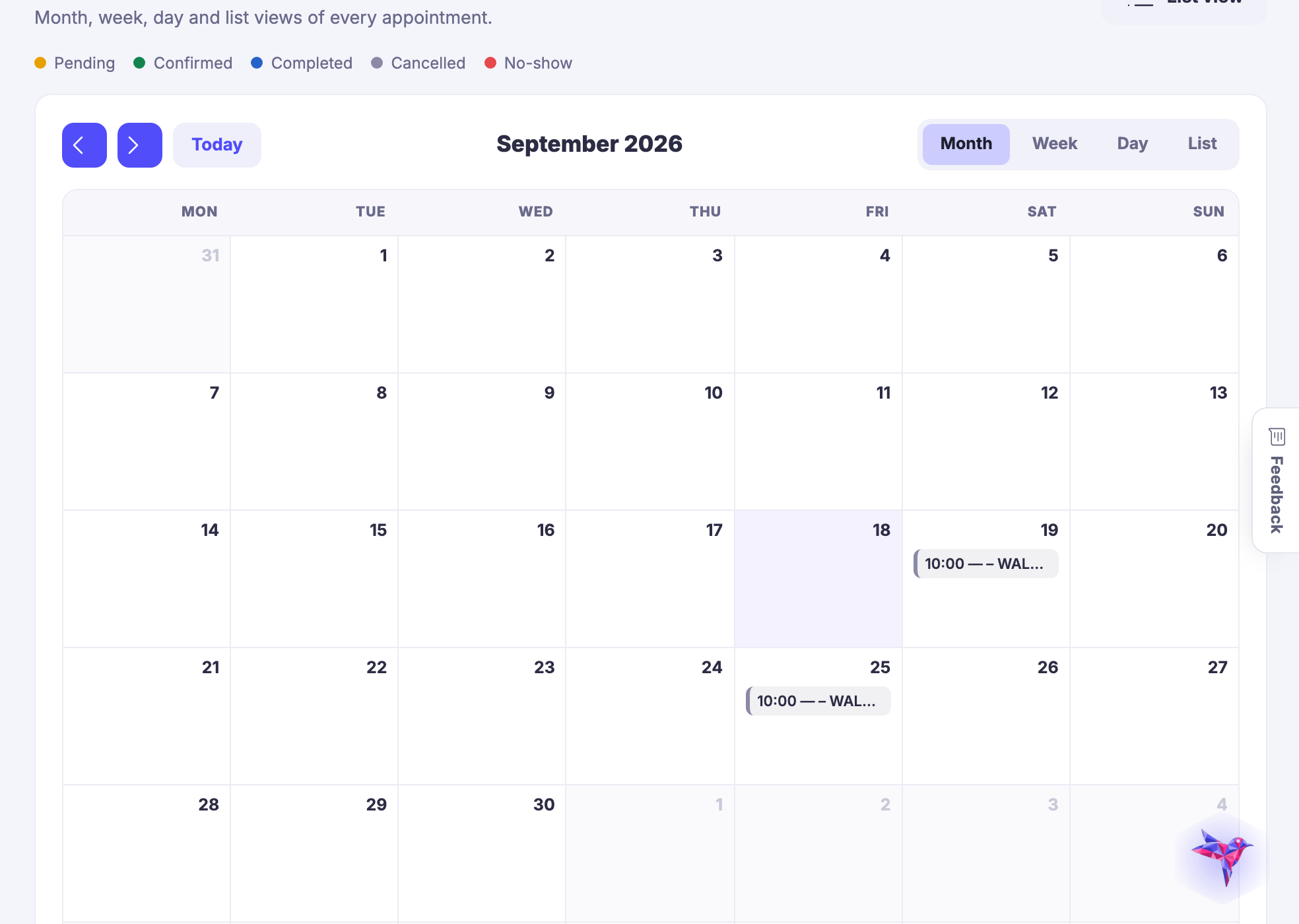
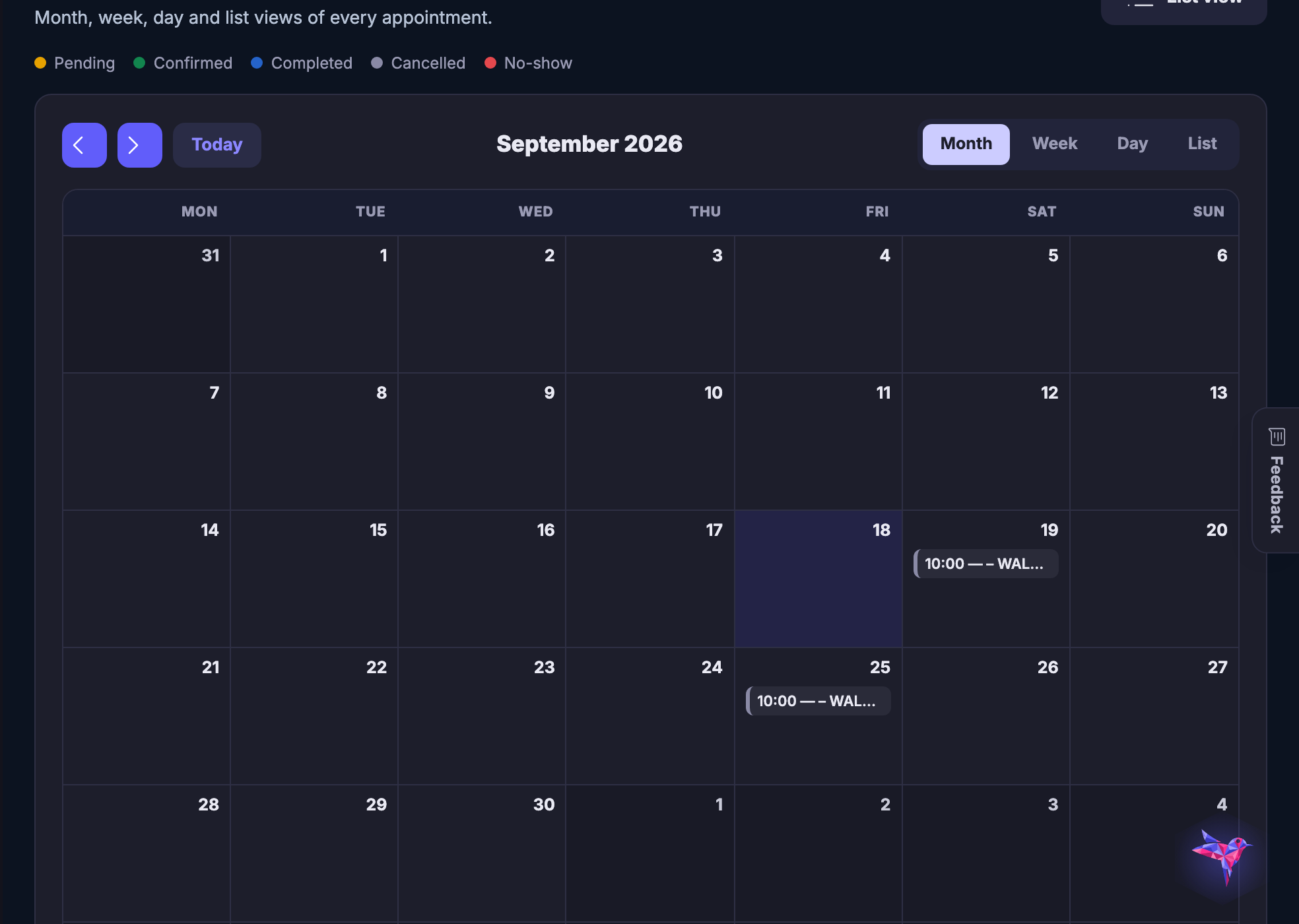
Every appointment you have sold, laid into the month it belongs to — and the same set as a week, a day or a plain list the moment the month is the wrong question.
The month, the week, the day, or a listFour ways of looking at one set of appointments, and you switch between them without going anywhere: the month when you are planning, the week when you are working, the day when you are running it, and a list when you would rather just read down it.
Where every booking stands, as a colourPending, confirmed, completed, cancelled and the ones where nobody came each carry their own small dot, named above the grid. The state of the month is something you see at a glance rather than something you count.
One grid for every service and every providerWhoever is taking the work and whatever they are taking, it lands in the same month — not one calendar per person, reconciled on a Friday evening.
Read more about Booking Calendar

The month your booked hours actually landed in — and the three other ways to read the same set.

The Booking Calendar is the second of the module’s two run-the-day screens, and it answers a different question from the first. The list tells you what is booked; the calendar tells you the shape of the time it was booked into — where the work clusters, which days are untouched, and what next week already looks like before you promise anybody anything.

One set of appointments, four ways to read it. Month while you are planning, week while you are working, day while you are running it, and a plain list when reading down it beats looking at it. Every service and every provider lands in the same grid, so the month is the whole business rather than one person’s diary.

Where a booking stands is a colour, not a click. Pending, confirmed, completed, cancelled and the ones where nobody came each own a dot, named above the grid, so a month that is going wrong looks wrong. Nothing has to be opened to be understood.

And what fills this month is decided upstream, on the section this card points at. The hours you open, the buffer between them, the notice you insist on, the daily limit, the days you block — those rules decide which times a customer is ever offered. The calendar is where you find out whether the boundaries you set were the right ones.

What it actually does

  • Month, week, day and list views of the same set of appointments
  • Every service and every provider in one grid, not one calendar each
  • Pending, confirmed, completed, cancelled and no-show, each a named dot

What that changes for you

  • You can see the shape of the month before you promise anyone an hour
  • A booking that went wrong looks wrong, without opening it
  • The week you are about to work is the week everybody else is reading

You come away with the month your sold hours actually landed in, and the four ways of reading it.

A look inside Booking Calendar

Bookings — platform screenshots

Real screens from the product. Open any one full size, or switch the set to light or dark.

Schließen
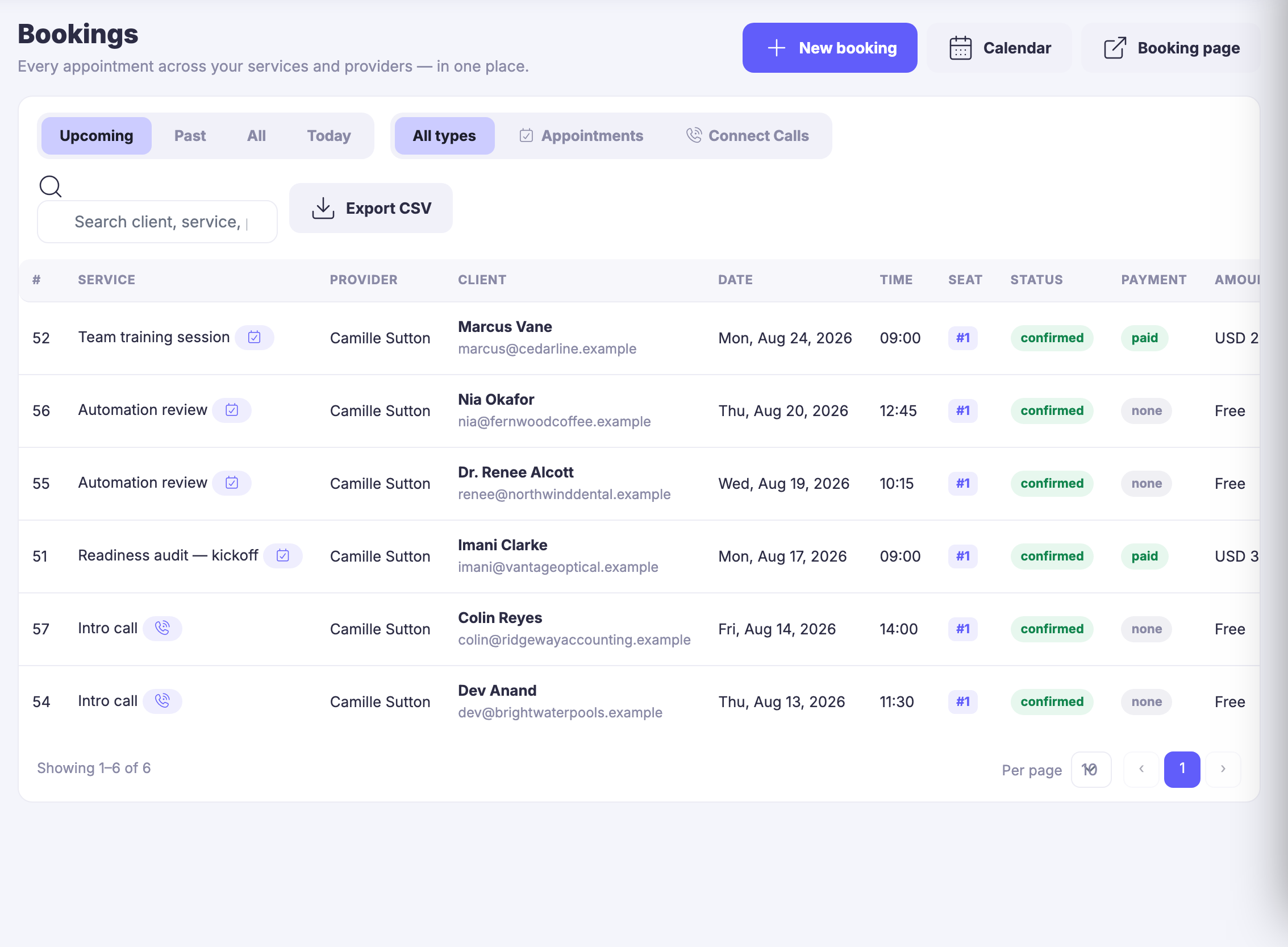
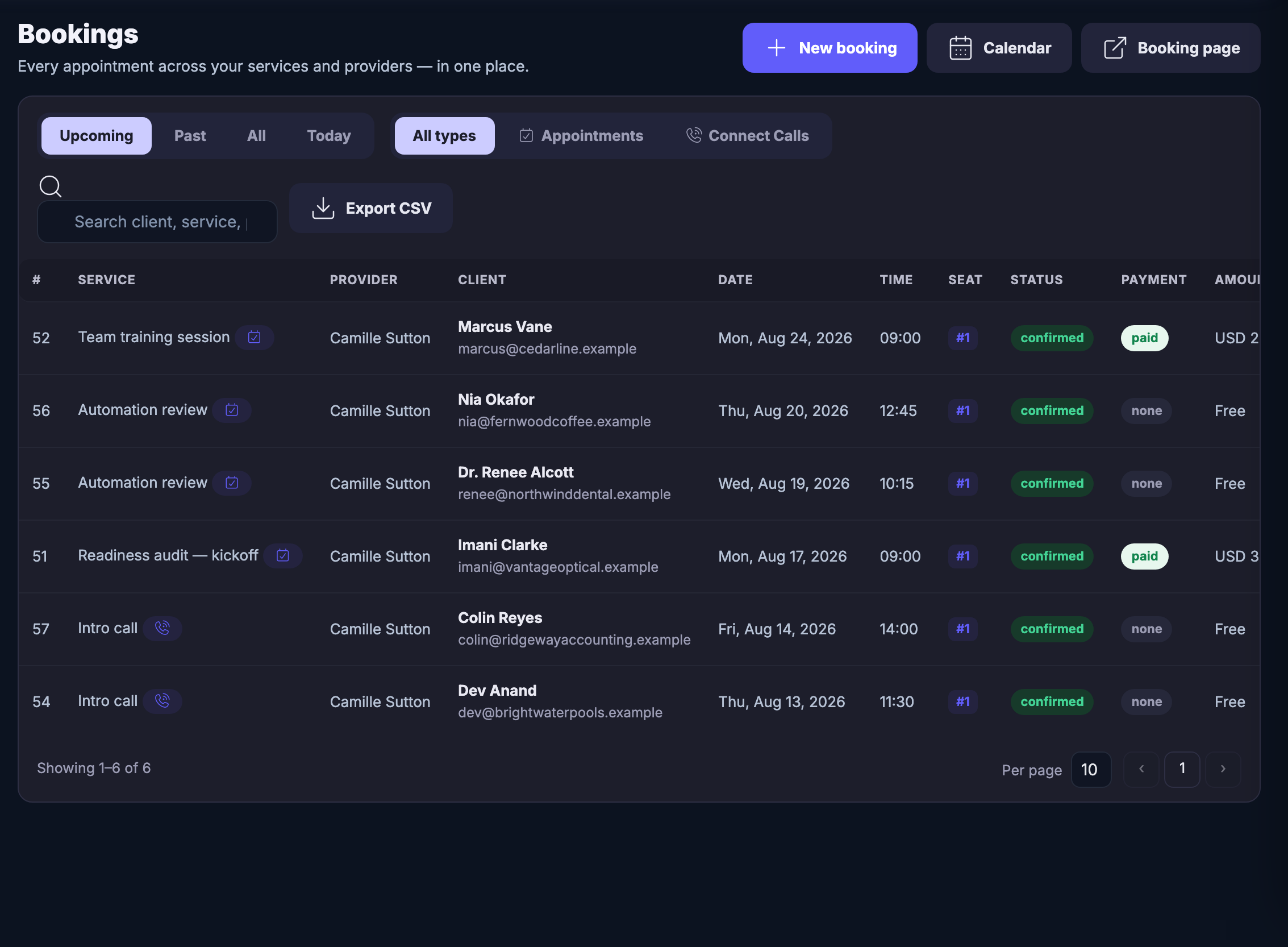
The Bookings list: every appointment across every service and every provider in one table, under the line “Every appointment across your services and providers — in one place.” Filter chips sit above it — upcoming, past, all and today on one side, all types, appointments or connect calls on the other — beside a search box and an export control. Each row carries a reference, the service booked, the provider taking it — Camille Sutton on every row of this seeded account — the client with their email address, the date, the time, the seat, a green confirmed marker, a payment column reading paid on the priced rows and none on the rest, and an amount that runs off the right edge of the window, some rows carrying a price and some reading free.The Bookings list: every appointment across every service and every provider in one table, under the line “Every appointment across your services and providers — in one place.” Filter chips sit above it — upcoming, past, all and today on one side, all types, appointments or connect calls on the other — beside a search box and an export control. Each row carries a reference, the service booked, the provider taking it — Camille Sutton on every row of this seeded account — the client with their email address, the date, the time, the seat, a green confirmed marker, a payment column reading paid on the priced rows and none on the rest, and an amount that runs off the right edge of the window, some rows carrying a price and some reading free.
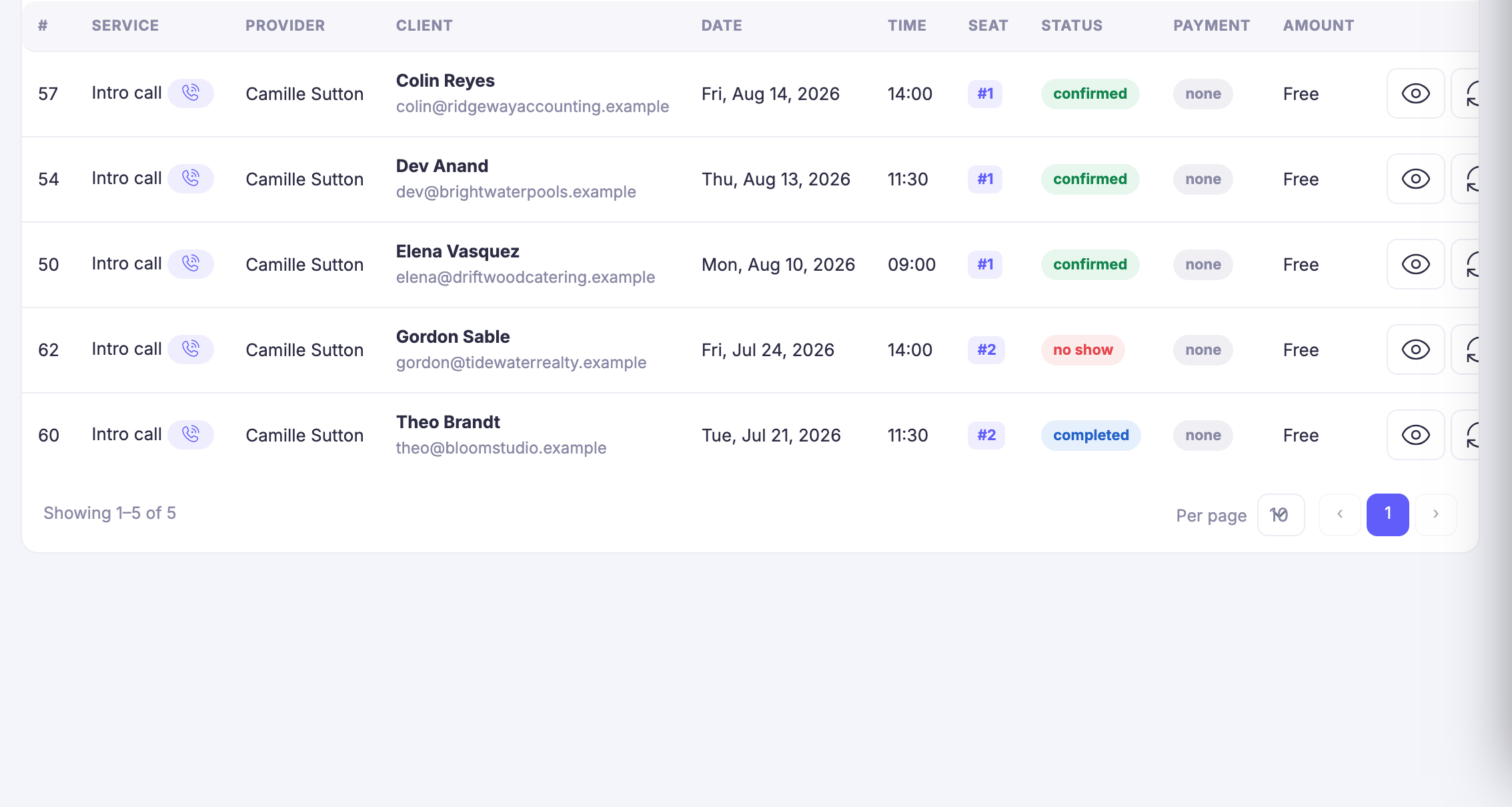
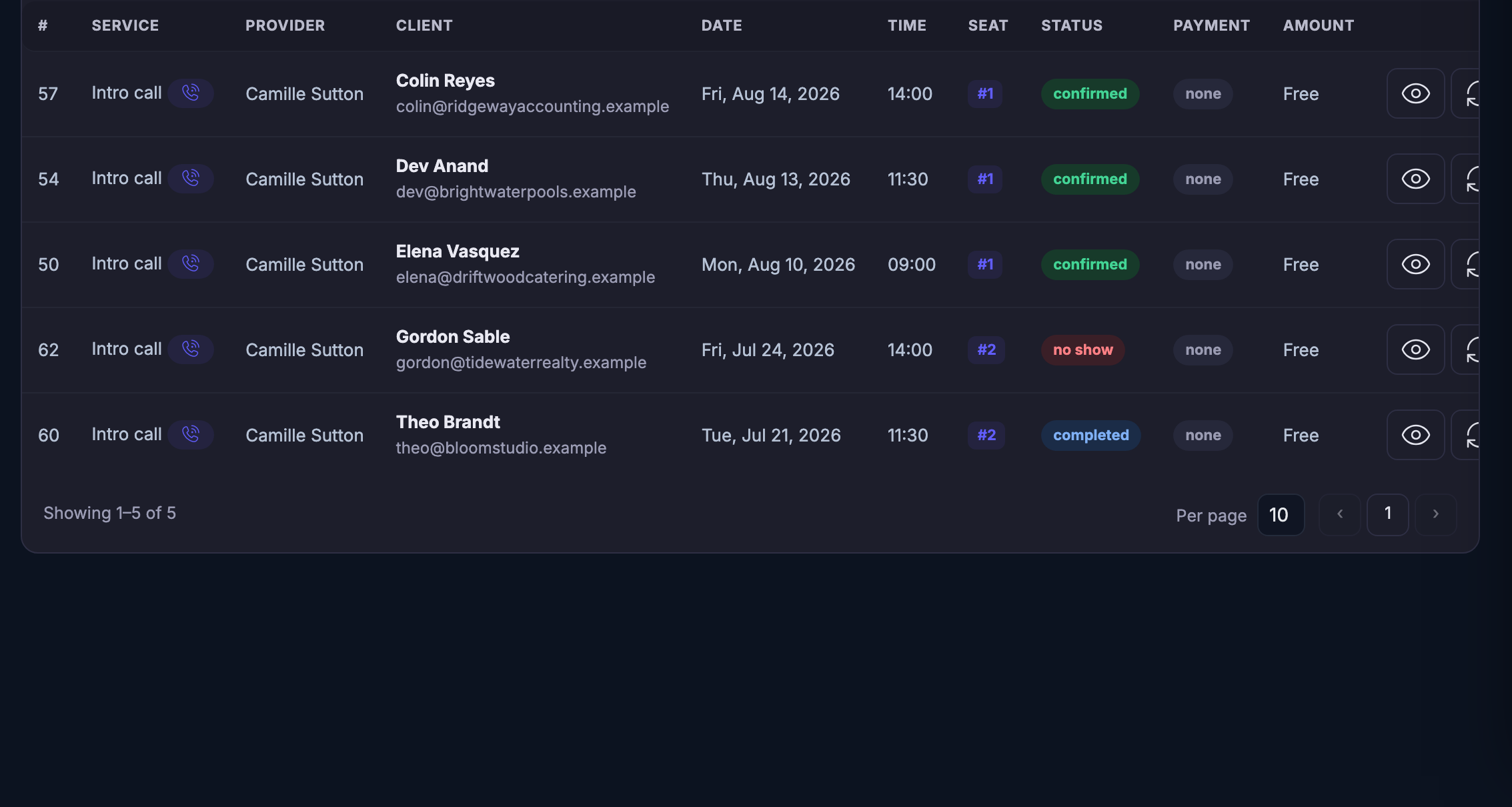
The same Bookings list narrowed to connect calls across every date. A short run of intro calls, each with a small call glyph beside the service and the same provider on every row, the client and their email address, dates behind and ahead of today mixed together, the seat, and a status that changes row to row — confirmed, no show, completed. Payment reads none and the amount reads free on every row. Each row ends with two controls, one to open the booking and one to move it to another time; below the table a line says how many are showing, beside a pager.The same Bookings list narrowed to connect calls across every date. A short run of intro calls, each with a small call glyph beside the service and the same provider on every row, the client and their email address, dates behind and ahead of today mixed together, the seat, and a status that changes row to row — confirmed, no show, completed. Payment reads none and the amount reads free on every row. Each row ends with two controls, one to open the booking and one to move it to another time; below the table a line says how many are showing, beside a pager.

Buchungen

Schließen
The Bookings list: every appointment across every service and every provider in one table, under the line “Every appointment across your services and providers — in one place.” Filter chips sit above it — upcoming, past, all and today on one side, all types, appointments or connect calls on the other — beside a search box and an export control. Each row carries a reference, the service booked, the provider taking it — Camille Sutton on every row of this seeded account — the client with their email address, the date, the time, the seat, a green confirmed marker, a payment column reading paid on the priced rows and none on the rest, and an amount that runs off the right edge of the window, some rows carrying a price and some reading free.The Bookings list: every appointment across every service and every provider in one table, under the line “Every appointment across your services and providers — in one place.” Filter chips sit above it — upcoming, past, all and today on one side, all types, appointments or connect calls on the other — beside a search box and an export control. Each row carries a reference, the service booked, the provider taking it — Camille Sutton on every row of this seeded account — the client with their email address, the date, the time, the seat, a green confirmed marker, a payment column reading paid on the priced rows and none on the rest, and an amount that runs off the right edge of the window, some rows carrying a price and some reading free.

Buchungen

Schließen
The same Bookings list narrowed to connect calls across every date. A short run of intro calls, each with a small call glyph beside the service and the same provider on every row, the client and their email address, dates behind and ahead of today mixed together, the seat, and a status that changes row to row — confirmed, no show, completed. Payment reads none and the amount reads free on every row. Each row ends with two controls, one to open the booking and one to move it to another time; below the table a line says how many are showing, beside a pager.The same Bookings list narrowed to connect calls across every date. A short run of intro calls, each with a small call glyph beside the service and the same provider on every row, the client and their email address, dates behind and ahead of today mixed together, the seat, and a status that changes row to row — confirmed, no show, completed. Payment reads none and the amount reads free on every row. Each row ends with two controls, one to open the booking and one to move it to another time; below the table a line says how many are showing, beside a pager.

A look inside Bookings

Stills from the product, one after the next.

The Bookings list: every appointment across every service and every provider in one table, under the line “Every appointment across your services and providers — in one place.” Filter chips sit above it — upcoming, past, all and today on one side, all types, appointments or connect calls on the other — beside a search box and an export control. Each row carries a reference, the service booked, the provider taking it — Camille Sutton on every row of this seeded account — the client with their email address, the date, the time, the seat, a green confirmed marker, a payment column reading paid on the priced rows and none on the rest, and an amount that runs off the right edge of the window, some rows carrying a price and some reading free.The Bookings list: every appointment across every service and every provider in one table, under the line “Every appointment across your services and providers — in one place.” Filter chips sit above it — upcoming, past, all and today on one side, all types, appointments or connect calls on the other — beside a search box and an export control. Each row carries a reference, the service booked, the provider taking it — Camille Sutton on every row of this seeded account — the client with their email address, the date, the time, the seat, a green confirmed marker, a payment column reading paid on the priced rows and none on the rest, and an amount that runs off the right edge of the window, some rows carrying a price and some reading free.
The same Bookings list narrowed to connect calls across every date. A short run of intro calls, each with a small call glyph beside the service and the same provider on every row, the client and their email address, dates behind and ahead of today mixed together, the seat, and a status that changes row to row — confirmed, no show, completed. Payment reads none and the amount reads free on every row. Each row ends with two controls, one to open the booking and one to move it to another time; below the table a line says how many are showing, beside a pager.The same Bookings list narrowed to connect calls across every date. A short run of intro calls, each with a small call glyph beside the service and the same provider on every row, the client and their email address, dates behind and ahead of today mixed together, the seat, and a status that changes row to row — confirmed, no show, completed. Payment reads none and the amount reads free on every row. Each row ends with two controls, one to open the booking and one to move it to another time; below the table a line says how many are showing, beside a pager.

My Booking Page — platform screenshots

Real screens from the product. Open any one full size, or switch the set to light or dark.

Schließen
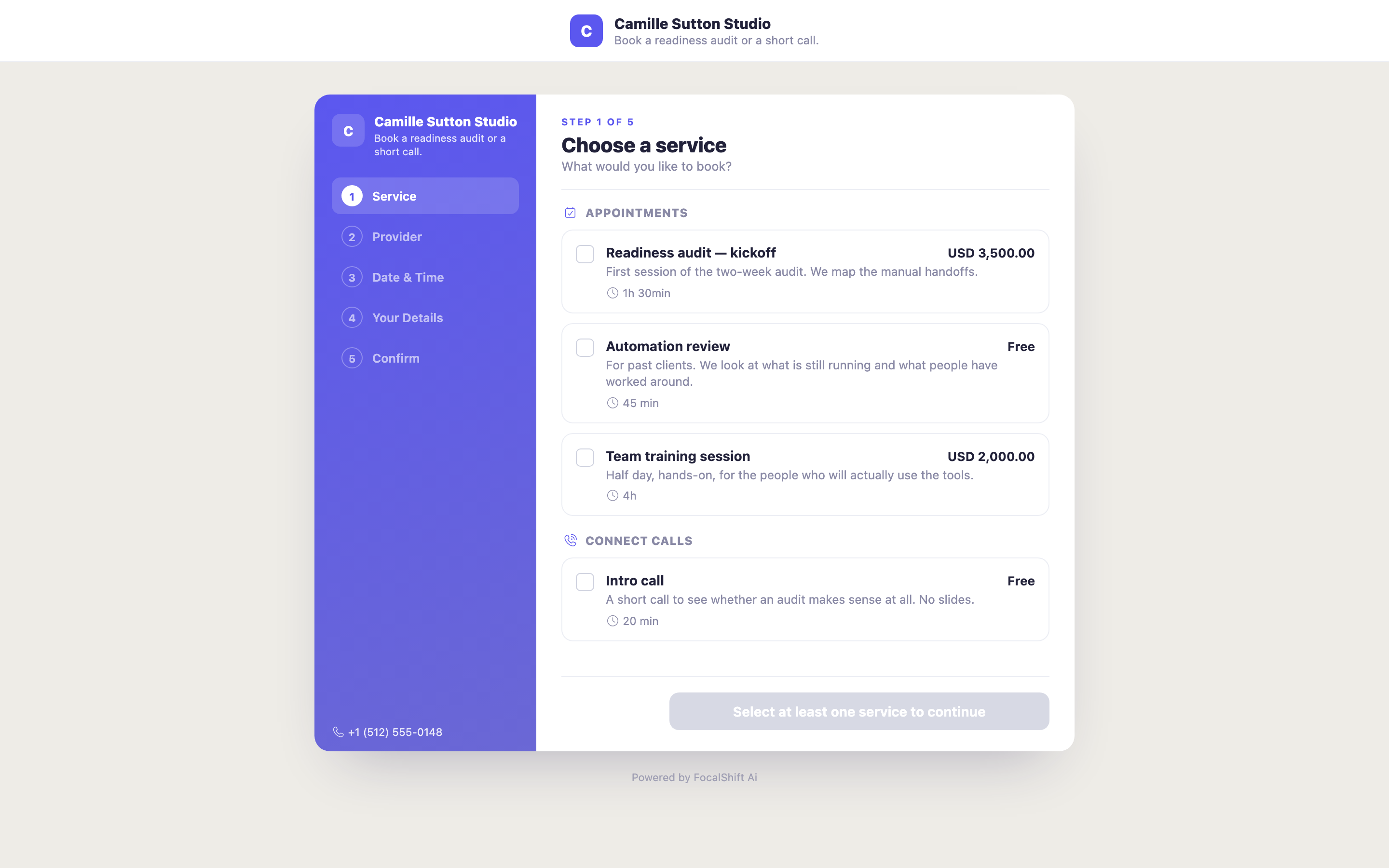
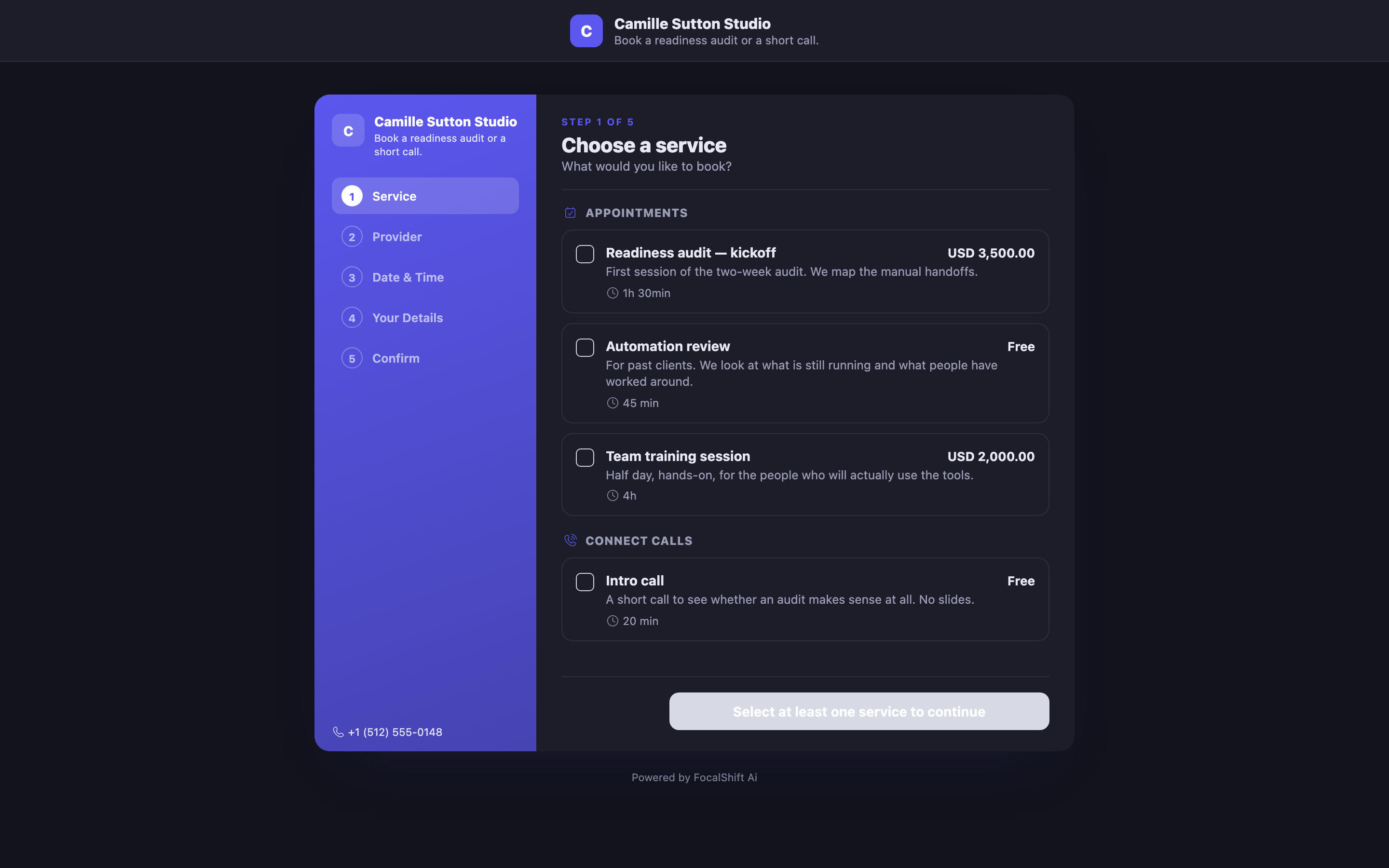
The public booking page as a customer sees it, logged out, wearing the demo business’s own name and a one-line invitation to book a readiness audit or a short call. A deep-violet sidebar counts five numbered steps — service, provider, date and time, your details, confirm — with the business’s phone number at its foot. The open step asks what the visitor would like to book and lists four services in two groups, appointments and connect calls: each row carries the service name, a one-line description and its length, with a tick box beside it; two carry a price in dollars and two read free. The continue control below stays grey and reads that at least one service must be selected to continue. Under the card a line reads Powered by FocalShift.The public booking page as a customer sees it, logged out, wearing the demo business’s own name and a one-line invitation to book a readiness audit or a short call. A deep-violet sidebar counts five numbered steps — service, provider, date and time, your details, confirm — with the business’s phone number at its foot. The open step asks what the visitor would like to book and lists four services in two groups, appointments and connect calls: each row carries the service name, a one-line description and its length, with a tick box beside it; two carry a price in dollars and two read free. The continue control below stays grey and reads that at least one service must be selected to continue. Under the card a line reads Powered by FocalShift.
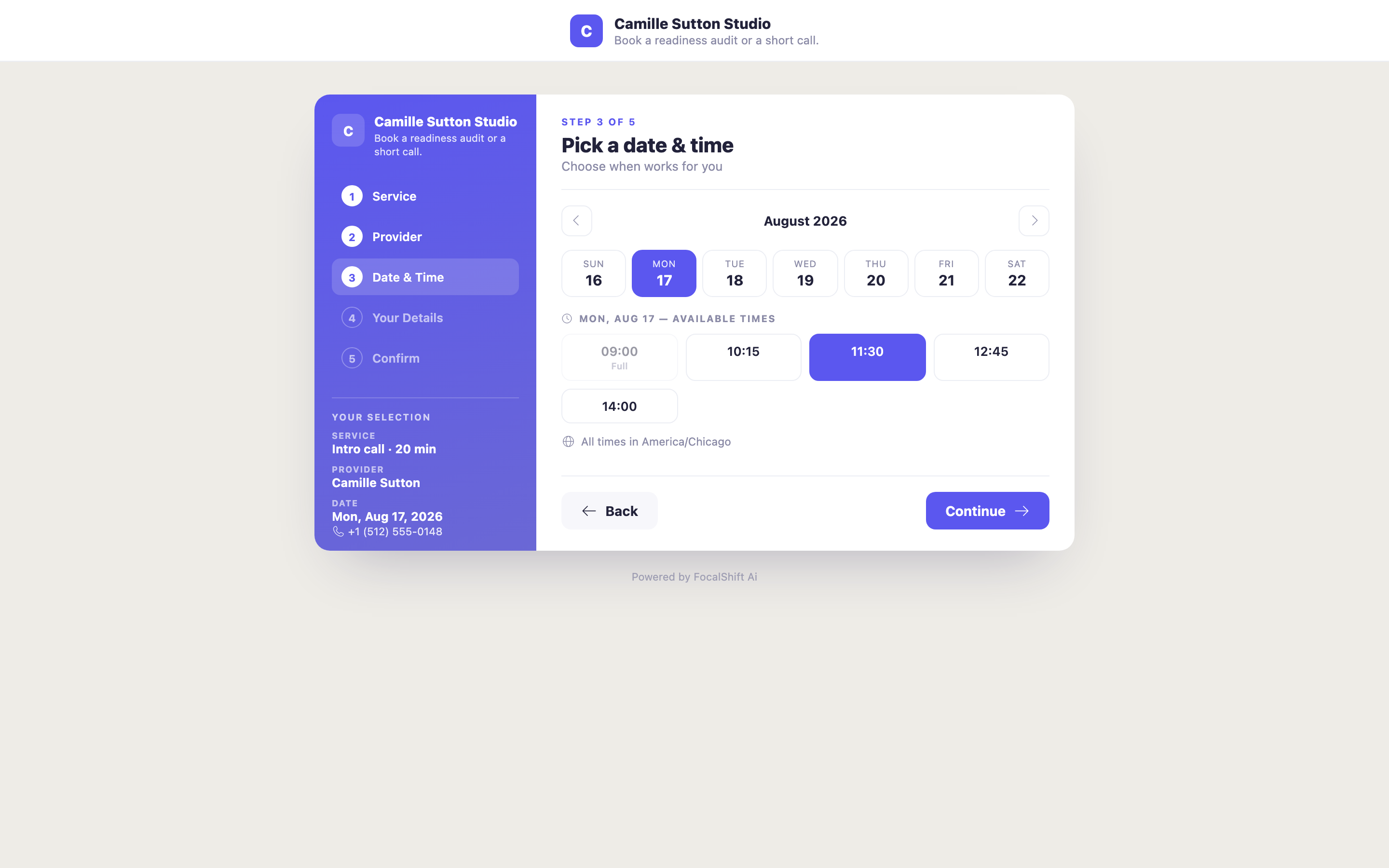
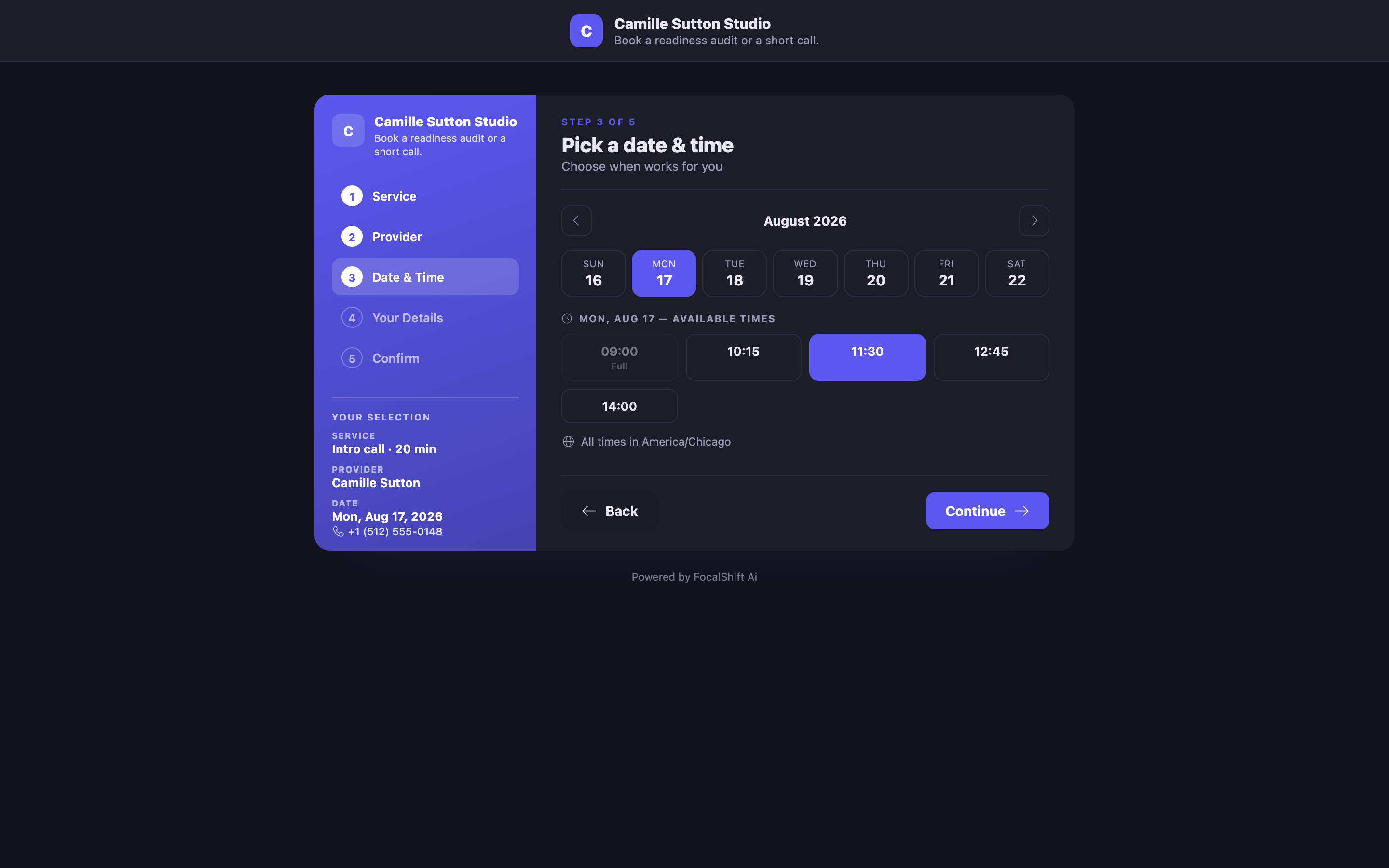
The same public page at the date-and-time step, after a free intro call has been chosen. The sidebar now carries the visitor’s selection — the service and its length, the provider, and the chosen day in August — above the phone number. The panel shows one August week as a strip of day cards, the chosen day filled violet, then a row of available times for that day: one selected in violet, one greyed and marked full, the others open, over a note naming the American timezone all times are shown in. Back and continue controls close the panel, and the same powered-by line sits under the card.The same public page at the date-and-time step, after a free intro call has been chosen. The sidebar now carries the visitor’s selection — the service and its length, the provider, and the chosen day in August — above the phone number. The panel shows one August week as a strip of day cards, the chosen day filled violet, then a row of available times for that day: one selected in violet, one greyed and marked full, the others open, over a note naming the American timezone all times are shown in. Back and continue controls close the panel, and the same powered-by line sits under the card.

Meine Buchungsseite

Schließen
The public booking page as a customer sees it, logged out, wearing the demo business’s own name and a one-line invitation to book a readiness audit or a short call. A deep-violet sidebar counts five numbered steps — service, provider, date and time, your details, confirm — with the business’s phone number at its foot. The open step asks what the visitor would like to book and lists four services in two groups, appointments and connect calls: each row carries the service name, a one-line description and its length, with a tick box beside it; two carry a price in dollars and two read free. The continue control below stays grey and reads that at least one service must be selected to continue. Under the card a line reads Powered by FocalShift.The public booking page as a customer sees it, logged out, wearing the demo business’s own name and a one-line invitation to book a readiness audit or a short call. A deep-violet sidebar counts five numbered steps — service, provider, date and time, your details, confirm — with the business’s phone number at its foot. The open step asks what the visitor would like to book and lists four services in two groups, appointments and connect calls: each row carries the service name, a one-line description and its length, with a tick box beside it; two carry a price in dollars and two read free. The continue control below stays grey and reads that at least one service must be selected to continue. Under the card a line reads Powered by FocalShift.

Meine Buchungsseite

Schließen
The same public page at the date-and-time step, after a free intro call has been chosen. The sidebar now carries the visitor’s selection — the service and its length, the provider, and the chosen day in August — above the phone number. The panel shows one August week as a strip of day cards, the chosen day filled violet, then a row of available times for that day: one selected in violet, one greyed and marked full, the others open, over a note naming the American timezone all times are shown in. Back and continue controls close the panel, and the same powered-by line sits under the card.The same public page at the date-and-time step, after a free intro call has been chosen. The sidebar now carries the visitor’s selection — the service and its length, the provider, and the chosen day in August — above the phone number. The panel shows one August week as a strip of day cards, the chosen day filled violet, then a row of available times for that day: one selected in violet, one greyed and marked full, the others open, over a note naming the American timezone all times are shown in. Back and continue controls close the panel, and the same powered-by line sits under the card.

A look inside My Booking Page

Stills from the product, one after the next.

The public booking page as a customer sees it, logged out, wearing the demo business’s own name and a one-line invitation to book a readiness audit or a short call. A deep-violet sidebar counts five numbered steps — service, provider, date and time, your details, confirm — with the business’s phone number at its foot. The open step asks what the visitor would like to book and lists four services in two groups, appointments and connect calls: each row carries the service name, a one-line description and its length, with a tick box beside it; two carry a price in dollars and two read free. The continue control below stays grey and reads that at least one service must be selected to continue. Under the card a line reads Powered by FocalShift.The public booking page as a customer sees it, logged out, wearing the demo business’s own name and a one-line invitation to book a readiness audit or a short call. A deep-violet sidebar counts five numbered steps — service, provider, date and time, your details, confirm — with the business’s phone number at its foot. The open step asks what the visitor would like to book and lists four services in two groups, appointments and connect calls: each row carries the service name, a one-line description and its length, with a tick box beside it; two carry a price in dollars and two read free. The continue control below stays grey and reads that at least one service must be selected to continue. Under the card a line reads Powered by FocalShift.
The same public page at the date-and-time step, after a free intro call has been chosen. The sidebar now carries the visitor’s selection — the service and its length, the provider, and the chosen day in August — above the phone number. The panel shows one August week as a strip of day cards, the chosen day filled violet, then a row of available times for that day: one selected in violet, one greyed and marked full, the others open, over a note naming the American timezone all times are shown in. Back and continue controls close the panel, and the same powered-by line sits under the card.The same public page at the date-and-time step, after a free intro call has been chosen. The sidebar now carries the visitor’s selection — the service and its length, the provider, and the chosen day in August — above the phone number. The panel shows one August week as a strip of day cards, the chosen day filled violet, then a row of available times for that day: one selected in violet, one greyed and marked full, the others open, over a note naming the American timezone all times are shown in. Back and continue controls close the panel, and the same powered-by line sits under the card.

The booking form — platform screenshots

Real screens from the product. Open any one full size, or switch the set to light or dark.

Schließen
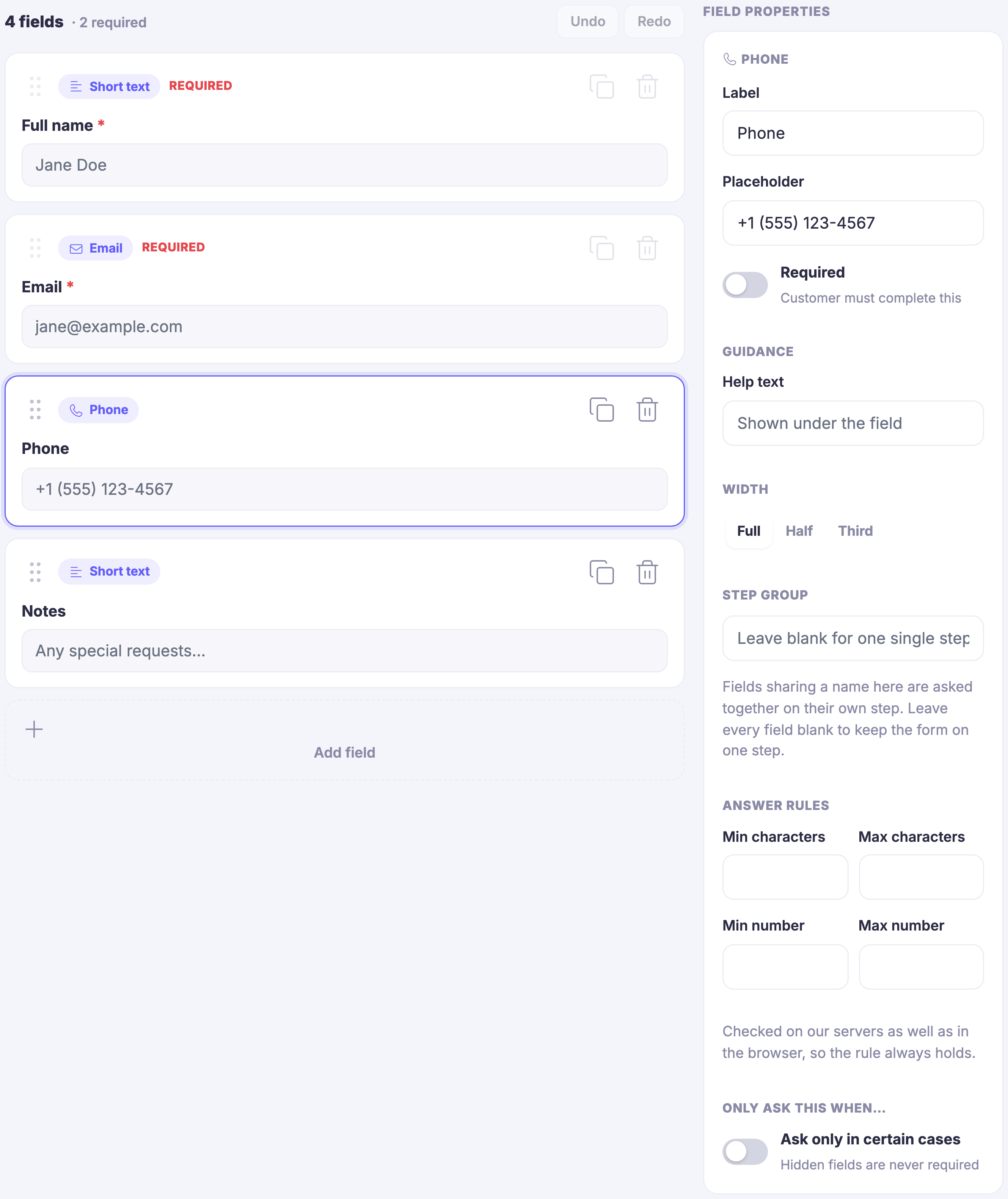
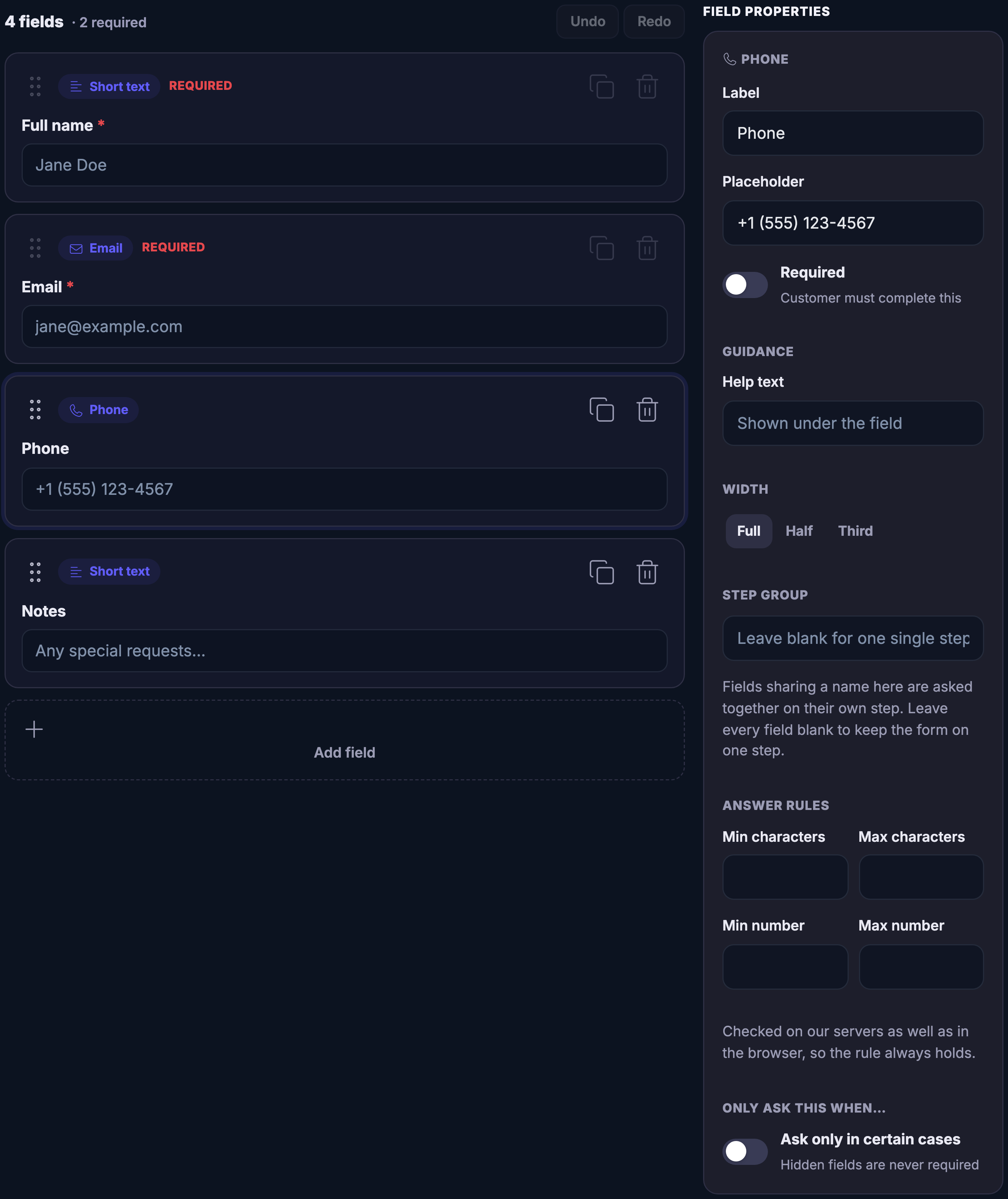
The booking form under composition. A line at the top reads four fields, two of them required, with undo and redo controls opposite. Below it the questions stand as four cards in order: a short-text question labelled Full name, marked required, showing an example name; an email question, also required, showing an example address; a phone question showing an example number; and a short-text question labelled Notes, inviting any special requests. Each card carries a small tag naming its type and, where it is compulsory, a required marker, and the third is outlined in the accent colour because it is the one being edited. Under the last card sits an empty slot for adding another question. Down the right-hand side the field properties panel is open on that phone question and shows its label and its example answer, a switch for whether it must be answered, the help text shown under the field, a choice of full, half or third width, a step-group box with a note that fields sharing a name are asked together on their own step, four answer-rule boxes for shortest and longest answer and smallest and largest number, a line saying the rule is checked on the servers as well as in the browser, and a closing switch for asking the question only in certain cases.The booking form under composition. A line at the top reads four fields, two of them required, with undo and redo controls opposite. Below it the questions stand as four cards in order: a short-text question labelled Full name, marked required, showing an example name; an email question, also required, showing an example address; a phone question showing an example number; and a short-text question labelled Notes, inviting any special requests. Each card carries a small tag naming its type and, where it is compulsory, a required marker, and the third is outlined in the accent colour because it is the one being edited. Under the last card sits an empty slot for adding another question. Down the right-hand side the field properties panel is open on that phone question and shows its label and its example answer, a switch for whether it must be answered, the help text shown under the field, a choice of full, half or third width, a step-group box with a note that fields sharing a name are asked together on their own step, four answer-rule boxes for shortest and longest answer and smallest and largest number, a line saying the rule is checked on the servers as well as in the browser, and a closing switch for asking the question only in certain cases.

The booking form

Schließen
The booking form under composition. A line at the top reads four fields, two of them required, with undo and redo controls opposite. Below it the questions stand as four cards in order: a short-text question labelled Full name, marked required, showing an example name; an email question, also required, showing an example address; a phone question showing an example number; and a short-text question labelled Notes, inviting any special requests. Each card carries a small tag naming its type and, where it is compulsory, a required marker, and the third is outlined in the accent colour because it is the one being edited. Under the last card sits an empty slot for adding another question. Down the right-hand side the field properties panel is open on that phone question and shows its label and its example answer, a switch for whether it must be answered, the help text shown under the field, a choice of full, half or third width, a step-group box with a note that fields sharing a name are asked together on their own step, four answer-rule boxes for shortest and longest answer and smallest and largest number, a line saying the rule is checked on the servers as well as in the browser, and a closing switch for asking the question only in certain cases.The booking form under composition. A line at the top reads four fields, two of them required, with undo and redo controls opposite. Below it the questions stand as four cards in order: a short-text question labelled Full name, marked required, showing an example name; an email question, also required, showing an example address; a phone question showing an example number; and a short-text question labelled Notes, inviting any special requests. Each card carries a small tag naming its type and, where it is compulsory, a required marker, and the third is outlined in the accent colour because it is the one being edited. Under the last card sits an empty slot for adding another question. Down the right-hand side the field properties panel is open on that phone question and shows its label and its example answer, a switch for whether it must be answered, the help text shown under the field, a choice of full, half or third width, a step-group box with a note that fields sharing a name are asked together on their own step, four answer-rule boxes for shortest and longest answer and smallest and largest number, a line saying the rule is checked on the servers as well as in the browser, and a closing switch for asking the question only in certain cases.

A look inside The booking form

Stills from the product, one after the next.

The booking form under composition. A line at the top reads four fields, two of them required, with undo and redo controls opposite. Below it the questions stand as four cards in order: a short-text question labelled Full name, marked required, showing an example name; an email question, also required, showing an example address; a phone question showing an example number; and a short-text question labelled Notes, inviting any special requests. Each card carries a small tag naming its type and, where it is compulsory, a required marker, and the third is outlined in the accent colour because it is the one being edited. Under the last card sits an empty slot for adding another question. Down the right-hand side the field properties panel is open on that phone question and shows its label and its example answer, a switch for whether it must be answered, the help text shown under the field, a choice of full, half or third width, a step-group box with a note that fields sharing a name are asked together on their own step, four answer-rule boxes for shortest and longest answer and smallest and largest number, a line saying the rule is checked on the servers as well as in the browser, and a closing switch for asking the question only in certain cases.The booking form under composition. A line at the top reads four fields, two of them required, with undo and redo controls opposite. Below it the questions stand as four cards in order: a short-text question labelled Full name, marked required, showing an example name; an email question, also required, showing an example address; a phone question showing an example number; and a short-text question labelled Notes, inviting any special requests. Each card carries a small tag naming its type and, where it is compulsory, a required marker, and the third is outlined in the accent colour because it is the one being edited. Under the last card sits an empty slot for adding another question. Down the right-hand side the field properties panel is open on that phone question and shows its label and its example answer, a switch for whether it must be answered, the help text shown under the field, a choice of full, half or third width, a step-group box with a note that fields sharing a name are asked together on their own step, four answer-rule boxes for shortest and longest answer and smallest and largest number, a line saying the rule is checked on the servers as well as in the browser, and a closing switch for asking the question only in certain cases.

Booking Calendar — platform screenshots

Real screens from the product. Open any one full size, or switch the set to light or dark.

Schließen
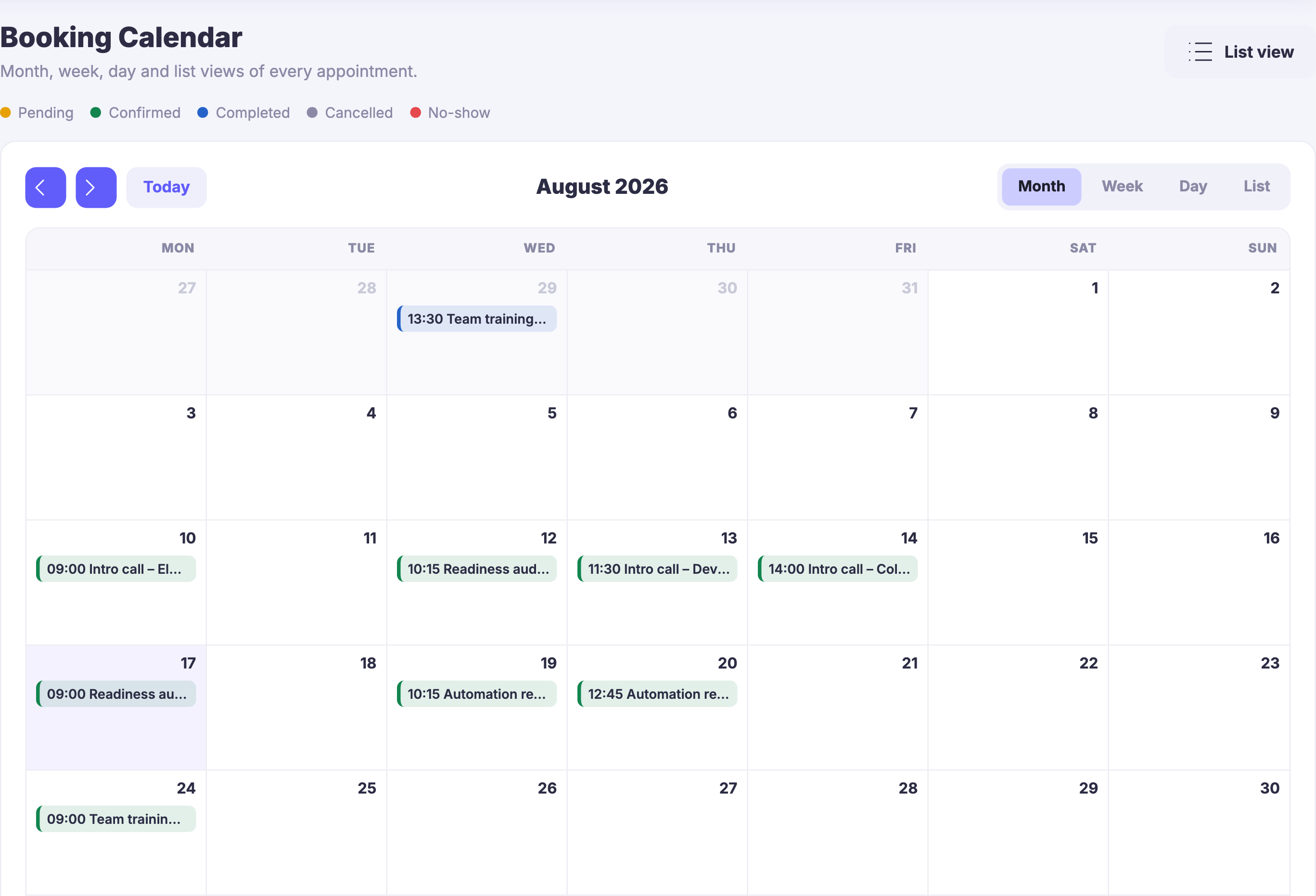
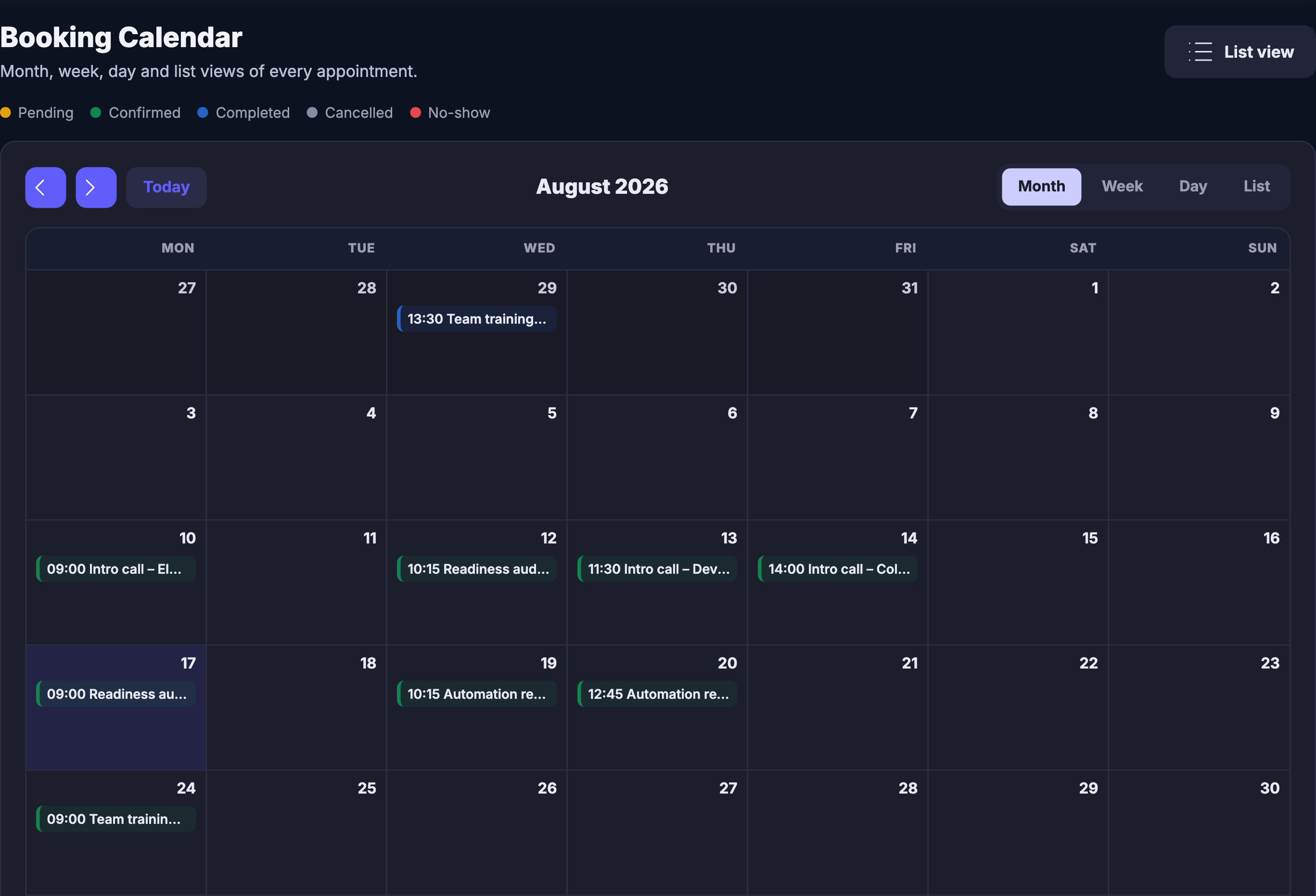
The Booking Calendar. The heading reads Booking Calendar over the line “Month, week, day and list views of every appointment”, and beneath it a key of five small coloured dots names the states a booking can be in — pending in amber, confirmed in green, completed in blue, cancelled in grey, and no-show in red. A control offering a list view sits at the far right. Below that the calendar itself: two arrows side by side and a control that returns to today, the month and year centred above the grid, and the four ways of looking at the same set — month, week, day and list — with month chosen. The grid runs Monday to Sunday, opening on the last days of the previous month; one day carries a pale wash, the day the calendar was open on. Appointments sit in it one to a day, each either confirmed in the green of the key or already completed in the blue, each carrying its start time and as much of its title as the width of the day allows — intro calls with named people, readiness audits, automation reviews and team training. Every other day is empty.The Booking Calendar. The heading reads Booking Calendar over the line “Month, week, day and list views of every appointment”, and beneath it a key of five small coloured dots names the states a booking can be in — pending in amber, confirmed in green, completed in blue, cancelled in grey, and no-show in red. A control offering a list view sits at the far right. Below that the calendar itself: two arrows side by side and a control that returns to today, the month and year centred above the grid, and the four ways of looking at the same set — month, week, day and list — with month chosen. The grid runs Monday to Sunday, opening on the last days of the previous month; one day carries a pale wash, the day the calendar was open on. Appointments sit in it one to a day, each either confirmed in the green of the key or already completed in the blue, each carrying its start time and as much of its title as the width of the day allows — intro calls with named people, readiness audits, automation reviews and team training. Every other day is empty.

Buchungskalender

Schließen
The Booking Calendar. The heading reads Booking Calendar over the line “Month, week, day and list views of every appointment”, and beneath it a key of five small coloured dots names the states a booking can be in — pending in amber, confirmed in green, completed in blue, cancelled in grey, and no-show in red. A control offering a list view sits at the far right. Below that the calendar itself: two arrows side by side and a control that returns to today, the month and year centred above the grid, and the four ways of looking at the same set — month, week, day and list — with month chosen. The grid runs Monday to Sunday, opening on the last days of the previous month; one day carries a pale wash, the day the calendar was open on. Appointments sit in it one to a day, each either confirmed in the green of the key or already completed in the blue, each carrying its start time and as much of its title as the width of the day allows — intro calls with named people, readiness audits, automation reviews and team training. Every other day is empty.The Booking Calendar. The heading reads Booking Calendar over the line “Month, week, day and list views of every appointment”, and beneath it a key of five small coloured dots names the states a booking can be in — pending in amber, confirmed in green, completed in blue, cancelled in grey, and no-show in red. A control offering a list view sits at the far right. Below that the calendar itself: two arrows side by side and a control that returns to today, the month and year centred above the grid, and the four ways of looking at the same set — month, week, day and list — with month chosen. The grid runs Monday to Sunday, opening on the last days of the previous month; one day carries a pale wash, the day the calendar was open on. Appointments sit in it one to a day, each either confirmed in the green of the key or already completed in the blue, each carrying its start time and as much of its title as the width of the day allows — intro calls with named people, readiness audits, automation reviews and team training. Every other day is empty.

A look inside Booking Calendar

Stills from the product, one after the next.

The Booking Calendar. The heading reads Booking Calendar over the line “Month, week, day and list views of every appointment”, and beneath it a key of five small coloured dots names the states a booking can be in — pending in amber, confirmed in green, completed in blue, cancelled in grey, and no-show in red. A control offering a list view sits at the far right. Below that the calendar itself: two arrows side by side and a control that returns to today, the month and year centred above the grid, and the four ways of looking at the same set — month, week, day and list — with month chosen. The grid runs Monday to Sunday, opening on the last days of the previous month; one day carries a pale wash, the day the calendar was open on. Appointments sit in it one to a day, each either confirmed in the green of the key or already completed in the blue, each carrying its start time and as much of its title as the width of the day allows — intro calls with named people, readiness audits, automation reviews and team training. Every other day is empty.The Booking Calendar. The heading reads Booking Calendar over the line “Month, week, day and list views of every appointment”, and beneath it a key of five small coloured dots names the states a booking can be in — pending in amber, confirmed in green, completed in blue, cancelled in grey, and no-show in red. A control offering a list view sits at the far right. Below that the calendar itself: two arrows side by side and a control that returns to today, the month and year centred above the grid, and the four ways of looking at the same set — month, week, day and list — with month chosen. The grid runs Monday to Sunday, opening on the last days of the previous month; one day carries a pale wash, the day the calendar was open on. Appointments sit in it one to a day, each either confirmed in the green of the key or already completed in the blue, each carrying its start time and as much of its title as the width of the day allows — intro calls with named people, readiness audits, automation reviews and team training. Every other day is empty.
One working week

The booking lands beside everything it affects.

See booked sessions beside meetings, content, projects, Academy work, availability, and personal commitments. Toggle the layers without losing the shape of the day.

9 AM
10 AM
11 AM
12 PM
1 PM
2 PM
3 PM
Mo
Launch reviewTeam · 10:00
Campaign approvalContent · 1:00
Di
Anruf verbindenMeeting · 11:00
Personal hold2:00
Mi
Office hoursAcademy · 10:00
Do
Brand DirectionKai · 2:00
Partner call10:00
Fr
Friday recapScheduled send
Hover or tap a layer to isolate it.
The FocalShift difference

The appointment is only the beginning.

A confirmed booking becomes useful context everywhere the relationship needs to move next. The time joins Calendar. Kai joins Contacts. A booking trigger can begin the preparation workflow. The conversation stays attached to the same person.

No spreadsheet export. No rebuilding the client in another system. No booking disappearing into a scheduling silo.

Because you said I sell my time.

Buchungen

Every appointment across your services and providers — who booked it, when it is, and where it stands — in one list.

One list, not one calendar per personEvery booking sits in the same table whoever is taking it: the service that was booked, the provider it belongs to, the client and how to reach them, the day, the time and the seat.
Narrow it to the question you are askingUpcoming when you want to know what is coming, past when you want to know what happened, today when today is all that matters — and appointments, connect calls or both together. The search box takes a client, a service or a provider, and what you are looking at exports as it stands.
Where every booking stands, in the row itselfConfirmed, completed, or nobody came — the state is part of the row rather than something you carry in your head, and the rows still ahead of you carry their own controls to open the booking or move it to another time.
Read more about Bookings

Every appointment you have sold, in one list you can work straight down.

Bookings is the run-the-day view of the module: one table holding every appointment across every service and every provider, rather than one calendar per person and an evening spent reconciling them. A row is the whole booking — the service, the provider taking it, the client and how to reach them, the day, the time, the seat, and where it stands.

The list narrows to the question you are actually asking. Upcoming, past, or only today; appointments, connect calls, or both together. The search box takes a client, a service or a provider by name, and whatever you are looking at can be taken out as a file exactly as it stands on the screen.

Status lives in the row. Confirmed, completed, and the ones where nobody came sit in the same column, so a booking that went wrong is something you can see rather than something you find out about. The rows still ahead of you carry their own controls — open the booking, or move it to another time.

And the appointment is only the beginning. The time joins the calendar, the client joins your contacts, the conversation stays attached to the same person, and a confirmed booking can begin the preparation that has to happen before the session does. Nothing is exported into another system and rebuilt there.

What it actually does

  • One table holding every appointment, every service and every provider
  • Filters for upcoming, past and today, and for appointments or connect calls
  • A status on every row, and controls to open or move the ones still ahead

What that changes for you

  • You stop assembling the day out of four calendars
  • Nobody has to ask what happened to a booking
  • A time that moves, moves once, where everyone reads it

You come away with the whole day in one list, and every appointment carrying what comes after it.

A look inside Bookings

Before the session

Confirmed. Remembered. Easy to change.

Give the client a secure path to review, reschedule, or cancel within your policy. The calendar stays current, the old time reopens when appropriate, and the next message follows the new reality.

NowBooking confirmed

Calendar invite and manage link are ready.

Before the appointmentReminder sent

The service, provider, time, and preparation stay clear.

Thursday · 2:00 PMSession begins

Everyone arrives with the same context.

What the calendar teaches

Learn which time turns into repeat business.

Booking volume
Busiest days
Returning clients
Service demand

The illustration shows the categories FocalShift reports—not fabricated platform-wide results. Your real booking, cancellation, no-show, provider, service, and client signals fill the view.

Let the right people book the right time—and let FocalShift carry the work forward.

Build the service, protect your availability, and publish when the experience is ready.

Create your booking page

The real screens

Bookings, signed in.

Two screens from a real account: the calendar the bookings land on, and the services a customer is choosing between.

Booking calendar — Where the bookings actually land, beside the availability that decided which slots were offered.
Booking calendar

Where the bookings actually land, beside the availability that decided which slots were offered.

Services — What a customer can book, how long it takes and what it costs — set here, offered everywhere.
Dienstleistungen

What a customer can book, how long it takes and what it costs — set here, offered everywhere.

Captured from a demo business on a live account. This page also answers for the old get–booked page, which said the same thing in fewer words.

Turn the hours you already have into work you wanted.

Join the beta program
One connected destination

Go deeper without losing the thread.

Each title beginning with a hashtag is a direct destination. The navigation can bring you to the exact part of the story without creating another disconnected page.

One link. Everything bookable.

Your booking page.

A clean public page carrying all your bookable services — share one link everywhere and let clients choose.

Because you said increase my booked hours.

Meine Buchungsseite

The public page your customers book you on — every bookable service behind one link, chosen, timed and confirmed without a message thread in the middle.

One link, and everything they can bookA clean public page carrying every bookable service you offer, grouped the way you sell them — appointments and connect calls — each with its own description and length. Share the one link and let the client choose.
Five steps from choosing to confirmedService, provider, date and time, their details, confirm — the page walks your client through in order, and their selection stays in view the whole way, down to the day and the time they picked.
Only the times you actually give awayThe page offers the hours you decided to open and nothing else. A slot that has filled reads full rather than vanishing quietly, and every time is shown in your own timezone, named on the page.
Read more about My Booking Page

The page that turns your open hours into appointments — without you in the conversation.

My Booking Page is the front door of the bookings module: a public page at its own address, wearing your name and your one-line invitation rather than anything of the platform’s. Everything bookable you offer is on it, grouped as appointments and connect calls, each service carrying its description and its length — so the link you share in a message, a bio or an email signature is the whole conversation about when to meet.

A customer walks five steps — service, provider, date and time, their details, confirm — with their selection pinned beside them the whole way. The questions you attached when you defined the service are asked before anything is confirmed, so people arrive at the session ready rather than arriving to be asked.

What the page offers is bounded by what you gave away. The availability you set upstream — hours, buffers, notice, limits, blocked dates — decides which times exist on the page at all; a slot that has filled reads full, and the page names the timezone it is showing. Your customer cannot book an hour you were never willing to give.

And the page is only the front of the machine. The destination this card points at shows the same front door offered as a link, a website embed and a QR code — and what a visitor takes there lands inside the business: the appointment in the day’s list, the time in your week, the person in your contacts.

What it actually does

  • One public page at one address, carrying every bookable service you offer
  • A five-step path — service, provider, date and time, details, confirm — with the selection in view throughout
  • Only your open hours on offer, full slots marked full, the timezone named on the page

What that changes for you

  • Booking stops being a message thread with you in the middle
  • Clients choose the right work, not just an empty hour
  • What they can take is bounded by what you decided to give

You come away with a front door for your time — one link that books the right work into the right hour.

A look inside My Booking Page

Maven adds this one: the page takes the booking, but everything you needed to know before the appointment has to be asked somewhere — and this is where you decide what that is.

The booking form

Ask what you need to know before the appointment, not during it — the questions your booking page puts to every client, composed the way you compose a page.

The questions are yours to composeEach question is a card you can pick up and move: its type, its label, the example answer under it, and whether it has to be answered at all. Duplicate one, drop one, reorder the lot — the form is a thing you arrange, not a list you fill in.
Every question has a panel behind itChoose a question and its properties open beside it: the label, the placeholder, the help text under the field, how wide it sits, which step it belongs to, and the answer rules — shortest, longest, smallest, largest.
Rules that hold on the way inAn answer rule is checked on our servers as well as in the browser, so it holds whatever the client is booking from. And a question can be set to appear only in certain cases, so nobody is asked something that does not apply to them.
Read more about The booking form

The hour is booked. What you still do not know is everything you were going to have to ask for anyway.

A booking is not just a time. It is a name, a way to reach somebody, and the two or three things you need in front of you before the session starts to be worth anything. The booking form is where you decide what those things are, once, so that every client who takes an hour arrives having already answered them.

It is composed rather than configured. Questions are cards on a canvas: pick one up, put it where it belongs, duplicate the one you want twice, delete the one that stopped earning its place. Choose a card and its whole panel opens beside it — the label the client reads, the example answer under the field, the help text, how wide it sits on the page, and the answer rules that decide what counts as a valid reply.

Questions can be grouped into their own step, so a long form arrives as two or three short ones instead of a wall. And a question can be made conditional, appearing only when an earlier answer makes it relevant — which is how one form serves work that is not all the same shape.

Nothing your clients see moves while you are still thinking. The form you are arranging is a draft with its own undo history; the one taking bookings stays exactly as it was until you publish, and a single control puts it back to the live version if you change your mind.

What it actually does

  • Questions composed as cards — typed, labelled, reordered, required or not
  • A properties panel per question: label, example answer, help text, width, step and answer rules
  • Conditional questions, and rules checked on the server as well as in the browser

What that changes for you

  • Clients arrive ready instead of arriving to be asked
  • One form serves work that is not all the same shape
  • What is live does not move while you are still editing

You come away with a form that does the asking, so the hour starts with the work.

A look inside The booking form

Next Up: Project boards

Shared work, clients and deliverables in one collaborative place.

Maven fragen