A social network, collaboration platform, AI tool suite and design canvas for creators, entrepreneurs, and small businesses.
An online community for registered members — profiles, posts, messages, rooms and boards, where you can offer what you make to other members. Shared boards, tasks and documents for working on projects with others. Business software for managing your business, your customers and your invoices, and for building and publishing your own website and storefront. And Maven, the AI assistant that runs your operations, creates and organises content, and answers your questions.
Your orbit
Discover people, projects, and stories that are related to you.
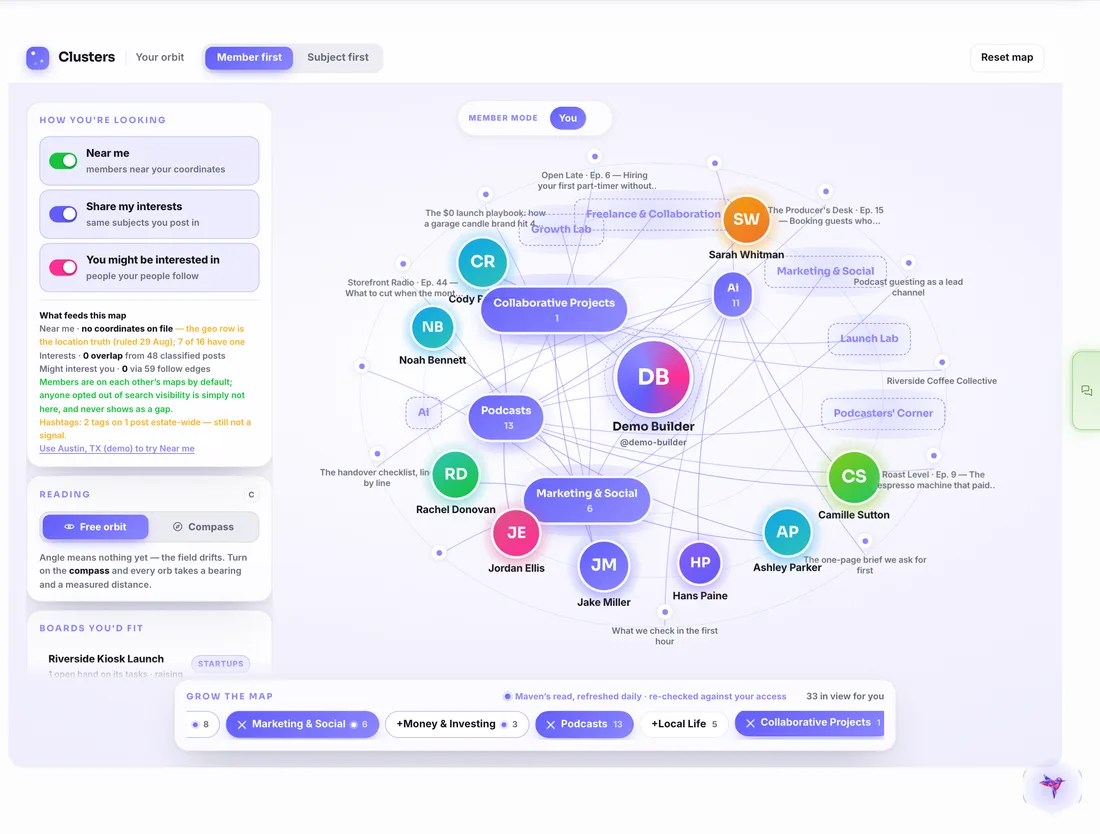
Open Clusters and the map is built for you on the spot: the people who
share your subjects, the people your people follow, the ones near you, the lenses worth
opening and the boards you would fit. Turn a lens on or off and the field re-settles around
you. Hover anything and the map dims and tells you, in words, exactly why that person is on
your map.
Hover the map: everything else steps back and one line lights up with its
reason — “Share my interests — 11 in Ai.” The orbit is a real screen of a real account;
the other three are drawings of the same views.
What you can actually do
Beyond prompts. Real actions with real-world results.
Not features on a list — things you'll actually do this week, all from Mission Control. Scroll the whole toolbox.
Monday · 9:02 · Your FocusBoard
Open a FocusBoard, and the whole piece of work opens with it.
A FocusBoard is one piece of work, and its board tells you where that work stands before you are even in it — what is open, what has slipped, what is waiting on your say-so, who is sitting on it and how far along it has got. Open the board and the same work becomes a list, a board, a table, a calendar or a dashboard, with columns you define yourself and a client window that stays shut until you open it.
A StoryBoard: every claim carries what it stands on.
A StoryBoard holds one line of enquiry: what you are trying to establish, and what would count as proof. Claims sit in a ledger, sources sit in a locker attached to the claims they carry, and the facts sit where they belong in time. How solid a claim is gets derived from what is attached to it — the author never picks the badge — and Maven may propose, but nothing an agent says becomes a fact without a person.
The Clipper sits in your browser. Press it on anything worth keeping and it reads the piece — the headline, the summary, the lead image, the part you had selected — shows you what it is about to save, and puts it in your Clipboard. From there it goes straight onto a board as a card, in the column where the work already is. Its key saves clips and nothing else: it cannot read your account or spend anything, and you can revoke it whenever you like.
An artifact is work you hand to a board. Send one from your own Files and the board keeps its own copy in private storage — not a link that can rot — with your note travelling beside it and everyone on the board told. A newer artifact can supersede an older one, anybody on the board can pull a copy back into their own Files, and a stranger gets nothing. Beside the shelf, Signals holds what the board has clipped from the network.
Seats sit around the board — your people and your own AI, each one labelled as what it is. The role on a seat is not a tidier menu: it is the rule checked on the server before any change lands, so a viewer cannot move a column, an editor cannot open the money tab, and whatever an AI seat wants to change waits for a person to approve it. One board’s team is that board’s team, so a client’s board and a studio’s board never bleed into each other.
Build, deploy, or connect your business project, mission, or movement into FocalShift.
Because the site, the list, the forms, the funnel and the store you already run become one connected business here: every visit, signup, booking and sale lands in the same place, where Maven and your team can act on it.
Connect your social media channels to automate new social content across the web.
Because once your channels are connected, one post becomes a week of scheduled content in every place your audience already is: Maven drafts it in your voice, the calendar spreads it across the channels, the queue publishes it on time, and what landed reports back into the same place you run the rest of the business.
Because every way a customer can find you here ends in the same funnel: the form on your site, the booking page, the review request, the pitch a sponsor signs, all become a lead with a stage, a value and a next step, followed up by Maven and your sequences until a person takes over.
Manage your conversations from across the web from one dashboard.
Entire flow from lead to customer and all the conversations in between.
Because every message about your business, whatever door it came through, lands in one timeline against the person who sent it, so you can see where each conversation is in the flow from first hello to paying customer and answer it from the same place.
Whether your store runs on FocalShift, WordPress or Shopify.
Because the products, the orders, the stock and the money are one record here: a sale on your storefront, at the counter or on the store you already run lands in the same inventory, ships from the same screen and shows up in the month with everything else you earn.
Build and manage your affiliate army directly from FocalShift Mission Control.
Because the people who send you customers deserve a real program, not a spreadsheet: they sign up, share a link that is theirs, and every sale they bring is tracked, credited and paid out from the same wallet you run the rest of your money through.
Go live and push your stream to popular platforms your audience is already using.
Because going live here is one room and one button: you stream from your own machine, the platforms you switched on carry it to the people already there, your guests arrive through a link that expires, your team talks in a lane the audience never sees, and the replay is yours to download when you are done.
Chat with FocalShift Maven AI, like a human, to get things done for your business.
Because Maven already knows your customers, your calendar, your money and your work, so you ask for what you need in plain words and it drafts, books, follows up and files it, holding anything that matters for your approval before it leaves.
Four shapes of send from the same audience — a designed campaign, a plain note that reads like a person wrote it, a split test on a slice of the list, or a journey that keeps listening.
Who opened, who clicked, what bounced and who unsubscribed are written underneath the campaign that caused them, so you know what moved after the send.
Pending, confirmed, completed, cancelled and the ones where nobody came each carry their own named dot, so the state of the month is something you see rather than work out.
Every service and every provider lands in the same grid — not one calendar per person, reconciled on a Friday evening.
Your channels connected once, and one sitting that covers the week in every place your audience already is.
One composer for everywhere you post: write the caption once, tick the channels this post is for, and each one gets the shape people expect there.
The preview fills as you type, one channel at a time, with that channel’s own length limit against your words.
Everything waiting to go out, grouped under the day it goes — waiting, held, sent, failed and drafted are five separate states, and a piece sits in exactly one.
Engagements your client can watch, and a milestone that bills itself.
One engagement, not four places — a retainer, a project or a partnership is one record carrying its own board, its agreement and its invoices.
What was agreed sits next to what got done.
Each client gets a door of their own that shows only their work: what you delivered, what is waiting on a signature, and what happens next.
Set what each stage is worth and mark it delivered — what is outstanding and what has been paid are read off the engagement rather than reconstructed from memory.
A budget per engagement, with spend read against it.
Approvals stop living in somebody’s inbox, and clients stop asking for a status update.
Nothing delivered goes unbilled, and what is invoiced lands in Geldstroom with everything else.
Connect the places you already post once, and then stop thinking about the connecting.
The channels connected to your workspace sit at the top of the composer — tick the ones a post is for and it goes to what you ticked.
Each campaign wears its state and its running counts — what is written, what has gone out, what is still waiting — so checking on the push is reading one row.
Compose straight into the campaign from that row, or open it on the calendar and see where each piece lands in the week.
Episodes link your offers, so listeners can become leads in your Lead Hub.
The episode keeps working after the week it went out, as clips and as follow-up.
The place the businesses on this platform live in public — where the posts are real work.
A profile made of work, not a bio: your campaigns, your rooms, your events and your finished pieces, live because they are the same records you work in.
A colour for the kind of thing it is, and the sort of place it is going.
The quiet weeks look quiet — an empty day is an empty square offering to be filled, while it is still free.
Say what the stretch is about and what you want it to do, and the planner comes back with the month drafted — a title and an opening line for each slot.
Deciding what to say stops being a job you do daily.
You compare offers by qualified people rather than by clicks.
Every lead remembers its door — the referral, the web form, the chat — all the way to the sale, and the doors are ranked by what came through them.
Contacts that never entered a stage and leads with no follow-up running are pointed out with the control that hands them to the pipeline, a sequence, or Maven.
Stages that are yours, named after how you actually sell, with more than one pipeline if you sell in more than one way.
Move a card and everything downstream re-ticks, including anything you set to happen at that stage.
You put the next marketing hour behind the door that earns, and nothing drifts out of the funnel unseen.
An agent you brief once and hand a list of leads to — it decides the next touch, inside limits you set.
The members on your own street, each with a line about what their business does — and a marking on the ones open to being hired.
Long-form from and about your city, gathered as members publish it, so what somebody local learned the hard way is readable before you learn it too.
One picture of repeat custom: campaigns running, leads in, bookings taken, offer claims and the responses your reputation has collected, across the top of one screen.
A set-up checklist that ticks itself from the real counts, so you stop discovering in November that something was never switched on.
Remember people the way the big chains do, without being one.
The letter you were always going to send, already written, waiting for the thing that starts it.
Started by something real — a signup, a booking, an order, a long silence — rather than by you remembering.
The waits between steps are real hours and days, not a diary you keep.
The moment a person writes a real reply, the sequence stops. Every time.
That one rule is the difference between a follow-up that reads like attention and one that reads like being processed.
Each cadence is one card: what it is called, how many steps it carries, whether it is running, whether anybody is part-way through it, and the rules that end it early.
Welcomes, follow-ups and win-backs are written once instead of every quarter.
Every sequence reports what it sent and what it earned, beside the rest of your Ai Mail.
A message that arrives as a conversation and leaves as a lead, without being retyped.
Receipts, confirmations and resets are logged beside everything else you send, so the message somebody is waiting for is not the one that failed quietly.
The whole flow from first hello to paying customer, as columns you move a card between.
“When someone books a call, send the prep sheet” is the whole rule, written in plain words.
It runs where your data already lives, so it never asks you to wire two apps together.
Because Maven is on the same platform, a workflow is not limited to if-this-then-that — it can draft a personal follow-up and hold it for your approval.
You didn't start a business to babysit six logins.
A scheduler here, an invoicing tool there, the social accounts somewhere else, and the inbox that ties it all together living in your head. Every tool works. None of them work together.
FocalShift replaces the pile with one door. Walk through it and the whole day is already in order.
Maven
What does today look like?
Six appointments, two of them new customers. Friday's post is drafted and waiting for your yes. One invoice from last week is still open.
9:00 · Rivera consultNew customer, first visit
Friday post · ready for approvalApprove, edit, or hold
8:00 · Meet Maven
Start every day already caught up.
Maven reads the same calendar, invoices and conversations you do. Ask for the week ahead, a post for Friday, or the three people you forgot to follow up with, and the answer comes from your own business, not a template.
When Maven wants to act on your behalf, it asks first. Yes becomes a button.
Each room below is a real part of Mission Control, and every one of them is included in the membership. Pick the job you have this morning; the rest is waiting when you need it.
Publish for everyone, or only for your subscribers.
Every post, story and podcast episode can be public, members-only, or reserved for premium subscribers. You set the line; the platform enforces it, and what your community pays for lands in the same wallet as everything else.
A coffee shop with regulars to keep. A one-person consultancy. An agency with clients who want to see progress. Whatever shape your build takes, the same command center fits it.
Start on your own. Bring the team when you're ready.
The Network is free to join. One plan to begin with when you turn the tools on, no setup call and nothing to install. Cancel anytime from your account.
We gebruiken enkele cookies om FocalShift Ai te laten werken en, alleen als je dit toestaat, om het gebruik te begrijpen. Cookiebeleid
EssentieelSigning in, security and your preferences. Always on — the site can't work without them.
AnalyseAnonymous usage so this site can see what is not working.
MarketingRecognising you and measuring what brought you here. Off unless you switch it on.
Vraag Maven
Four questions. Maven takes it from there.
I sell through my own small shop. I reach people in
email conversations. I want more leads. I would like to automate
my follow-up.
Voer inand Maven gets to work.
Maven assessing your needs.
Everything Maven can build with. Now it chooses.You said my own small shop. The machine room can wait.You said email conversations. You are reaching people, not administering them.You said leads. Nothing to archive until something runs.You said my follow-up. Automating the work comes before measuring it.Two more Maven meant, though you never said them.Two kept ready — other FocalShift features, for when you want them.In the order you will meet them.Ready.
DetailhandelDetailhandelYou said my own small shop
MarketingMarketingYou said email conversations
Ai MailAi MailYou said leads
AutomatiseringscentrumAutomatiseringscentrumYou said my follow-up
Lead HubLead HubMaven adds the near-buyers, kept
AcademieAcademieMaven adds so none of it is a guess
FocusBoardsFocusBoards
AI-studioAI-studio
HardwareHardware
DomeinenDomeinen
FirewallFirewall
TeamwerkTeamwerk
ContactenContacten
MembershipsMemberships
Back-upsBack-ups
SjablonenSjablonen
AnalyseAnalyse
WaarschuwingenWaarschuwingen
Other FocalShift featuresFocusBoards, AI Studio — ready when you want them



















 Maven
Maven